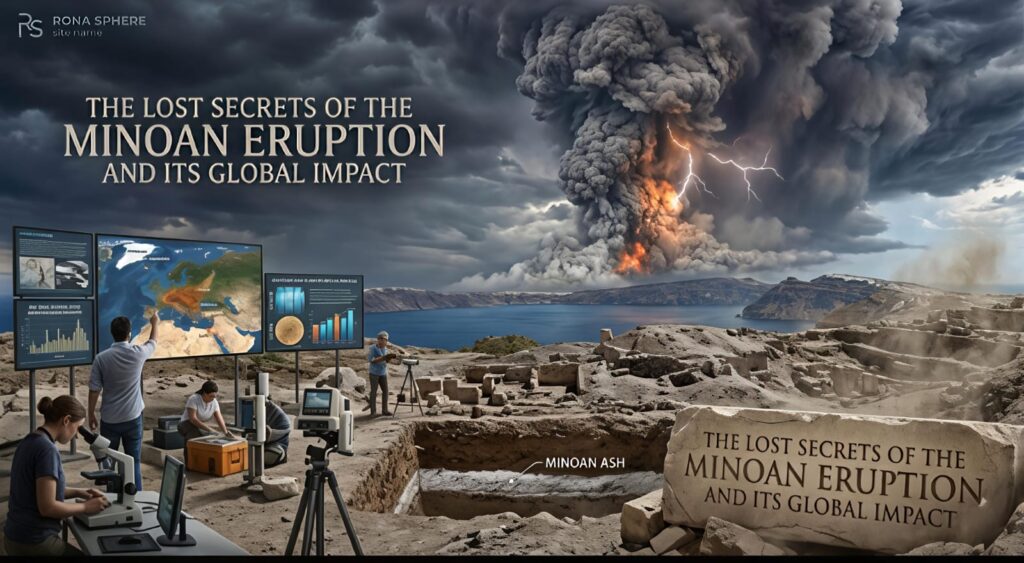
Imagine a world of gold and blue. Specifically, think of the ancient Mediterranean. People were sailing. Traders were selling. However, a giant mountain was waiting. Suddenly, it exploded. This event was the Minoan Eruption. Consequently, the world changed forever. Today, we call the island Santorini. Long ago, it was called Thera. Furthermore, this blast was one of the biggest ever. Indeed, it was larger than any bomb. Therefore, it did more than just break rocks. Actually, the Minoan Eruption moved the needle of human progress. In this article, we will explore why. Moreover, we will see how it still affects us.
The Golden Age of the Minoans
Before the disaster, the Minoans were the stars. Initially, they lived on the island of Crete. Moreover, they were great sailors. Furthermore, they were the first “Thalassocracy.” This means they ruled by the sea.
Why the Minoans Mattered
First, let us look at their culture. Surprisingly, they had flushing toilets. Also, they had paved roads. Consequently, they were very advanced for 1600 BCE. Furthermore, their art was beautiful. They painted colorful frescoes. In addition, they loved bull-leaping. This was a dangerous sport. However, it showed their bravery. Therefore, they were a confident people.
The Trade Empire
Specifically, the Minoans controlled the Bronze trade. Because bronze needs tin and copper, trade is vital. Thus, the Minoans were the middlemen. They connected Egypt to Europe. Additionally, they traded with the Near East. Consequently, they became very rich. Furthermore, they did not have walls around their cities. Clearly, they did not fear their neighbors. Instead, they trusted the ocean. Unfortunately, the ocean would soon betray them. This was all because of the Minoan Eruption.
The Science of the Sleeping Giant
Under the beautiful island of Thera, magma was moving. Specifically, it was building up pressure. Scientists call this a “Plinian” eruption.
What is a Plinian Eruption?
Initially, the volcano shoots a tall column of ash into the sky. It looks like a pine tree. Furthermore, it reaches the stratosphere. Consequently, the wind carries ash for thousands of miles. This was the first phase of the Minoan Eruption.
The Power of the Blast
To understand the size, we use the VEI scale. The Minoan Eruption was a VEI 7. In contrast, Mount St. Helens was only a VEI 5. Therefore, this blast was 100 times stronger. Moreover, it ejected 100 cubic kilometers of rock. Consequently, the island literally turned into dust. Furthermore, the center of the island collapsed. This created a giant hole called a caldera.
The Timeline of Terror
How did it happen? First, the earth began to shake. These were the warning signs.
The Warning Earthquakes
Actually, many people escaped. We know this because few bodies were found. However, the earthquakes destroyed their homes. Therefore, they fled to the shore. Then, the volcano began to vent steam. Next, the sky turned black.
The Four Phases of the Blast
Phase One: First, ash rained down. Specifically, it buried the town of Akrotiri.
Phase Two: Next, water hit the magma. Consequently, huge steam explosions occurred.
Phase Three: Then, pyroclastic flows started. These are clouds of fire. Furthermore, they move faster than a car.
Phase Four: Finally, the island fell into the sea. Thus, the tsunamis were born.
The Tsunami That Crushed Crete
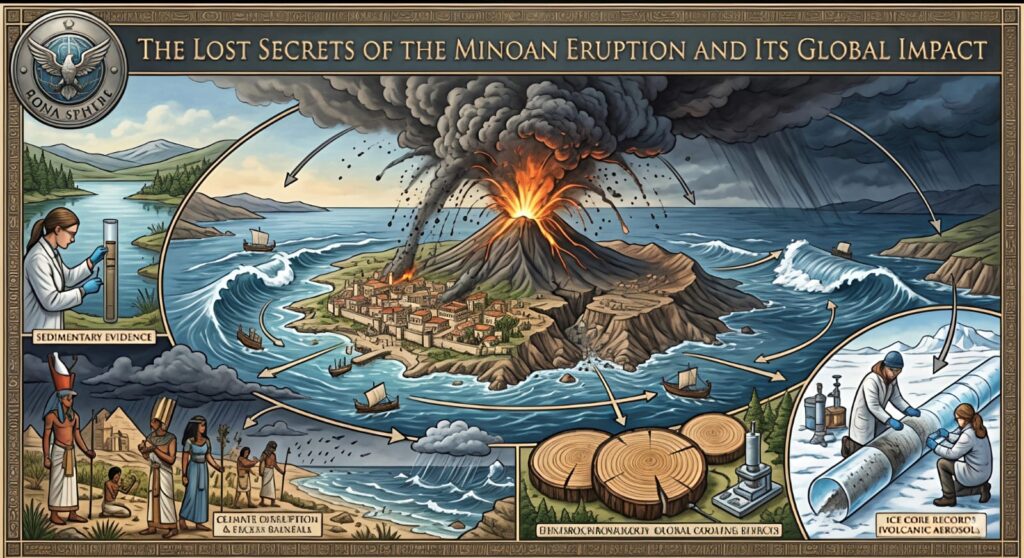
When the island collapsed, it pushed the water. Consequently, a wall of water moved outward.
The Height of the Waves
Some experts say the waves were 150 feet high. For comparison, that is like a 15-story building. Furthermore, the waves hit the north coast of Crete. Specifically, they hit the harbor of Knossos.
Total Naval Destruction
Immediately, the Minoan fleet was gone. This was their only defense. Without ships, they could not trade. Moreover, they could not fight. Consequently, their economy died in one day. Furthermore, the salt from the water ruined the soil. Therefore, they could not grow food. Indeed, the Minoan Eruption was a double-hit. It destroyed the ships and the farms.
The Great Volcanic Winter
The Minoan Eruption did not stay in Greece. Instead, it went global.
Ash in the Sky
Millions of tons of sulfur entered the air. Consequently, the sulfur reflected the sunlight. Therefore, the earth grew cold. This is called a “Volcanic Winter.”
Evidence in the Ice
Today, we look at Greenland. Specifically, we look at ice cores. Scientists find volcanic glass deep in the ice. Furthermore, it matches the chemistry of Santorini. Thus, we know the date of the Minoan Eruption.
Tree Rings in America
Also, we look at old trees. Specifically, we look at Bristlecone Pines in California. In 1628 BCE, the rings are very thin. This means the trees did not grow. Why? Because it was too cold. Consequently, we see the global reach of the Minoan Eruption.
Impact on Ancient Egypt
Egypt was a neighbor of the Minoans. Consequently, they felt the effects too.
The Tempest Stele
Actually, there is a famous stone in Egypt. It is called the Tempest Stele. Specifically, it describes a “great darkness.” It also mentions massive floods. Some historians believe this describes the Minoan Eruption. Furthermore, it says the sky was “in a state of roar.” Therefore, the sound of the blast might have traveled 500 miles.
The Ten Plagues?
Interestingly, some people link the volcano to the Bible. Specifically, they look at the book of Exodus. They suggest the “Plague of Darkness” was volcanic ash. Also, they think the “River of Blood” was volcanic minerals. While this is a theory, it is very interesting. Regardless, the Minoan Eruption definitely caused chaos in Egypt.
The Collapse of the Xia Dynasty in China
On the other side of the world, China suffered. Specifically, the Xia Dynasty was in power.
The Yellow Fog
Ancient Chinese records talk about a “yellow fog.” Furthermore, they say the sun was dim. Consequently, the crops failed for three years. Therefore, the people revolted.
The Rise of the Shang
Because the Xia King could not feed the people, he lost his power. Subsequently, the Shang Dynasty took over. Thus, a volcano in Greece changed the history of China. This shows how connected our world is. Even then, the Minoan Eruption was a global event.
The Power Shift: Enter the Mycenaeans
On the Greek mainland, a new group was watching. They were the Mycenaeans. Unlike the Minoans, they were warriors.
Seizing the Opportunity
Before the blast, the Mycenaeans were afraid of the Minoan navy. However, after the Minoan Eruption, the navy was gone. Consequently, the Mycenaeans sailed to Crete. They did not find a strong empire. Instead, they found a broken people.
The Takeover
Furthermore, the Mycenaeans moved into the palaces. Specifically, they took over Knossos. However, they kept some Minoan culture. For example, they used Minoan writing. But they changed it. This became “Linear B.” Thus, the Minoan Eruption led to the first true “Greek” culture.
Akrotiri: The Frozen City
On Santorini, there is a special place. It is called Akrotiri. Today, you can visit it.
The Discovery
In 1967, an archaeologist began to dig. He found a whole city under the ash. Specifically, the ash preserved the buildings.
Life in the Ruins
Inside, there are three-story houses. Furthermore, there are beautiful wall paintings. One shows two boys boxing. Another shows blue monkeys. Because of the ash, the colors are still bright. However, there are no people. Consequently, we know they had time to leave. But they never came back. The Minoan Eruption made their home unlivable.
Was This the Real Atlantis?
Most people know the story of Atlantis. Specifically, a rich island sank into the sea. Plato wrote this story 1,000 years later.
Comparing the Facts
First, Atlantis was an advanced sea power. The Minoans were too. Second, Atlantis was destroyed by water. The Minoans were hit by a tsunami. Third, Atlantis disappeared in a day. The Minoan Eruption was very fast.
The Location Problem
However, Plato said Atlantis was in the Atlantic. But many think he made a mistake. Or, perhaps, he changed the name. Therefore, many experts believe the Minoan Eruption is the origin of the myth. Thus, the volcano created one of the world’s greatest legends.
How the Eruption Changed Technology
Disasters often force people to invent new things. The Minoan Eruption was no different.
The End of the Bronze Age?
Actually, the eruption helped end the Bronze Age. Because the trade routes were broken, people needed new metals. Consequently, they began to use iron. Iron was easier to find locally. Therefore, the Minoan Eruption may have pushed humanity into the Iron Age.
Better Ship Building
Also, sailors learned lessons. Specifically, they built stronger ships. They needed to survive rougher seas. Furthermore, they improved their navigation. They realized the ocean could be dangerous. Thus, technology moved forward.
Climate Science and the Volcano
Today, we use the Minoan Eruption to study our future. Specifically, we look at sulfur.
Sulfur and Cooling
When a volcano erupts, it releases sulfur dioxide. This gas turns into tiny droplets. Consequently, these droplets reflect the sun. This cools the earth.
Lessons for Global Warming
Some scientists want to mimic this. They call it “geoengineering.” Specifically, they want to put sulfur in the air to stop warming. However, the Minoan Eruption shows the danger. It caused famine and war. Therefore, we must be careful with nature. History is our best teacher.
Why We Must Remember the Minoan Eruption
You might wonder why we care about an old volcano. Specifically, we care because it shows our fragility.
The Impact on Democracy
Without this eruption, the Mycenaeans might not have risen. Consequently, the Greek city-states might not have formed. Therefore, we might not have had democracy. Our entire Western way of life comes from Greece. And Greece came from the ashes of the Minoan Eruption.
The Resilience of Humans
Furthermore, it shows how humans survive. Even after the world ended, people moved on. They built new cities. They wrote new stories. Thus, the Minoan Eruption is a story of hope. It shows that life finds a way.
Practical Survival Tips: Lessons from Akrotiri
If you live near a volcano, listen to the Minoans. They knew what to do.
Watch the Earth: Initially, the Minoans noticed the shaking. Consequently, they left early.
Don’t Look Back: Specifically, they didn’t wait for the big blast. They sailed away.
Prepare for the Sea: Furthermore, they knew the water was dangerous.
Store Food: Actually, ash ruins crops. Therefore, you need a backup plan.
Modern Volcano Monitoring
Today, we have sensors. Specifically, we have GPS and gas detectors. Consequently, we get more warning. For instance, in 2026, we can see magma moving underground. But we still cannot stop it. Thus, the Minoan Eruption reminds us to be humble.
Deep Dive: The Geology of Santorini
Let us look closer at the rocks. Specifically, the island is a “stratovolcano.”
The Magma Chamber
Deep down, there is a giant pool of liquid rock. Initially, it was full of gas. Consequently, it was like a shaken soda bottle. When the “cap” broke, it exploded.
The Pyroclastic Surge
During the Minoan Eruption, the ash didn’t just fall. Instead, it flowed. These flows are “surges.” They can travel over water. Furthermore, they are very hot. Specifically, they are about 700 degrees Fahrenheit. Therefore, anything they touch burns instantly. This is why Akrotiri is so well-preserved. The ash covered everything before it could rot.
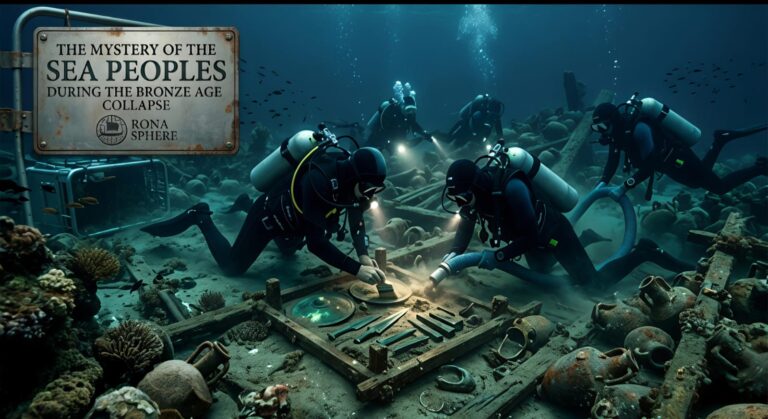
The Role of the Sea Peoples
Later in history, a group called the “Sea Peoples” attacked the Mediterranean.
Who Were They?
Actually, nobody is 100% sure. However, many think they were refugees. Specifically, they were people displaced by the Minoan Eruption.
The Domino Effect
Because the volcano destroyed their homes, they had to migrate. Consequently, they pushed other people. This caused a “domino effect” of war. Eventually, this led to the Bronze Age Collapse. Thus, the Minoan Eruption was the first domino to fall. It changed the map of the world for 500 years.
How to Visit Santorini Today
If you want to see the history, you should go. Specifically, visit the town of Oia.
Seeing the Caldera
When you look at the blue water, you are looking at the volcano. Specifically, you are looking at the hole left by the Minoan Eruption.
The Museum of Prehistoric Thera
Also, go to the museum. You can see the gold jewelry. Furthermore, you can see the painted pots. These items survived the blast. Consequently, they tell the story of a lost world.
Summary Table: The Impact of the Minoan Eruption
| Region | Immediate Effect | Long-term Result |
|---|---|---|
| Crete | Tsunami destroyed the navy. | Rise of the Mycenaeans. |
| Egypt | Ash clouds and flooding. | Cultural legends (Plagues). |
| China | Crop failure and cold. | Fall of the Xia Dynasty. |
| Global | Temperature drop. | Shift to the Iron Age. |
Export to Sheets
Final Thoughts: The Fire in the Sea
The Minoan Eruption was a monster. It was loud. It was dark. Furthermore, it was deadly. However, it was also a creator. It created the Greek world. It created the myth of Atlantis. Consequently, it created us.
We must respect the Earth. Specifically, we must respect its power. The Minoan Eruption is not just a story in a book. Instead, it is a warning. It is a reminder that the ground can move. But it is also a reminder that humans are strong. We can rebuild. We can remember. And we can learn.
The Legacy of Thera
In the end, the Minoan Eruption teaches us about connection. One volcano in the sea changed the king in China. It changed the farmer in Egypt. Furthermore, it changed the sailor in Crete. Thus, we are all connected by our history. And that history is written in ash and stone.
Thank you for reading this guide. Specifically, we hope you learned something new. The Minoan Eruption is a fascinating topic. Furthermore, it is a vital part of our human story. Therefore, keep exploring. Keep asking questions. And always watch the horizon.
Frequently Asked Questions
When did the Minoan Eruption happen?
Specifically, it happened around 1600 BCE. Some scientists say 1628 BCE.
How big was the tsunami?
The waves were likely between 100 and 150 feet high. Consequently, they were devastating.
Is Santorini still active?
Yes, it is. Actually, there have been many small eruptions since then. However, nothing as big as the Minoan Eruption.
Can we see the ash today?
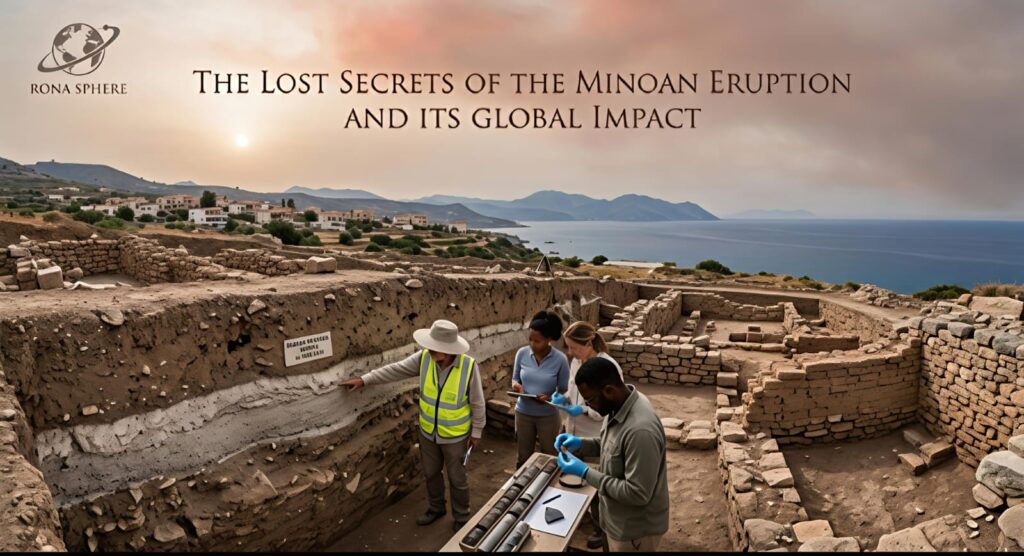
Absolutely. Specifically, if you dig on Santorini, you will find a layer of white pumice. Furthermore, you can see this ash in the cliffs of the island.
Did the Minoans survive?
Most of the people on the island escaped. However, their civilization on Crete slowly faded away. Consequently, they were conquered by the Greeks. Thus, the people lived on, but the empire died.
The story of the Minoan Eruption ends here. But the history continues every day. Because we study the past, we can build a better future. Consequently, we are smarter than the ancients. But we are still at the mercy of the Earth. Therefore, stay curious. And stay safe.
About the Author