
The face of Charles II of Spain remains one of the most haunting images in all of human history. Furthermore, it serves as a chilling visual record of what happens when power stays too close to home. When you look at his portraits, you see a man who could barely chew his own food. Consequently, his story is the ultimate climax of the Secrets of the Habsburg Jaw: Genetics and Royal European History. Specifically, his life was a tragic end to a dynasty that chose “purity” over health.
What Exactly Was the Habsburg Jaw?
To understand the Secrets of the Habsburg Jaw: Genetics and Royal European History, we must first define the condition. Doctors call it mandibular prognathism. Essentially, this means the lower jaw grows much further out than the upper jaw. In contrast, most people have a slight “overbite” or teeth that meet perfectly. For the Habsburgs, however, the lower jaw jutted out like a shelf.
More Than Just a Large Chin
Specifically, the condition involved several distinct facial traits. First, there was the famous “Habsburg Lip,” which was thick and hung low. Additionally, many family members had a very long, hooked nose. Consequently, their faces looked elongated and narrow. Furthermore, many rulers suffered from maxillary deficiency, where the middle of the face looks flat or sunken. Therefore, the “jaw” was actually a complex set of bone growth issues.
Why the Name Stuck
Because this trait appeared in so many generations of the Habsburg family, the name became permanent. Actually, they were one of the most powerful families in the world. They ruled Spain, Austria, and parts of Italy and the Netherlands. Consequently, their faces were everywhere. However, the very thing that made them recognizable also made them vulnerable. Indeed, the “Habsburg look” was a clear sign of their shrinking gene pool.
The Strategic Trap: Why They Inbred
You might ask why they didn’t just marry people from other families. Primarily, the answer is greed and power. The Habsburgs wanted to keep their land and money within the family. Consequently, they viewed outsiders as a threat to their control. Therefore, they married their cousins, nieces, and uncles for centuries.
The Logic of “Purity”
Back then, people didn’t understand DNA. Instead, they believed in “royal blood.” They thought that mixing their blood with “commoners” or even other royal lines would weaken their divine right to rule. Consequently, they kept the circle tight. For instance, they believed they were keeping the crown safe. In reality, however, they were destroying the biological health of their children.
A Timeline of Marriage Decisions
1400s: The family starts using marriage to gain land.
1500s: Uncle-niece marriages become common to keep Spain and Austria united.
1600s: The genetic damage becomes impossible to ignore.
1700: The Spanish line goes extinct because the final king is too sick to have kids.
The Simple Science: How Inbreeding Works
To truly unlock the Secrets of the Habsburg Jaw: Genetics and Royal European History, we have to talk about math. Every person has two copies of most genes—one from mom and one from dad. Usually, if one gene is “broken,” the other one fixes the problem. However, inbreeding changes this balance.
Recessive Traits Explained
Many health issues are “recessive.” This means you only get the disease if both parents give you the broken gene. Specifically, in a normal population, the chances of two people having the same rare broken gene are very low. But if your parents are related, they likely carry the exact same broken genes from their ancestors. Consequently, the child has a high chance of getting a “double dose” of the bad trait.
The Coefficient of Inbreeding (F)
Scientists use a score called the coefficient of inbreeding to show how “inbred” someone is. For example, a child of two random strangers has a score of almost zero. In contrast, a child of first cousins has a score of 0.06. By the time Charles II was born, his score was 0.25! Surprisingly, this is higher than if his parents had been brother and sister. Therefore, the Secrets of the Habsburg Jaw: Genetics and Royal European History are really just the result of a very high F score.
Charles II: The Ultimate Victim
The most famous example of the Secrets of the Habsburg Jaw: Genetics and Royal European History is Charles II of Spain. He was born in 1661 and was sick from the very start. Indeed, his life was a constant struggle against his own DNA.
A Life of Pain
First, his jaw was so deformed that his teeth didn’t meet. Consequently, he couldn’t chew his food and often swallowed it whole. This led to terrible stomach aches and weight loss. Additionally, his tongue was so large that he had trouble speaking. People often couldn’t understand what he was saying. Furthermore, he didn’t learn to walk until he was almost eight years old.
The End of the Line
Charles II was married twice, but he could never have children. Scientists now believe he had two rare genetic disorders. One caused his kidneys to fail, and the other made him infertile. Consequently, he had no heir to take his throne. When he died in 1700, a massive war broke out across Europe because there was no one left to rule. Therefore, his jaw didn’t just change his face—it changed the map of the world.
Art History: How Painters Hid the Truth
How do we know so much about their faces? We have hundreds of paintings! However, these paintings aren’t always 100% honest. Specifically, court painters like Diego Velázquez had a very hard job. They had to make the kings look powerful, but they also had to show what they actually looked like.
The Painter’s Trick
If you look closely at portraits of Philip IV, you can see how the artist tried to help. For example, he might use shadows to hide the chin. Or, he might paint the king from a specific angle to make the jaw look smaller. Furthermore, many artists focused on the king’s fancy clothes and shiny armor to distract the viewer from the face. Nevertheless, the Secrets of the Habsburg Jaw: Genetics and Royal European History were too big to hide completely.
Comparing the Real to the Royal
In contrast to the official paintings, diaries from foreign visitors tell a different story. Ambassadors often wrote home saying the king looked “frightening” or “ghostly.” Consequently, we have to read between the lines of the art. The paintings show us the “official” face, while the journals show us the biological reality.
The 2019 Breakthrough: Real Scientific Proof
For a long time, the link between inbreeding and the jaw was just a theory. However, in 2019, a group of scientists decided to find the truth. They studied 66 portraits of 15 different Habsburg family members. Specifically, they asked surgeons to look at the faces and rate how bad the deformity was.
The Findings
The results were clear. They found that the more inbred a person was, the more likely they were to have a severe jaw. Furthermore, the study proved that the “Habsburg Jaw” and the “Habsburg Lip” were linked. Consequently, this was the first time we had mathematical proof of the Secrets of the Habsburg Jaw: Genetics and Royal European History.
Why This Matters Today
This study wasn’t just about old kings. Actually, it helps us understand how facial features are passed down in all humans. By looking at the extreme cases of the Habsburgs, we learn how multiple genes work together to shape our bones. Therefore, the royal family’s tragedy has become a gift to modern science.
How to Spot the Habsburg Jaw: A “How-To” Guide
Are you visiting a museum and want to find these royal secrets? Here is a simple guide to identifying the Secrets of the Habsburg Jaw: Genetics and Royal European History in portraits.
Step 1: Look at the Profile
First, stand to the side of the painting. If the lower lip and chin stick out further than the nose or the forehead, you are likely looking at a Habsburg.
Step 2: Check the Mouth
Next, look at the mouth. Is it slightly open? Because their jaws didn’t fit together, many Habsburgs couldn’t close their mouths comfortably. Consequently, they often look like they are “mouth-breathing.”
Step 3: Observe the Eyes
Furthermore, many inbred royals had “droopy” eyes or heavy eyelids. This was another sign of their genetic makeup. Specifically, it gives them a tired or sad look.
Step 4: Examine the Nose
Finally, check for a long, “Roman” nose. While not a deformity on its own, when combined with the jaw, it is a classic sign of the family line.
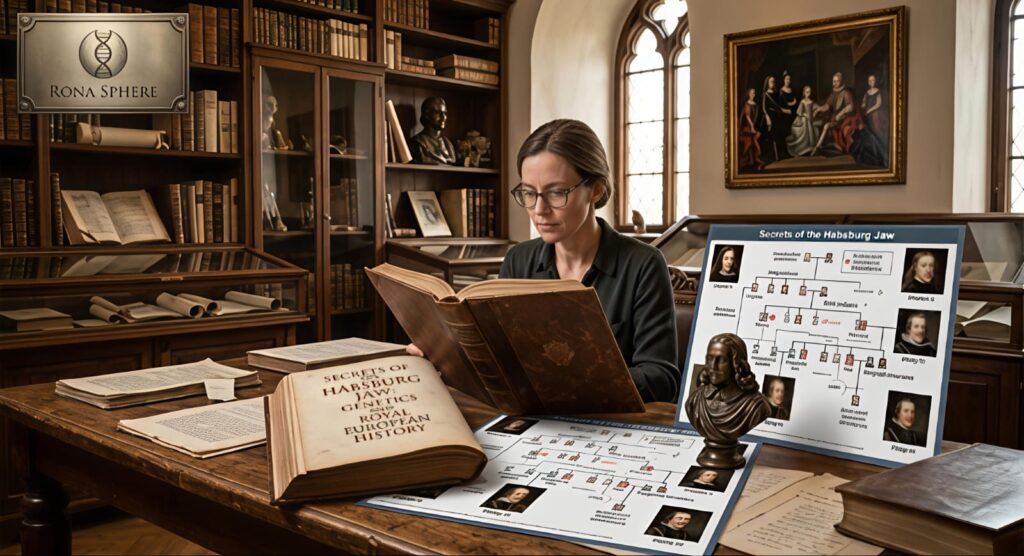
The Austrian Branch: A Slightly Better Fate
While the Spanish Habsburgs died out, the Austrian branch lived much longer. You might wonder why. Essentially, they were a bit more careful. Furthermore, they brought in “new blood” from other families more often.
Survival Tactics
The Austrian Habsburgs still had the jaw, but it was usually less severe. Consequently, they were able to keep ruling until 1918. In contrast to the Spanish line, they didn’t reach that “terminal” level of inbreeding as quickly. However, the jaw still popped up every few generations. Indeed, even some modern descendants of the family have a slightly prominent chin!
The Cultural Impact: From Villains to Memes
Today, the Secrets of the Habsburg Jaw: Genetics and Royal European History have moved from history books to the internet. Specifically, people use images of Charles II to talk about the dangers of “staying in the family.”
In Movies and Books
Many fantasy stories use the Habsburgs as inspiration. For example, if a writer wants to show a royal family that is “old and decaying,” they often give them a large jaw. Consequently, the jaw has become a symbol of corruption and the end of an era.
In the Classroom
Teachers love using the Habsburg family tree to teach biology. Specifically, it is the perfect “bad example” of how genetics work. Students can easily see how the traits get worse over time. Therefore, the Habsburgs are still teaching us lessons hundreds of years after they are gone.
The Health Lessons: What We Can Learn
Beyond the history, the Secrets of the Habsburg Jaw: Genetics and Royal European History offer practical health advice. Specifically, they show us why genetic diversity is so important for a population.
The Importance of Diversity
Nature loves variety. When we have a diverse gene pool, we are more resistant to diseases. Furthermore, we are less likely to pass down rare deformities. In contrast, isolation leads to weakness. This is true for royal families, but it is also true for animal species like cheetahs or certain dog breeds.
Modern Genetic Counseling
Today, if two people who are related want to have children, they can talk to a genetic counselor. Consequently, they can test their DNA to see if they carry the same “hidden” traits. This technology prevents the kind of suffering that Charles II went through. Therefore, we have used the Secrets of the Habsburg Jaw: Genetics and Royal European History to build a healthier future.
Famous Habsburgs and Their Jaws
| Ruler | Severity of Jaw | Key History |
|---|---|---|
| Maximilian I | Mild | The “founder” of the look. |
| Philip II | Moderate | Ruled during the Spanish Armada. |
| Philip IV | Severe | The great patron of Velázquez. |
| Charles II | Extreme | The final king who could not eat or walk. |
The Myth of the “Bewitched” King
For a long time, people thought Charles II was cursed by magic. Consequently, they called him “The Bewitched.” They tried to perform exorcisms on him to “cure” his jaw and his sickness. In reality, however, he wasn’t cursed by a witch; he was cursed by his own family’s choices.
Science vs. Superstition
This transition from “magic” to “science” is a huge part of the Secrets of the Habsburg Jaw: Genetics and Royal European History. It shows how our understanding of the world has changed. Specifically, we no longer blame ghosts for physical problems. Instead, we look at the DNA. This shift has allowed us to treat conditions that used to be seen as death sentences.
The Legacy of the Throne
The Habsburgs were one of the most successful families in history. They controlled the world’s gold, its biggest navy, and millions of people. Furthermore, they built beautiful cathedrals and supported great artists. But in the end, they couldn’t beat the laws of biology.
A Warning for the Future
The Secrets of the Habsburg Jaw: Genetics and Royal European History serve as a warning. They show that no amount of money or power can protect you from the basics of life. Nature doesn’t care if you are a king or a peasant. Consequently, we must respect the rules of the natural world.
How to Learn More About Royal Genetics
If you are fascinated by this topic, there are many ways to keep exploring.
Read Scientific Papers: Look for the 2019 study in Annals of Human Biology. It is very detailed!
Visit Art Galleries: Many museums have digital tours where you can zoom in on the Habsburg faces.
Study Your Own Tree: Use genealogy sites to see if your ancestors stayed in one small town for a long time. You might find some interesting traits of your own!
Conclusion: The Final Secret
Ultimately, the biggest secret of the Secrets of the Habsburg Jaw: Genetics and Royal European History is that it was preventable. The family had the power to change, but they chose to stay the same. Consequently, they became a museum piece—a lesson in what happens when a group of people thinks they are better than the laws of nature.
Therefore, when you see a portrait of a Habsburg, don’t just see a king. Specifically, see a human being who was shaped by the pride and the science of his time. By understanding their story, we learn to value the diversity that keeps our own world healthy and strong. Furthermore, we ensure that the tragedies of the past stay in the past.
Extended Deep Dive: The Genetics of the Habsburg Lip
We have talked a lot about the jaw. However, the “Habsburg Lip” was just as famous. Specifically, the lower lip was very thick and often hung down, exposing the inside of the mouth. In contrast to a normal lip, this was caused by soft tissue growth that didn’t stop.
Is It One Gene?
Actually, scientists used to think it was just one “bad” gene. But now, we know it is polygenic. This means many different genes work together. For instance, if you get three “bad” genes from your mom and three from your dad, the trait becomes very strong. This is exactly what happened to the Habsburgs. Consequently, each generation got a slightly worse version of the lip and jaw.
The Role of Bone Density
Furthermore, the Habsburgs often had very thin or weak jawbones, despite their size. This made it even harder for them to support their own faces. Therefore, the Secrets of the Habsburg Jaw: Genetics and Royal European History involve the skin, the muscle, and the bone all failing at once.
Royal Inbreeding in Other Dynasties
Were the Habsburgs the only ones? Not at all! Actually, many royal families did this. For example, the ancient Egyptians were even more extreme. Pharaohs often married their own sisters. Consequently, they had many of the same issues.
The Romanovs and Hemophilia
In contrast to the Habsburgs, the Russian Romanov family suffered from a blood disorder called hemophilia. This was also caused by marrying within a small circle of royals. Specifically, Queen Victoria of England was a “carrier” for the disease. Because her children married into all the other royal families of Europe, the “royal disease” spread everywhere.
Why the Habsburgs are Unique
However, the Habsburgs are the best case study because their deformity was so visible. You don’t need a blood test to see a Habsburg jaw. Consequently, it remains the most famous example of royal inbreeding in history. The Secrets of the Habsburg Jaw: Genetics and Royal European History are written on their faces for all to see.
Detailed Analysis of Philip IV
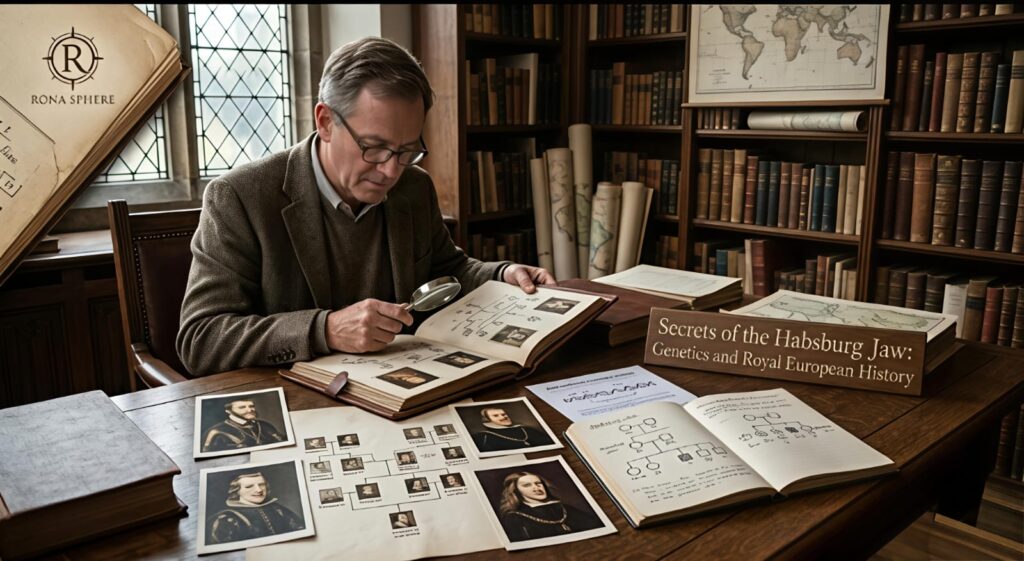
Philip IV was one of the most powerful Habsburgs. Furthermore, he was the man who hired Velázquez. If you look at his portraits over the years, you can see him aging. Specifically, you can see his jaw becoming more of a burden as he gets older.
The “Melancholy” King
Philip was known for being very sad. Consequently, historians wonder if his physical health affected his mood. If you couldn’t eat comfortably and everyone stared at your face, you would be sad too! Therefore, the Secrets of the Habsburg Jaw: Genetics and Royal European History influenced the very personality of the people ruling Europe.
His Children’s Fate
Philip IV had many children who died young. Specifically, this is another classic sign of inbreeding. While the jaw is the most famous sign, the high infant mortality rate was the real “silent killer” of the dynasty. Consequently, for every king who survived with a jaw, there were many siblings who didn’t survive at all.
Final Summary Table: The Cost of a Dynasty
| Feature | Biological Cause | Impact on the Person | Impact on History |
|---|---|---|---|
| Prognathism | Inbreeding / Polygenic | Pain, trouble eating | Visual symbol of the family |
| Infertility | Genetic mutations | No heirs | War of Spanish Succession |
| Infant Mortality | Recessive bad genes | Loss of children | Weakening of the bloodline |
| Speech Issues | Jaw and tongue size | Hard to communicate | Reliance on advisors |
In conclusion, the Secrets of the Habsburg Jaw: Genetics and Royal European History teach us that we are all products of our DNA. Furthermore, they show that history is not just about battles and treaties. It is also about the microscopic world inside our cells. By understanding these secrets, we see the true face of history—jaw and all.
About the Author