Maps change constantly. Thus, old borders vanish. Next, mighty empires fall. Consequently, tiny state get lost easily. Today, we will explore hidden history. Specifically, we will look at 10 forgotten European micro-states that vanished from the map.
Indeed, these tiny places had strange laws. Plus, many minted their own weird coins. Sometimes, pirates or poets ruled them. Ultimately, larger countries swallowed them whole. Yet, their wild stories live on. Furthermore, you can still find their ancient borders.
Next, this guide will show you exactly how. Therefore, grab your notebook. First, we must understand why these places existed. Then, we will dive into the list.
Why Did These Micro-Nations Exist?
History is very messy. Often, leaders made huge mistakes. Thus, mapmakers drew wrong lines. Consequently, accidental countries popped up. Furthermore, these tiny states survived by being useful.
Larger empires needed neutral ground. Also, smugglers loved these lawless zones. Besides, rebels needed safe places to hide. Hence, the forgotten European micro-states grew. They became wild, free, and totally weird.
Key Traits of a Lost Nation
Typically, a micro-state is incredibly small. For instance, modern Monaco is tiny. However, the 10 forgotten European micro-states that vanished from the map lost their freedom. Generally, they shared four main traits:
Tiny Land Area: Most were under 100 square miles.
Few People: Indeed, some had just 500 citizens.
Weird Cash: Consequently, they traded smuggled goods or rare rocks.
Odd Leaders: Also, priests, poets, or normal farmers ran them.
Now, let us meet these lost lands.
1. Neutral Moresnet: The Zinc State (1816–1920)
First, we look at Neutral Moresnet. Truly, it was a bizarre place. It sat right between Prussia and the Netherlands. Today, Belgium owns this land.
Fast Facts About Moresnet
Lifespan: 1816 to 1920
Size: 1.3 square miles
Capital City: Kelmis
Main Trade: Zinc mining
The Accidental Origin
Long ago, European kings drew new borders. Specifically, they met in 1815. However, two big countries wanted one specific mine. Consequently, they fought endlessly. Thus, they made a neutral zone. Indeed, Moresnet was born purely from stubbornness.
Life Without Rules
Life here was truly amazing. First, people paid zero taxes. Also, men never joined the army. Consequently, outsiders rushed into the tiny town. Furthermore, a local doctor named Wilhelm Molly had a wild dream. He wanted everyone to speak Esperanto. Next, he tried to name the country “Amikejo.” This word means “Place of Friendship.”
How It Disappeared
Eventually, the big zinc mine ran out. Plus, World War I started. Immediately, Germany invaded the town. Later, peace treaties gave the land to Belgium. Thus, Moresnet vanished forever.
How to Visit Today
Surprisingly, you can still go there. First, travel to Kelmis in Belgium. Next, find the Museum Vieille Montagne. Truly, this place tells the whole zinc story. Then, walk into the local woods. You can still spot the old border rocks.
2. Republic of Cospaia: The Rebel Farm (1440–1826)
Next, we travel south to sunny Italy. Here, we find the Republic of Cospaia. Unquestionably, it is one of the coolest forgotten European micro-states that vanished from the map. It lived as a free town for nearly 400 years.
Fast Facts About Cospaia state
Lifespan: 1440 to 1826
Size: 0.8 square miles
Capital City: Cospaia
Main Trade: Smuggled tobacco
The River Mistake
In 1440, the Pope sold some dirt to Florence. However, mapmakers messed up badly. They used a local river as the border. Unfortunately, two rivers shared the exact same name. Consequently, a tiny strip of land got left out. Immediately, the happy locals declared total freedom.
A Town Without Police
Cospaia had zero cops. Plus, it had zero taxes. Also, no king ruled the town. Instead, wise elders made simple rules. Later, the Pope banned tobacco across Italy. However, Cospaia ignored him. Thus, they grew fields of illegal tobacco. Consequently, they grew incredibly rich by sneaking it out.
How It Disappeared
Eventually, big countries hated the smugglers. Thus, the Pope and Tuscany teamed up. They forced the tiny town to quit. Next, they split the land in half. However, they gave every local a silver coin. This was their formal apology.
How to Visit Today
Today, Cospaia is a tiny Italian village. First, drive into the green hills of Umbria. Next, look for ancient stone markers. Furthermore, locals still throw a big party every summer. They celebrate their wild past. Thus, you can eat great food and learn history.
3. Couto Misto: The Valley of Secrets (10th Century–1864)
Third, we visit Couto Misto. This deep valley sat between Spain and Portugal. Truly, it is a very old example of the 10 forgotten European micro-states that vanished from the map.
Fast Facts About Couto Misto
Lifespan: 10th Century to 1864
Size: 10.4 square miles
Capital City: Santiago de Rubiás
Main Trade: Hidden goods and farm crops
The Mountain Fortress
Historically, the border here was very rough. Thus, kings could not control the high valley. Consequently, three small villages united. They formed their own mini-nation. Plus, they played Spain and Portugal against each other perfectly.
The Rule of Absolute Freedom
Life in Couto Misto was very free. First, you picked your own country on your wedding day. You could be Spanish, Portuguese, or neither. Also, the valley offered legal safety. Therefore, running criminals hid there safely. Furthermore, they had a magic road. People called it the “Privileged Way.” No cop could arrest you on this path.
How It Disappeared
Eventually, modern nations wanted strict borders. Thus, Spain and Portugal signed a big treaty in 1864. Next, they sliced the valley in two. Consequently, a thousand years of freedom ended.
How to Visit Today
Presently, you can hike this gorgeous area. First, find Santiago de Rubiás in Spain. Then, look for the old magic road. Additionally, locals still keep a special wooden chest. It holds the keys to the old nation. Unquestionably, hikers will love this trip.
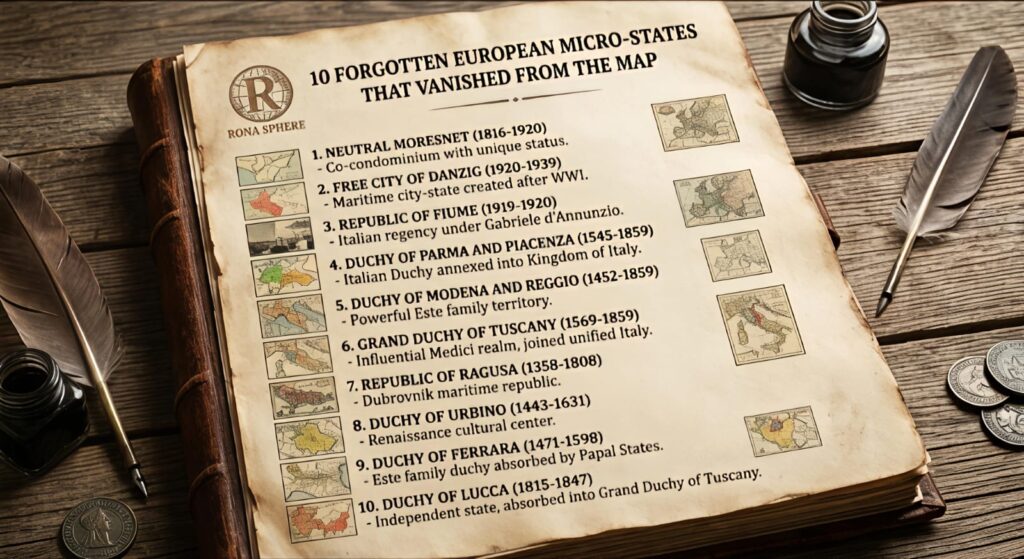
4. Free City of Danzig: The Tense Harbor (1920–1939)
Now, we jump to the modern era. The Free City of Danzig was very famous. Sadly, this entry on our list of 10 forgotten European micro-states that vanished from the map sparked a massive war.
Fast Facts About Danzig
Lifespan: 1920 to 1939
Size: 754 square miles
Capital City: Danzig (Now Gdańsk)
Main Trade: Huge ships and cargo
The Post-War Fix
After World War I, winners punished Germany. However, the new country of Poland needed ships. Thus, the world leaders made a deal. They took Danzig away from Germany. Then, they made it a free city.
Spies and Stamps
Danzig was very rich. Plus, it made beautiful money. Also, it printed unique stamps. However, fear filled the streets. Most locals felt German. Yet, Poland ran the big businesses. Consequently, spies sat in every single cafe. Furthermore, the local post office hid Polish soldiers.
How It Disappeared
Ultimately, Adolf Hitler wanted the city back. Poland said no. Thus, Germany attacked the city’s post office in 1939. Consequently, World War II began. After the long war, Poland kept the city.
How to Visit Today
Today, Danzig is the stunning Polish city of Gdańsk. First, walk the beautiful Royal Way. Next, look at the huge brick churches. Furthermore, you must see the Post Office Museum. It shows how the global war started right there.
5. Free State of Fiume: The Pirate Party (1920–1924)
Fifth, we find pure madness in Fiume. Indeed, a crazy poet stole this entire city. Thus, it is the wildest of the 10 forgotten European micro-states that vanished from the map.
Fast Facts About Fiume
Lifespan: 1920 to 1924
Size: 11 square miles
Capital City: Fiume (Now Rijeka)
Main Trade: Stolen boats and wine
The Poet’s Attack
After a big war, Italy and Yugoslavia fought over Fiume. Suddenly, an Italian poet stepped up. His name was Gabriele D’Annunzio. He marched there with armed rebels. Shockingly, the real guards gave up. Consequently, the poet became the king.
Music and Crime
Fiume ran like a giant festival. First, the poet wrote new laws. He made music the core rule of the city. However, they needed money fast. Thus, his men became pirates. They stole cargo from passing ships. Next, they sold the stuff to buy food.
How It Disappeared
Eventually, Italy felt very embarrassed. Thus, the real navy showed up. They shot big guns at the poet’s house. Consequently, he gave up quickly. Then, bigger countries took the land.
How to Visit Today
Currently, Fiume is Rijeka in Croatia. First, visit the local history museum. You will see the poet’s weird weapons. Next, walk near the deep blue water. Try to picture pirate ships parking in town. Truly, it feels like a movie set.
6. Republic of Gersau: The Mountain Peace (1390–1798)
Next, we visit calm Switzerland. The Republic of Gersau loved peace. Unquestionably, it was a perfectly run mini-state.
Fast Facts About Gersau
Lifespan: 1390 to 1798
Size: 9.3 square miles
Capital City: Gersau
Main Trade: Silk and fresh wood
Buying Freedom
Long ago, cruel lords ran everything. However, the farmers of Gersau wanted out. Thus, they saved up their pennies. They literally bought their own town for 60 coins. Consequently, they became a free nation on a steep hill.
The Outdoor Votes
Gersau was super small. Plus, you needed a boat to get there. Thus, ruling it was very simple. Once a year, every man stood in a field. Next, they voted on every rule together. Truly, they lived calmly while others fought wars.
How It Disappeared
Sadly, Napoleon hated their freedom. His French troops marched into the snowy mountains. Thus, Napoleon crushed the tiny town in 1798. Next, he forced them to join a larger Swiss group. They never got their total freedom back.
How to Visit Today
Today, Gersau is a lovely resort town. First, take a slow ferry across Lake Lucerne. It gives the best view. Next, check out the tiny town museum. Furthermore, locals still fly their old flag. They remember their free days fondly.
7. Free City of Cracow: The Polish Hope (1815–1846)
Seventh, we return to Poland. The Free City of Cracow was very special. It kept a dead nation’s spirit alive.
Fast Facts About Cracow
Lifespan: 1815 to 1846
Size: 449 square miles
Capital City: Kraków
Main Trade: Black coal and food crops
The Tiny Safe Zone
In the past, giant empires erased Poland completely. However, they felt slightly guilty. Thus, they built the Free City of Cracow in 1815. Three huge empires watched over it. Consequently, it was the only free Polish land left.
A Rich Culture
Life here was very smart and rich. First, an old university taught brilliant students. Plus, everyone spoke Polish loudly. Also, rebels hid there often. Furthermore, they paid no border taxes. Thus, merchants made huge piles of money.
How It Disappeared
Eventually, locals wanted a real, big Poland. They started shooting guns in 1846. Sadly, the Austrian army was too strong. They crushed the brave rebels. Next, Austria stole the city. Thus, the dream died.
How to Visit Today
Presently, Kraków is stunningly beautiful. First, stand in the giant Market Square. Next, walk up to Wawel Castle. You can feel the fierce pride. Furthermore, visit the local art spaces. They teach you all about the lost rebellion.
8. Saar Protectorate: The Olympic Outcast (1947–1956)
Eighth, we look at a very weird modern place. The Saar Protectorate actually played in the Olympics.
Fast Facts About the Saar
Lifespan: 1947 to 1956
Size: 991 square miles
Capital City: Saarbrücken
Main Trade: Hard coal and hot steel
The French Fix
After World War II, France was furious. Plus, they needed heavy rocks for power. Thus, they chopped a piece off Germany. They made a new mini-state. France held the big guns, but locals made the small rules.
Playing Real Country
The Saar tried hard to look real. First, they made custom stamps. Also, they built a national soccer team. Shockingly, they played against Germany in a big tournament. Furthermore, they sent their own runners to the 1952 Olympics.
How It Disappeared
Ultimately, the people missed Germany. They spoke German daily. Thus, they held a giant vote in 1955. Everyone voted to go back home. Consequently, the tiny state vanished into West Germany.
How to Visit Today
Today, the Saarland is a great German state. First, go to Saarbrücken. Next, find the giant Völklingen Ironworks. Truly, it is a rusty, massive steel plant. It shows the heavy power of this lost state.
9. Republic of Senarica: The Mountain Doge (1343–1797)
Ninth, we find a deeply hidden secret. The Republic of Senarica is mostly unknown. Yet, it ruled the high peaks for ages.
Fast Facts About Senarica
Lifespan: 1343 to 1797
Size: roughly 0.02 square miles
Capital City: Senarica
Main Trade: Wood and mountain crafts
The Queen’s Gift
Long ago, the Queen of Naples needed brave fighters. The men of Senarica fought perfectly. Thus, she gave them total freedom. Strangely, these farmers loved the rich city of Venice. Therefore, they copied the Venetian rules. They even called their local boss the “Doge.”
Tiny but Proud
Senarica was ridiculously small. Indeed, it had only a few stone houses. However, they acted very tough. They built a tiny, grand church. Plus, they signed an actual paper treaty with giant Venice. Consequently, the rich Venetians guarded these poor farmers.
How It Disappeared
Eventually, a new King of Naples got greedy. He sent soldiers up the steep hills. Thus, he crushed the tiny town in 1797. The mountain Doge lost his funny job forever.
How to Visit Today
Currently, Senarica is very quiet. First, drive up the Gran Sasso mountains in Italy. The winding roads are scary. Next, walk the old, rocky paths. You can still see old Venetian lions carved on doors. Truly, it feels like time stopped here.
10. Free Territory of Trieste: The Spy Zone (1947–1954)
Finally, we hit our last stop. The Free Territory of Trieste was purely intense. It was a famous Cold War trap.
Fast Facts About Trieste
Lifespan: 1947 to 1954
Size: 285 square miles
Capital City: Trieste
Main Trade: Hot coffee and huge ships
The Divided City
After the big war, Italy and Yugoslavia hated each other. Both wanted this shiny port. Thus, the world stepped in. They cut the area into two zones. Americans held Zone A. Meanwhile, tough Yugoslavs held Zone B.
A Cold War Movie
Life here was insane. First, American troops drank coffee near Soviet spies. Also, sneaky smugglers moved boxes every night. Furthermore, the town had custom ID cards. However, angry riots happened almost daily.
How It Disappeared
Ultimately, babysitting this town was too hard. Thus, the big countries signed a new paper. They gave Zone A to Italy. Next, they gave Zone B to Yugoslavia. Consequently, the free zone melted away.
How to Visit Today
Today, Trieste is a gorgeous Italian city by the sea. First, drink dark espresso in the main square. Next, walk the breezy coastline. Furthermore, drive near the modern border. You can still find rusty guard shacks hiding in the bushes.
Practical How-To Guide: Finding Vanished Borders
Reading about history is fun. However, walking on it is much better. You can actually touch these old lines. Therefore, you need specific skills. Follow these four steps to hunt for vanished nations safely.
1. Dig Up Old Maps
First, do not trust modern apps. Modern screens hide old truths. Thus, you must find paper maps. Look for maps from the exact year the micro-state existed. Print them clearly. Next, lay them over a new digital map. This trick shows you exactly which new street holds the old secret.
2. Hunt for Stone Markers
Also, ancient kings did not use wire fences. Instead, they used huge, heavy rocks. Surprisingly, many rocks still sit in the dirt. When you visit these places, look down. Often, you will spot a rock with faded numbers. Finding one feels exactly like winning a prize.
3. Talk to Older Locals
Furthermore, national leaders want to forget these rebellious towns. However, grandpas remember. Therefore, walk into a quiet local pub. Order a basic drink. Then, ask about the old, weird republic. Usually, they will smile. Next, they will point you toward a hidden clue.
4. Pack the Right Gear
Next, you need proper tools. Border hunting is messy work. First, buy sturdy hiking boots. Also, carry a physical compass. Deep forests block cell signals often. Plus, bring a small notebook. Write down every clue you find. Hence, you become a real history detective.
The Best Times to Visit Lost Nations
Timing your trip matters. You want the best weather. Plus, you want to see the local parties. Here is a quick seasonal guide.
Spring Travel
First, spring brings blooming flowers. It is perfect for walking old Italian borders. The dirt is soft. Thus, finding stones is much easier.
Summer Festivals
Also, summer is party season. For example, Cospaia throws a huge tobacco party in June. Thus, visiting in summer guarantees loud music and great food.
Autumn Hikes
Furthermore, fall gives you cool air. This is vital for climbing Swiss mountains. Therefore, hike Gersau in October. The red leaves make the lost borders look magical.
Conclusion
Maps look very permanent. However, reality is totally different. Borders snap and bend constantly. Consequently, these 10 forgotten European micro-states that vanished from the map teach us a big lesson. Nations are very fragile. They rise up fast. Then, they vanish completely.
Furthermore, these tiny lands show human weirdness perfectly. We build neutral zones for zinc. Next, we let poets steal towns. Also, we let farmers pretend to be kings. Ultimately, these funny quirks make travel amazing.
Therefore, go pack your bags today. Print out your old maps. Put on your boots. Truly, a great adventure calls you. The next time you cross a border, look down. You might be stepping into a totally vanished world.
About the Author