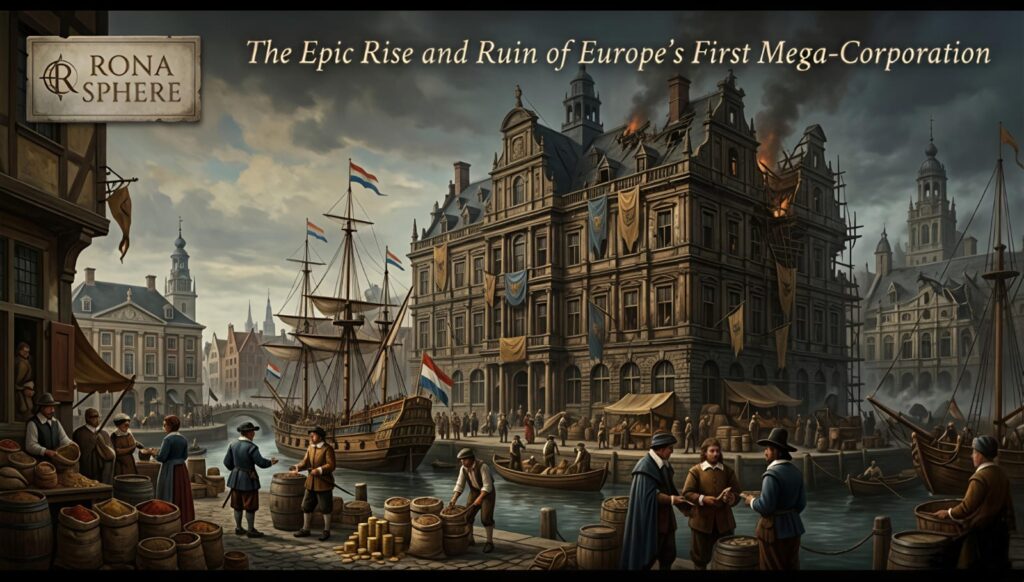
This is the true tale of the Rise and Fall of the Hanseatic League: Europe First Mega-Corporation. Imagine a company that rules the world. This firm owns a massive navy. It has its own legal system. Also, it can crush a king’s army with one trade ban. However, this is not a modern tech giant. Instead, it is a story from the Middle Ages.
For over five hundred years, these traders held the North in a tight grip. Consequently, they became the most powerful force in Europe. They did not wear crowns. Instead, they wore fine wool and silk. Therefore, their power came from the ledger, not the sword. In this guide, we explore the Rise and Fall of the Hanseatic League: Europe’s First Mega-Corporation.
How the Giant Was Born
To start, we must look at the year 1159. At that time, Northern Europe was a wild, dark place. Traveling alone was very dangerous. Specifically, pirates ruled the cold Baltic Sea. Also, thieves lived in every forest. Therefore, the merchants decided to change the game.
The Power of the Pact
Lübeck was the first city to act. In 1159, Duke Henry the Lion rebuilt the town as a trade hub. Subsequently, the local merchants formed a “Hansa.” This old word simply means a group or a guild. Then, they invited other towns to join them. Specifically, they wanted to share the cost of guards.
Furthermore, they wanted to set fair prices for all. Thus, the city of Hamburg signed a deal with Lübeck in 1241. This deal is the key start of the Rise and Fall of the Hanseatic League: Europe’s First Mega-Corporation. Together, they controlled the flow of goods between two seas. Consequently, they became rich almost overnight.
The Secret Weapon—The Hanseatic Cog
Every great business needs a tool that others lack. For the League, that tool was a new ship. Specifically, they built the Cog. This ship was a marvel of the age. Also, it was much bigger than anything seen before.
Why the Cog Changed Trade
Previously, ships were small and light. However, the Cog was fat and sturdy. It could carry hundreds of tons of heavy goods. For example, it carried salt, wood, and wheat. Plus, it only needed a very small crew to sail. Therefore, the cost per ton dropped very fast.
Consequently, the League could sell goods at lower prices. Moreover, the Cog had high sides. This made it very hard for pirates to climb on board. Thus, the Cog ensured the Rise and Fall of the Hanseatic League: Europe’s First Mega-Corporation would favor the merchants.
Controlling the World’s Salt
To understand the Rise and Fall of the Hanseatic League: Europe’s First Mega-Corporation, you must know about salt. In the Middle Ages, salt was like oil. It was the only way to keep meat and fish from rotting. Consequently, salt was the most valuable item in trade.
The Salt and Herring Engine
The League took total control of the salt mines in Lüneburg. Furthermore, they used this salt to preserve millions of fish. Specifically, they caught herring in the Baltic Sea. Then, they salted them and put them in barrels. Since the Church made people eat fish on fast days, the demand was huge.
Consequently, the League had a guaranteed market. Everyone from kings to peasants needed their fish. Therefore, the profits were endless. Indeed, this monopoly was the backbone of their power. This era marks the high point in the Rise and Fall of the Hanseatic League: Europe’s First Mega-Corporation.
The Four Walled Bases—The Kontore
The League did not just sail ships. They built forts in other countries. Specifically, they called these bases Kontore. These were small German islands inside foreign cities. Furthermore, these outposts were the “branch offices” of the mega-corporation.
1. The Peterhof in Novgorod
Deep in Russia, the League built a massive walled base. Here, they traded cloth for furs. Also, they bought tons of beeswax for candles. However, the German merchants lived in fear of the local lords. Consequently, they never left their fortress at night. Still, the trade was too rich to ignore.
2. The Steelyard in London
In London, the League owned a huge piece of land on the river. They called it the Steelyard. Specifically, the English King gave them special tax breaks. Therefore, they sold goods cheaper than the English could. This caused many fights with the local Londoners. Yet, the King protected the League because he needed their money.
3. Bryggen in Bergen
In Norway, the League controlled the dried cod trade. They built long rows of colorful wooden houses. Furthermore, they did not allow any Norwegians to trade fish without them. Consequently, the city of Bergen became a German colony in all but name. This control is vital to the Rise and Fall of the Hanseatic League: Europe’s First Mega-Corporation.
War Without an Army
Sometimes, a king would try to raise taxes on the League. In response, the League used its ultimate weapon. Specifically, they used the trade blockade. If a king was mean, they simply stopped all ships.
Starving a King
Imagine a country that has no salt and no fish. Suddenly, the food starts to rot. People begin to starve. Then, the merchants wait. Consequently, the king’s own people would start a riot. Ultimately, the king would have to beg the merchants to come back. This shows the power in the Rise and Fall of the Hanseatic League: Europe’s First Mega-Corporation.
However, they could also fight with real ships. In 1370, they beat the King of Denmark in a massive sea war. They were so strong they even got to choose the next king. Therefore, they proved that money could beat royal blood.
The Golden Era of Wealth
By the year 1400, the League was at its peak. This was the most golden part of the Rise and Fall of the Hanseatic League: Europe’s First Mega-Corporation. The cities were filled with rich families. They wanted to show off their gold.
Brick Gothic Glory
Since they had no stone, they used red bricks. They built churches so tall they touched the clouds. Also, they built grand town halls with gold clocks. Consequently, this style became known as Brick Gothic. Specifically, it was the “look” of the mega-corporation. You can still see these buildings in cities like Lübeck and Danzig today.
Daily Life for a Merchant
Life in the League was very strict. Specifically, boys were sent to foreign cities at age twelve. There, they had to learn how to count and write in three languages. Furthermore, they were forbidden from marrying local girls.
The Life of an Apprentice
The boys lived in cold dorms. They worked from dawn until dusk. Also, they had to prove they were honest. If a merchant lied, the whole League would kick him out. Consequently, trust was their greatest asset. Therefore, a merchant’s word was as good as gold. This trust is what built the Rise and Fall of the Hanseatic League: Europe’s First Mega-Corporation.
The Start of the Fall
Every empire eventually finds a rival. For the League, the first big rival was the Dutch. Specifically, the Dutch were smarter and faster. This marks the downward turn in the Rise and Fall of the Hanseatic League: Europe’s First Mega-Corporation.
The New Ship: The Fluyt
While the League used the old Cog, the Dutch built the Fluyt. This new ship was much faster. Also, it could carry more cargo with even fewer men. Consequently, the Dutch could ship goods for half the price. The League tried to ban the Dutch ships. However, people wanted the lower prices. Thus, the League began to lose its customers.
The World Grows Too Big
In 1492, everything changed forever. Christopher Columbus sailed to the Americas. Consequently, the focus of trade moved to the Atlantic Ocean. Specifically, gold and silver were coming from the New World.
Obsolete Routes
The League was built for the Baltic Sea. But now, the Baltic was a side street. The real money was in the West. Furthermore, the herring fish moved their home. They swam from the Baltic to the North Sea. Consequently, the League lost its fish and its route. This is a sad part of the Rise and Fall of the Hanseatic League: Europe’s First Mega-Corporation.
The Rise of Strong Kings
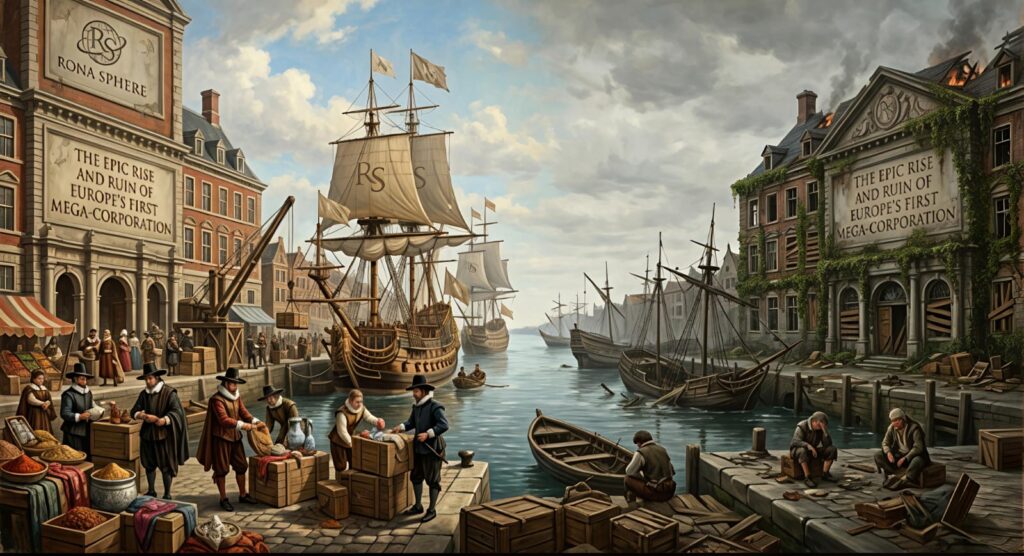
In the beginning, kings were weak. By the 1500s, they were becoming very strong. Specifically, the King of England wanted his own traders to get rich. Therefore, he shut down the Steelyard in London.
Similarly, the Russian Tsar, Ivan the Terrible, attacked the base in Novgorod. He stole all the furs and jailed the merchants. Consequently, the League had no power to fight back. Their walls were falling. This signaled the end of the Rise and Fall of the Hanseatic League: Europe’s First Mega-Corporation.
The Thirty Years’ War
If tech and kings were not enough, war finished the job. Specifically, a massive war broke out in Germany. It lasted thirty years. Towns were burned. People died by the millions. Consequently, the trade networks were broken. Therefore, the League cities could no longer help each other.
Part 12: The Final Meeting
In 1669, the last official meeting took place. Only nine cities sent people. They realized they had no power left. Consequently, they quietly ended the League. There was no big war at the end. Instead, it just faded away like a ghost. Thus, the Rise and Fall of the Hanseatic League: Europe’s First Mega-Corporation was complete.
Part 13: 5 Modern Lessons We Can Learn
Why should we care about old merchants? Because they invented the world we live in now. Specifically, the Rise and Fall of the Hanseatic League: Europe’s First Mega-Corporation gives us five big lessons.
1. Networking is Power
The League showed that small groups can beat giants if they work together.
2. Standardize Everything
They used the same size barrels for all fish. This made trade fast and easy.
3. Innovation is Not Optional
They refused to build better ships. Consequently, the Dutch destroyed them.
4. Trust is Your Best Product
Their whole system was built on honesty. Once the trust was gone, the money left too.
5. Adapt to Geography
The world changed from the Baltic to the Atlantic. The League stayed behind. Therefore, they became a relic.
The Architecture of Success
Today, we can still see the ghosts of this empire. If you go to Hamburg, you will see massive red brick warehouses. Furthermore, you will see “Hanseatic” on the license plates. This is the living memory of the Rise and Fall of the Hanseatic League: Europe’s First Mega-Corporation.
The UNESCO Heritage
Cities like Tallinn and Riga are now world famous for their beauty. Specifically, the League built these cities to be grand. They wanted to show that merchants were just as good as kings. Consequently, the buildings they left behind are masterpieces of art.
The Digital Hansa?
Some people say that the internet is the new Baltic Sea. Specifically, companies like Amazon and Google operate across borders. They have their own rules. Also, they have more money than many countries.
History Repeating Itself
We can look at the Rise and Fall of the Hanseatic League: Europe’s First Mega-Corporation to see the future. Will these new giants also fail? If they stop innovating, they might. Therefore, history is a map for the future.
The Legacy of Global Trade
The League was the first to think of Europe as one big market. They did not care about borders. Specifically, they cared about the flow of goods. Consequently, they paved the way for the European Union.
A World Connected
Before the League, people only ate what they grew. After the League, they could eat Russian fish and wear English wool. Thus, they changed the human diet and style. This is a lasting impact of the Rise and Fall of the Hanseatic League: Europe’s First Mega-Corporation.
The Psychology of the Merchants
What made these men so bold? Specifically, they had a “can-do” spirit. They did not wait for help. They went out and made their own luck. Furthermore, they risked their lives on stormy seas for a better life.
The Merchant’s Courage
They faced pirates and plague. Yet, they kept sailing. This drive is what created the first global business. Consequently, we should admire their grit. The Rise and Fall of the Hanseatic League: Europe’s First Mega-Corporation is a story of human will.
Summary of the Eras
To keep it simple, let’s break down the history.
1150-1250: The Birth. Towns find each other and sign deals.
1250-1370: The Rise. The Cog ship and Salt trade make them giants.
1370-1450: The Golden Age. They beat kings and build red brick cities.
1450-1550: The Struggle. The Dutch arrive and the fish move away.
1550-1669: The Fall. New Worlds and strong kings end the dream.
Therefore, we see a clear cycle in the Rise and Fall of the Hanseatic League: Europe’s First Mega-Corporation.
The Secret of the Archives
In Lübeck, there are millions of old papers. They are the records of every deal the League ever made. Specifically, they show how they kept track of every penny. This record-keeping was ahead of its time.
Data is Wealth
They knew exactly how much grain was in Poland. Also, they knew the price of wool in London. Consequently, they used data to win. This is another lesson from the Rise and Fall of the Hanseatic League: Europe’s First Mega-Corporation. They were the first data-driven business.
Conclusion—The Enduring Spirit
In the end, the Hanseatic League was more than a company. It was a vision of a world connected by trade. Even though it fell, the spirit of the merchant lived on. Specifically, it moved to the Dutch and then the English.
Ultimately, we are all living in a world built by those early German traders. They proved that a group of friends with a good plan could change history. Thus, the Rise and Fall of the Hanseatic League: Europe’s First Mega-Corporation remains one of the greatest stories ever told.
Next time you see a shipping container, think of the Cog. Next time you eat salted fish, think of Lübeck. Their legacy is everywhere. Consequently, the Rise and Fall of the Hanseatic League: Europe’s First Mega-Corporation is a tale that never truly ends.
About the Author