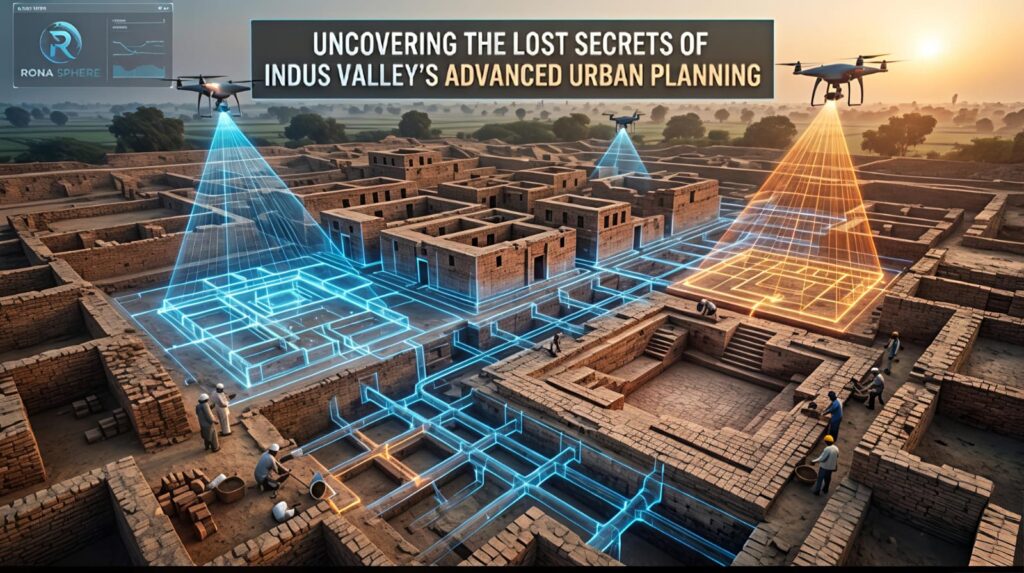
Imagine walking through a city built over 4,500 years ago. You see perfectly straight streets. You smell fresh air instead of waste. Every house has its own bathroom. Interestingly, this is not a modern city. This is a look into The Indus Valley Civilization’s Advanced Urban Planning. While other ancient people lived in messy camps, the Indus people built the world’s first “smart cities.”
In this guide, we will explore why their genius still surprises us today. Furthermore, we will see how The Indus Valley Civilization’s Advanced Urban Planning prioritized health, fairness, and nature.
The Grid: Why Order Matters
Most old cities grew like a tangled web of paths. However, the Indus people liked order. Specifically, they used a strict grid system to plan their towns.
The Chessboard Design
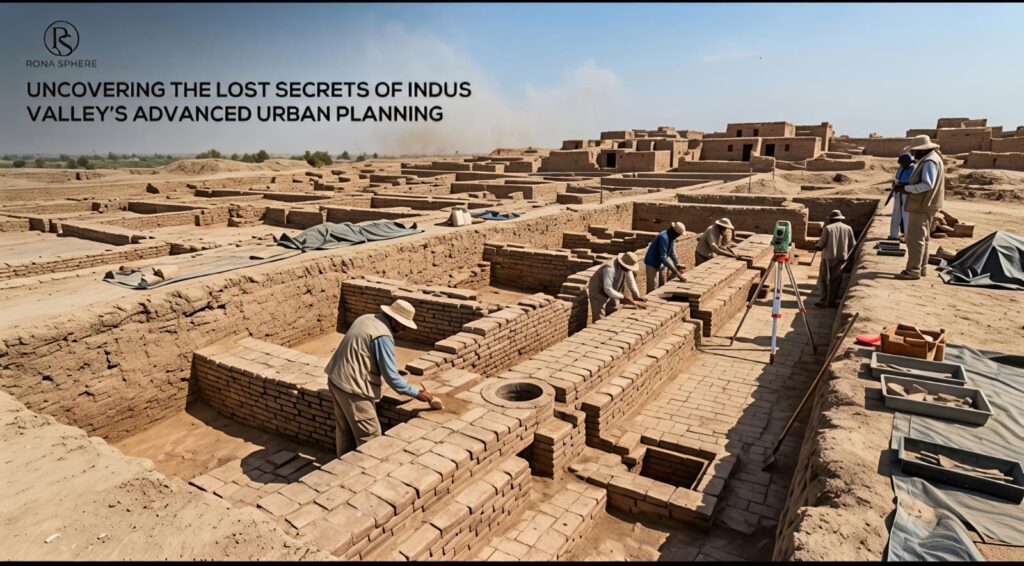
The cities of Mohenjo-Daro and Harappa looked like giant chessboards. Consequently, the main streets ran North-to-South and East-to-West. These streets met at perfect right angles. In fact, this was the first time in history anyone used such a layout.
Wind Power: To start with, architects aligned streets with the wind. As a result, the wind acted like a natural broom to sweep away dust.
Easy Movement: Moreover, they rounded the corners of buildings. Therefore, heavy carts could turn easily without hitting the walls.
Smart Zoning: Additionally, they separated the city into parts. For instance, people lived in one area while shops were in another.
A Lesson for Today
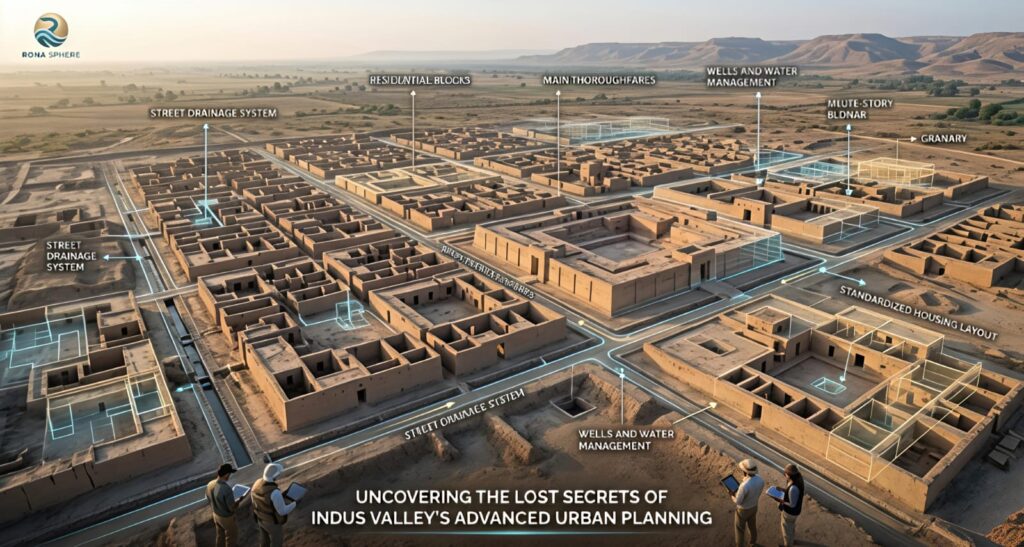
Notably, we still use this grid logic in cities like New York. By choosing a grid, The Indus Valley Civilization’s Advanced Urban Planning allowed the city to grow safely. Furthermore, it made it easy to install water pipes and drains. Thus, they solved urban problems before they even started.
The Great Bath: The World’s First Public Pool
One of the most famous parts of The Indus Valley Civilization’s Advanced Urban Planning is the Great Bath. This was not just a hole in the ground. Actually, it was a masterpiece of engineering.
How They Built It
Builders used many layers to keep the water inside. Specifically, they used bricks and a special type of natural tar called bitumen.
Waterproofing: They lined the tank with bitumen. Consequently, no water leaked out into the soil.
Fresh Water: They had a large well nearby. Therefore, they could fill the bath with clean water whenever they wanted.
The Drain: To maintain hygiene, they built a massive sloped drain. Thus, dirty water flowed out quickly.
Why It Was Special
Moreover, the Great Bath had changing rooms around it. Because of this, many experts think it was a place for religious washing. However, it also shows that the community valued clean water. Indeed, The Indus Valley Civilization’s Advanced Urban Planning put the health of the people first.
The Underground Miracle: Sanitation
While we often look at tall buildings, the real magic happened under the ground. In fact, the drainage system of the Indus Valley was better than some systems in Europe during the 1800s.
| Feature | How It Worked | Why It Was Better |
|---|---|---|
| Covered Drains | Builders used flat stones to cover the drains. | This stopped smells and prevented bugs from spreading sickness. |
| Soak Pits | They built pits to catch solid waste. | Only liquid water flowed out, so the pipes stayed clear. |
| Street Connections | Every house had a pipe that led to the street. | This created a giant network that served every single person. |
Export to Sheets
Consequently, the streets stayed dry and clean. Instead of throwing trash out of the window, people used these smart systems. Therefore, The Indus Valley Civilization’s Advanced Urban Planning helped thousands of people live together without getting sick.
The Standardized Brick: Building with Precision
Imagine trying to build a wall if every brick was a different size. It would be a nightmare. However, the Indus people solved this with a simple rule.
The Golden Ratio
Every brick followed a strict ratio of 4:2:1. This means the length was four times the thickness. Furthermore, they used the same size across thousands of miles. Whether you were in the mountains or by the sea, the bricks were the same.
Mass Production: Because the size was fixed, they could make bricks in huge numbers.
Strength: Specifically, they baked the bricks in kilns. Consequently, the bricks were very strong and lasted for centuries.
Accuracy: Moreover, this allowed architects to plan exactly how many bricks they needed for a house.
Indeed, this level of control shows the strength of The Indus Valley Civilization’s Advanced Urban Planning. They didn’t just build; they manufactured their cities.
The Citadel and the People
Most Indus cities had two main parts. Specifically, there was a high “Citadel” and a “Lower Town.”
The Citadel: The High Ground
The Citadel sat on a giant man-made hill. Because of this, it stayed safe during floods.
Public Life: It held the granary and the Great Bath.
Security: It provided a place to go if the river rose too high.
Administration: Most likely, the leaders worked here to manage The Indus Valley Civilization’s Advanced Urban Planning.
The Lower Town: The Heart of the Home
In contrast, the Lower Town was where the families lived. However, these weren’t just simple huts.
Privacy: Most houses had an entrance that didn’t face the main street. Consequently, families had a quiet place to live.
Two Stories: Many houses had stairs. Therefore, people could have more room without taking up more land.
Courtyards: Every house had a central open space. This allowed for cool air to flow through the rooms.
Granaries: The Ancient Bank Account
Food was the most important thing for ancient people. Therefore, The Indus Valley Civilization’s Advanced Urban Planning included massive storage buildings called granaries.
Specifically, the “Great Granary” was built with air vents. Consequently, the air kept the grain dry and cool. Because the grain didn’t rot, the city had food even during bad years. Furthermore, these buildings were near the river. Thus, they could trade food with other cities easily. Truly, this shows that they were great at business and planning.
How They Managed Water
Living near a river is great for soil, but it is dangerous for floods. Consequently, the Indus people became masters of water control.
Protecting the City
First, they built massive walls around their towns. These walls were not for war. Instead, they were built to block the floodwaters. Second, they built their houses on high platforms. As a result, when the river overflowed, the people stayed dry.
Drinking Water
Furthermore, they dug deep wells. In fact, Mohenjo-Daro had over 700 wells! Because they had so many, almost every group of houses had its own clean water source. This is another example of how The Indus Valley Civilization’s Advanced Urban Planning made life better for everyone.
A Society of Equals?
In many ancient cultures, kings built giant palaces while the poor lived in the dirt. However, in the Indus Valley, we don’t see that.
Fair Infrastructure
Almost everyone had a good house. Specifically, everyone had access to the same drainage system. Because of this, many historians think they had a very fair society. Indeed, the focus of The Indus Valley Civilization’s Advanced Urban Planning was the public good, not just one ruler’s pride.
No Great Temples
Interestingly, we have not found any giant temples or statues of kings. Instead, we found beautiful jewelry, toys, and seals. This suggests that they cared more about trade and daily life. Consequently, their urban planning reflected this practical, peaceful way of living.
Trade and Logistics
The Indus Valley Civilization’s Advanced Urban Planning also included ways to help trade.
Dockyards: At a place called Lothal, they built a massive dockyard.
Tide Control: They understood how the tides worked. Therefore, they could bring ships in and out of the dock with ease.
Weights and Scales: They used stone weights that were very accurate. Because everyone used the same weights, trade was fair.
Consequently, they traded with people as far away as Mesopotamia (modern-day Iraq). This shows that their planning was not just for the city, but for the whole world.
Lessons for Our Future
Why should we study The Indus Valley Civilization’s Advanced Urban Planning now? Actually, they solved many problems that we still face.
Sustainable Building: They used local clay and wood.
Flood Management: They built with the river in mind, not against it.
Public Health: They knew that clean water is the most important part of a city.
Density: They built homes that were compact but comfortable.
If we follow these ideas, we can build better cities today. For example, focusing on drainage and public spaces can make our lives much healthier.
The End of the Cities
After a long time, these cities were left behind. Some think the rivers dried up. Others think the climate changed. However, even when the people left, their ideas stayed. Specifically, the concept of the grid and the drain lived on in other cultures.
Nevertheless, we should remember that for over a thousand years, The Indus Valley Civilization’s Advanced Urban Planning worked perfectly. It kept people safe, clean, and fed.
Conclusion: The First Great Engineers
Ultimately, The Indus Valley Civilization’s Advanced Urban Planning was a triumph of the human mind. They used math and logic to create a paradise in the desert. Specifically, they proved that a city can be both large and clean.
Furthermore, they showed us that planning for the common person is the best way to build a lasting civilization. Consequently, as we build the “smart cities” of the future, we should look back at the Indus Valley. Indeed, they were the first ones to get it right.
Common Questions About The Indus Valley Civilization’s Advanced Urban Planning
Q: How did they make their streets so straight?
Actually, they likely used simple surveying tools like cords and stakes. Because they were so careful, they were able to maintain perfect lines over long distances.
Q: Did they have toilets?
Yes, in fact, they had the first sit-down toilets in history. These were connected to the underground drains. Therefore, their houses were very sanitary.
Q: Was there a central government?
Specifically, we don’t know for sure. However, the way every brick and street was the same suggests a very strong central plan. Consequently, someone was definitely in charge of The Indus Valley Civilization’s Advanced Urban Planning.
Q: What materials did they use most?
Mostly, they used baked bricks, wood, and mud. Because they had plenty of clay from the rivers, they were able to build massive cities quickly.
Q: Why did they build on platforms?
To begin with, the platforms protected them from the river’s floods. As a result, the houses remained safe even during the rainy season.
About the Author