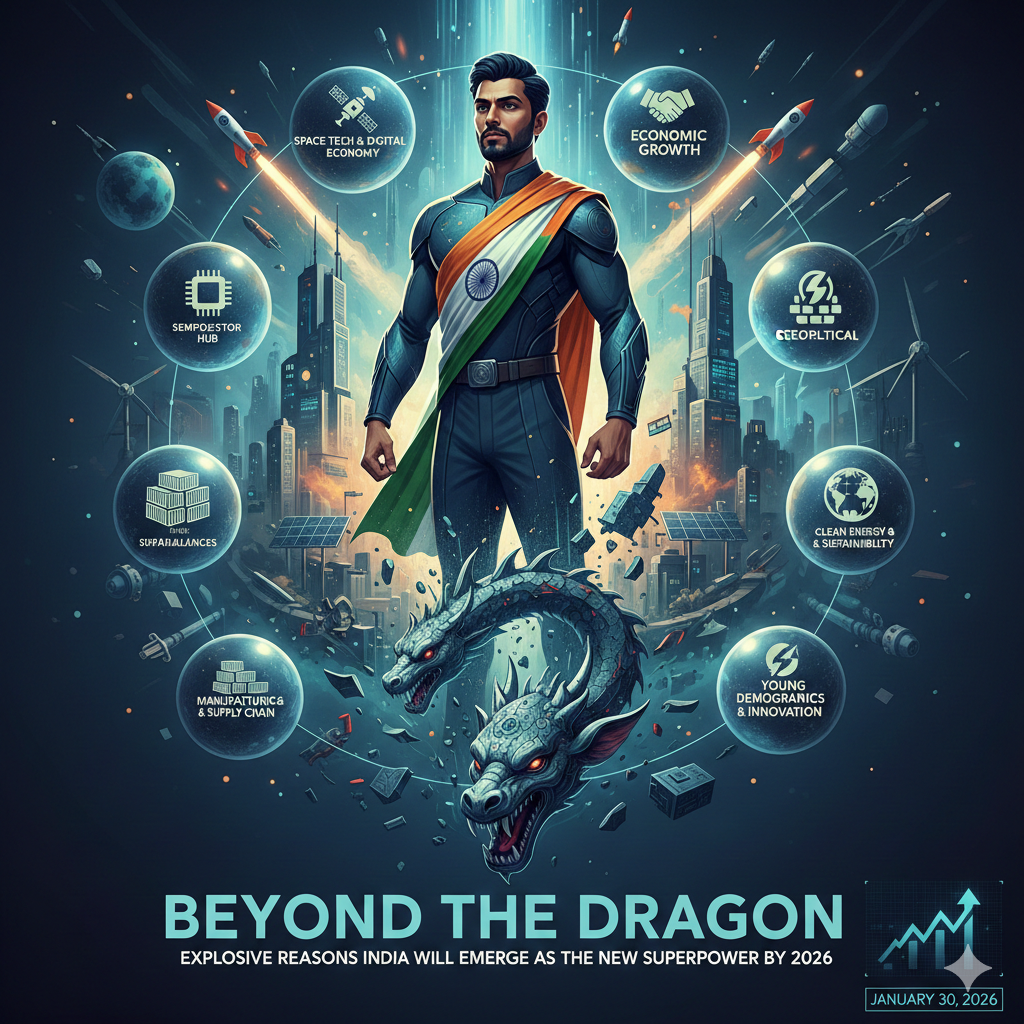
For many years, the world watched the “Chinese Dragon” grow at a scary speed. It became the factory for every toy, phone, and tool on Earth. However, as we enter 2026, a new story is taking over. The “Indian Elephant” has found its rhythm. It is now moving faster than the Dragon. This shift in The Dragon vs. The Elephant race is not just a small change. Instead, it is a massive flip in how the world works.
In 2026, we see China facing many old-age problems. In contrast, India is young, tech-savvy, and ready to lead. Consequently, investors and big brands are moving south. They are leaving the Dragon and betting on the Elephant. This article will show you why 2026 is the year India officially takes the crown.
The Power of Youth: A Growing Workforce
The most important part of The Dragon vs. The Elephant story is the people. China’s population is getting old very fast. For decades, they had a “one-child” rule. Consequently, they now have fewer workers and more retired people to care for. Furthermore, this makes labor in China very expensive.
Why India is Different
In contrast, India has the world’s largest group of young people. The average age in India is only 28. Furthermore, nearly 67% of Indians are in the working-age group. Consequently, India has a “demographic dividend” that will last for decades. Because these young people are digital natives, they learn new jobs quickly.
Workforce Size: India will have over 1 billion workers by the next decade.
Energy: Young workers drive innovation and start new companies.
Spending: Young people buy more houses, cars, and gadgets, which helps the economy grow.
Manufacturing: Moving the Factory Floor
In the past, “Made in China” was everywhere. But in 2026, the The Dragon vs. The Elephant balance has shifted. Global giants like Apple and Samsung have built massive hubs in India. Furthermore, the “Make in India” plan gives big cash rewards to companies that build factories there.
The “China Plus One” Strategy
Many countries are now afraid of relying too much on China. Consequently, they use a “China Plus One” plan. They keep some work in China but move the rest to India. Furthermore, India’s labour is much cheaper than China’s in 2026. Because of this, even Tesla is looking at India as its next big home.
| Feature | The Dragon (China) | The Elephant (India) |
| Labor Cost | High and rising | Low and stable |
| Worker Age | Getting older | Very young |
| Ease of Business | More government rules | Cutting red tape |
The Digital Revolution: A Smarter Elephant
India is winning the tech part of The Dragon vs. The Elephant battle. While China has a “Great Firewall,” India has built “Digital Public Goods”. This sounds complex, but it is actually simple. It means the government made a digital “highway” that anyone can use for free.
The UPI Miracle
Most Indians now pay for everything using their phones. Whether it is a luxury car or a bunch of bananas, they use UPI. Furthermore, India’s digital payment system is the best in the world. Consequently, it has made the economy very fast and transparent. Furthermore, the “India Stack” helps millions of poor people get government help directly in their banks.
Key Fact: India processes more real-time digital payments than the US, China, and Europe combined.
Trust and Democracy: The Global Choice
When we look at The Dragon vs. The Elephant, we must look at who the world trusts. China is a closed system with many secrets. Consequently, many Western countries are moving away from it. Furthermore, trade wars have made it hard for the Dragon to sell its goods.
India as a Partner
In contrast, India is a democracy. It has a free press and independent courts. Furthermore, India is a key member of the “Quad” with the US, Japan, and Australia. Because India follows global rules, it is seen as a “safe harbour” for money. Consequently, 2026 has seen a record amount of foreign money flowing into Indian stocks.
Infrastructure: Building the Future
For a long time, China had better roads and ports. However, the Elephant is catching up fast. In the race between the dragon and the elephant, India is spending billions on “Gati Shakti”. This is a master plan to connect every road, rail, and port.
Speeding Up the Nation
India is building nearly 30 kilometres of highway every single day. Furthermore, new “Smart Cities” are popping up across the country. Because of this, it is now much cheaper to move goods across India. Consequently, businesses can grow faster and reach more customers.
High-Speed Rail: New trains are cutting travel time between big cities.
Modern Ports: India’s ports are now as fast as those in Singapore or Dubai.
Aviation: India is buying hundreds of new planes to connect small towns.
Energy: The Green Revolution
The next big battle in The Dragon vs. The Elephant is about energy. China uses a lot of coal, which is dirty. In contrast, India is taking a “shortcut” to green energy. Furthermore, India is a global leader in solar power.
Sun Power
By 2026, India has hit its green energy goals early. Furthermore, the country is betting big on “Green Hydrogen.” Because India has so much sun, it can produce this clean fuel very cheaply. Consequently, India will soon stop buying so much oil from other countries. This will save the nation billions of dollars.
The Rise of Startups and Unicorns
In the The Dragon vs. The Elephant rivalry, innovation is king. China has recently been hard on its big tech companies. Consequently, many Chinese entrepreneurs are afraid to take risks. In contrast, India is celebrating its “Unicorns” (startups worth over $1 billion).
A Culture of Solvers
Indian youth are not just looking for jobs. They are creating apps that solve real problems. Furthermore, these startups are working in farming, health, and education. Because they use AI and big data, they are making life better for everyone. Consequently, Bengaluru and Hyderabad are now seen as the new global tech capitals.
Consumer Power: 1.4 Billion Dreamers
The best part of The Dragon vs. The Elephant is the market. China’s market is saturated. Most people there already have a phone and a car. In contrast, India’s middle class is just starting to spend. Furthermore, by 2026, millions of families have joined the middle class.
The Spending Boom
These families want better food, better clothes, and better travel. Consequently, global brands are rushing to India. Furthermore, this internal demand makes India’s growth very stable. Even if the rest of the world has a bad year, the Elephant keeps moving because its own people are buying.
Education and the Brain Gain
In the past, many smart Indians left for the US or UK. This was called “Brain Drain.” But in 2026, we see a “Brain Gain.” Furthermore, many skilled Indians are moving back home to start companies. In the The Dragon vs. The Elephant context, this is a huge win for India.
Skill India
The government is also training millions of workers in new skills like coding and AI. Consequently, the workforce is becoming “future-ready.” Furthermore, India has more English speakers than almost any other country. Because of this, it is very easy for global companies to work with Indian teams.
Geopolitics: The Voice of the Global South
India has become a leader for many developing nations. In the The Dragon vs. The Elephant contest, India is seen as a “friendly” big brother. While China’s “Belt and Road” has caused debt problems for some countries, India’s help is seen as more balanced.
A Multipolar World
India does not want a world with just one or two powers. Instead, it wants a “multipolar” world. Furthermore, India uses its power to talk about climate change and fair trade. Consequently, the Elephant is earning respect from both the East and the West.
Challenges: Staying on Track
We must be honest. To win the The Dragon vs. The Elephant race, India still has work to do. Furthermore, it needs to keep making it easier for small businesses to start. Because there is still some “red tape,” the government must continue to cut it.
Focus Areas
Education Quality: Making sure every child gets a world-class education.
Health: Building more hospitals in rural areas.
Women in Work: Encouraging more women to join the workforce to boost GDP.
Conclusion: 2026 and Beyond
The year 2026 is the year the world realized the truth. In the epic tale of The Dragon vs. The Elephant, the Elephant has finally taken the lead. India has the youth, the digital tools, and the trust of the world. Furthermore, it has a clear plan for the future.
While the Dragon is still a great power, its best days might be behind it. In contrast, the Elephant is just getting started. Consequently, the next ten years will be known as the “Indian Decade”. Furthermore, this growth is not just good for India; it is good for the whole world. It brings more choices, more innovation, and a new hope for a democratic future.
The race of The Dragon vs. The Elephant has a new frontrunner. And that frontrunner is India.
Summary of India’s 2026 Lead
GDP: Growing at nearly 8%, while China stays below 5%.
Youth: A median age of 28 provides a massive work advantage.
Tech: Leading the world in digital payments and software.
Trust: Western nations prefer India’s democratic system.
The Dragon vs. The Elephant is a story of change. And in 2026, the change is here.
About the Author