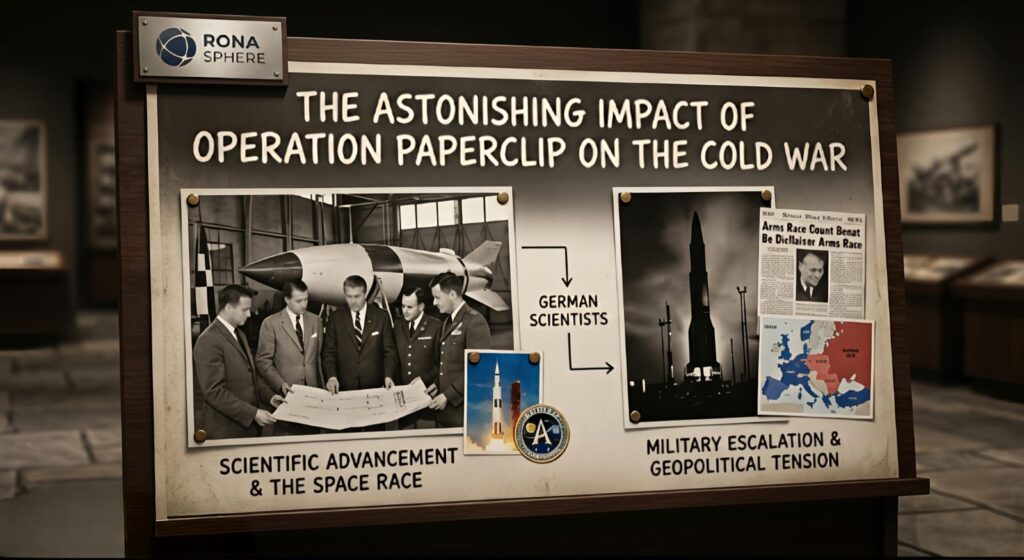
The Secret Race for Brains in a Broken World
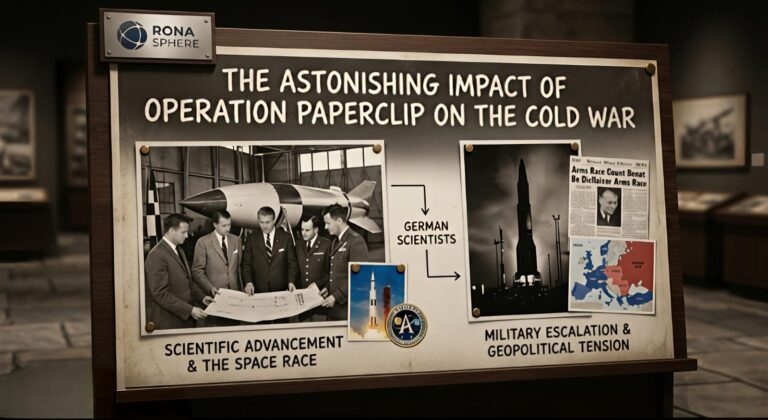
The great war ended in 1945. But a new shadow war began fast. The United States and the Soviet Union wanted total power. Therefore, both nations raced to find the best German minds. We call this secret mission Operation Paperclip. Specifically, American forces brought over 1,600 German experts to the US.
Many of these smart men served a cruel regime. Nevertheless, American generals wanted their deep skills. The Cold War loomed just ahead. As a result, leaders ignored big moral questions to save the country. In this guide, we explore Operation Paperclip: How WWII scientists shaped the Cold War. You will learn how these men built massive rockets. Ultimately, they helped put Americans on the moon.
The Desperate Search for the Osenberg List
German science jumped far ahead in the 1930s. Indeed, German leaders spent huge sums on super weapons. However, the Allied armies pushed deep into Germany in 1945. Subsequently, German officers tried to hide secret files. They burned millions of research pages. Meanwhile, some scientists buried blueprints in secret mountain caves.
Luckily, a Polish worker found a vital list in a toilet. Eventually, British spies pieced the torn paper back together. They called this the Osenberg List. Essentially, it was a phone book of the smartest German engineers. Afterward, this list reached American hands. US agents realized they had struck pure gold. Thus, the great hunt for brains began.
Why the US Needed WWII Scientists So Badly
You might ask why America needed foreign help. Actually, the answer is very simple. The US lacked several key technologies.
Rocketry Gap: The US fell years behind in rocket tech. For instance, America had nothing to match the V-2 rocket.
Aviation: German engineers already built early jet fighters. Meanwhile, American pilots still used old propellers.
Chemicals: The German army invented deadly new nerve gases. Consequently, the US Army wanted to study these threats.
The Soviet Threat: Josef Stalin grabbed every scientist his troops could find. Thus, America could not let the Soviets win.
How Operation Paperclip Actually Worked
The Secret Recruitment Process
Bringing enemy scientists to America was a huge task. Initially, the American public hated Germany. Therefore, the US government kept the operation a total secret. President Harry Truman approved the program in 1946. But he gave a very strict order. Specifically, he banned active Nazi party members from entering.
Unfortunately, this rule created a massive problem for the military. Most top scientists belonged to the Nazi party. Furthermore, many used slave labour to build weapons. To solve this, US intelligence officers decided to bend the rules.
Dustbin: The Castle of Secrets
US forces first gathered the experts in Europe. Specifically, they sent them to a camp called “Dustbin.” This camp sat inside an old castle. There, officers asked the scientists questions for months.
The officers quickly saw how smart these men were. Consequently, the officers changed their tone. They stopped treating them like prisoners. Instead, they treated them like guests. The US offered them warm food and a new life. Basically, they promised these men a fresh start in America.
The Secret Trick of the Paperclip
Military officers still had to sneak these men past the law. Consequently, the agents simply changed the scientists’ files. Interestingly, this action gave the project its name. Agents used paperclips to attach clean life stories to the real files.
Effectively, they erased dark pasts to make the men look innocent. Instead of war criminals, these men became vital assets. Agents deleted any mention of the SS. Ultimately, this cover-up sparks huge debates today.
Key WWII Scientists Who Shaped the Cold War
You must look at the men involved to understand this history. Below, we look at the figures of Operation Paperclip: How WWII scientists shaped the Cold War. These men changed world history forever.
Wernher von Braun: The Space Master
Wernher von Braun was the star of this secret project. Previously, he built the deadly V-2 rocket. This weapon killed thousands in London. Moreover, von Braun held a high rank in the SS. Regardless, the US Army wanted his brain.
Eventually, von Braun surrendered to US soldiers. They moved him to Fort Bliss, Texas. There, he taught the military about rockets. He lived a quiet life in the desert. Soon, he began a plan to win over the public.
The Disney Strategy: Selling Space
Von Braun knew he needed Americans to like him. Therefore, he teamed up with Walt Disney. Together, they made TV shows about space travel.
These shows played in homes across America. Consequently, people fell in love with space. Von Braun changed his image. Instead of an enemy, he became a TV star. Ultimately, this trick helped fund the moon mission.
From V-2 Rockets to the Moon
Von Braun’s journey from enemy to hero is wild. Over time, he became a top boss at NASA. Furthermore, he designed the Saturn V rocket.
Incredibly, this rocket launched the Apollo 11 crew to the moon. Thus, the US won the Space Race. However, a man who once worked for a dictator fuelled this victory.
Other Key Figures and Their Impact
Von Braun was not alone. In addition, hundreds of others changed our world. Some built weapons, while others saved lives.
Arthur Rudolph: He managed a V-2 rocket factory. Later, NASA hired him for the Saturn V project. Eventually, he left the US in 1984 when his past came out.
Hubertus Strughold: People call him the father of space medicine. Specifically, his work helped keep astronauts alive. Conversely, his past linked to cruel tests on prisoners.
Kurt Debus: He served the SS during the war. Remarkably, he became the first director of the Kennedy Space Center. He built the launch pads we use today.
Walter Dornberger: He managed the V-2 program as a general. Afterward, he became a boss at Bell Aircraft. Indeed, he helped build the X-15 rocket plane.
The Dark Side: Nerve Gas and Tests
Space is the bright side of this story. However, Operation Paperclip: How WWII scientists shaped the Cold War has a dark side. The military also hired experts in poison and drugs.
The Edgewood Arsenal Secrets
The US Army set up a secret lab in Maryland. They called it the Edgewood Arsenal. Here, they brought over German chemists. These men had invented deadly nerve gases like Sarin.
Consequently, the US military wanted to test these gases. They also tested drugs like LSD. Shockingly, they tested these on thousands of US soldiers. Many young men did not know the risks. As a result, many veterans suffered for years.
Key Chemical Experts
Kurt Blome: He ran a biological weapons program for Germany. The US arrested him for crimes. Amazingly, they later hired him to work on new poisons.
Walter Schieber: He helped make chemicals for the German army. The US ignored his dark history. Instead, they used his skills to build American weapon piles.
The Soviet Strategy: Force and Fear
The US did not play this game alone. Meanwhile, the Soviet Union ran its own search. Actually, the Soviet plan was much more brutal.
They called it Operation Osoaviakhim. In contrast to the US, the Soviets used force. Troops marched into German homes in 1946. Consequently, they packed 2,000 scientists onto trains at gunpoint. Next, they shipped the men deep into Russia.
Life Under Soviet Rule
The scientists lived in secret towns. There, they designed rockets for the Red Army. They worked under strict guards. Unlike the Americans, the Soviets never trusted these Germans.
Soviet engineers learned everything they could. Then, they sent the Germans home. The Soviet Union built a huge space program this way. Ultimately, this brain drain sparked the Space Race.
The Arms Race: Missiles and Fear
The story of Operation Paperclip: How WWII scientists shaped the Cold War leads to the arms race. Both sides used German brains to build bigger bombs.
The Birth of the ICBM
The V-2 rocket changed war. It could fly high and hit a city. However, it could only go a few hundred miles. The Cold War needed something bigger.
Therefore, German scientists in the US helped build the ICBM. Essentially, an ICBM can fly across the ocean in 30 minutes. Furthermore, the military put nuclear bombs on these rockets.
Mutually Assured Destruction
The ICBM changed the world. Both sides had these weapons. Consequently, a new idea began. People called it Mutually Assured Destruction.
Basically, if one side fired, the other would fire back. Both nations would die. Ironically, the weapons from Operation Paperclip kept the peace. The fear of death stopped a third world war. Thus, German scientists shaped the peace of the Cold War.
The Lasting Legacy of the Project
The story of Operation Paperclip: How WWII scientists shaped the Cold War shows fast progress. Undoubtedly, these experts changed the balance of power. They shaped the tech we use today.
Tech Progress vs. Moral Cost
The tech from this program is amazing. For example, Paperclip scientists helped build weather satellites. These help us predict storms. Furthermore, they helped build spy satellites. As a result, the US could watch Soviet bases from space.
However, this progress had a high moral cost. V-2 victims never got justice. Similarly, slave prisoners never saw their bosses go to jail. Instead, the US gave those bosses medals. They lived in nice homes and drove fast cars.
Lessons for the Modern Tech World
History is often gray, not black and white. Therefore, we can learn lessons from this chapter. You can apply these to the modern AI race.
1. Don’t Let Fear Drive You
Scared leaders make bad moral choices. During the Cold War, fear blinded the US. Today, companies fear losing the AI race. Consequently, they might ignore safety.
Action Step: Always pause. Make tech choices based on safety, not panic.
2. Question Fast Progress
Fast growth is good. Nevertheless, we must ask what we sacrifice. The US got to the moon but lost justice.
Action Step: Create an ethics board. Ask hard questions before you launch new tech.
3. Be Honest with People
The US government hid this secret for years. They lied to the public. Eventually, the truth came out anyway.
Action Step: Build trust through honesty. Never hide flaws or data leaks. Consequently, honest brands win.
4. Know Your Partners
The US used bad people to make good tech. However, this choice haunts history.
Action Step: Check your partners. Make sure your team uses fair labor. Ultimately, you take the blame for your partners’ actions.
The Truth That Built Our World
We want heroes to be perfect. Actually, the Cold War tells a different story. Operation Paperclip: How WWII scientists shaped the Cold War shows a hard truth. Namely, men with dark pasts built the free world.
The rockets that went to space began as weapons of death. Similarly, the medicine that saved astronauts came from cruel acts. Ultimately, Operation Paperclip is a chilling lesson. It shows how far a nation will go to survive.
Deep Dive: The Alsos Mission and the Hunt
Before the paperclips were used, soldiers had to find the targets. Specifically, the US military created a special group. They called it the Alsos Mission. Therefore, this group followed the front lines of the war.
The team consisted of scientists and soldiers. Indeed, their only job was to find German research. They searched labs, schools, and offices. Subsequently, they caught top physicists like Werner Heisenberg. Consequently, the US learned exactly how close Germany came to an atomic bomb.
Finding the Hidden Gold of Research
German teams tried to hide their best ideas. For instance, they put documents in metal cans. They threw these cans into deep lakes. Furthermore, they hid papers inside old barn walls.
However, the Alsos team was very smart. They found the hidden caches one by one. As a result, tons of data went to America. This data formed the base for modern engineering. Ultimately, the hunt was a total success.
The Rocket Cities: Huntsville and El Paso
Where did these men go? Initially, they went to El Paso, Texas. There, they lived at Fort Bliss. It was a dusty desert. But the scientists did not mind. They had work to do.
Later, the military moved them to Huntsville, Alabama. Consequently, Huntsville became “Rocket City.” The Germans changed the town. They started orchestras and built schools. Indeed, the town still loves von Braun today. He is a local hero there.
The Legacy in Alabama
You can visit the Space and Rocket Center in Huntsville. There, you see the Saturn V. It is a giant machine. Moreover, you see the work of the Paperclip team. They turned a small town into a tech hub. Thus, the impact of these scientists is still visible.
The Human Cost of the V-2
We must talk about the victims. The V-2 killed 9,000 people in cities. But it killed even more in the factory. Specifically, 12,000 slave workers died building it. They worked in a dark tunnel called Mittelbau-Dora.
Consequently, many feel the moon landing is tainted. The men who led NASA knew about these tunnels. Nevertheless, they did not stop the work. This is the hardest part of the story. As a result, we must hold two ideas at once. The tech was great, but the cost was high.
The Silence of the Scientists
After the war, the scientists did not talk about the tunnels. Instead, they talked about the stars. They wanted to forget the war. Ultimately, the US government helped them forget. This silence lasted for decades.
The Geopolitical Impact on Europe and Beyond
The loss of these brains hurt Germany for decades. Consequently, Europe lost its lead in global science. The center of tech shifted across the Atlantic. Therefore, the US became the new capital of innovation.
Meanwhile, Europe had to rebuild from ruins. They lacked the top minds to lead new industries. In contrast, American universities boomed with new knowledge. The German experts taught a new generation of American students. Thus, the effects of the program lasted for decades.
The Brain Drain Phenomenon
This massive movement of talent created a new term. Specifically, historians call it a “brain drain.” It happens when a country loses its best workers to a rival. Indeed, Operation Paperclip was the largest brain drain in modern history. As a result, Germany could not compete in the early computer age.
The Creation of the Joint Intelligence Objectives Agency
A special agency ran this whole secret plan. Namely, the military created the JIOA. This group had one main goal. They needed to acquire enemy technology fast.
Therefore, the JIOA set up offices in Europe and Washington. They coordinated with the army, navy, and air force. Furthermore, they managed the secret transport of the scientists. They gave the men fake names and new passports. Consequently, the JIOA operated outside the normal laws of immigration.
Fighting the State Department
Not everyone in the US government liked this plan. For instance, many workers at the State Department tried to block the visas. They knew these men were dangerous. However, the JIOA was more powerful. They used national security as an excuse to override the law. Ultimately, the JIOA won the internal bureaucratic war.
Secrets of the V-2 Rocket Design
The V-2 was a true marvel of engineering. Essentially, it was the world’s first long-range guided missile. It used liquid fuel to launch high into the sky. Subsequently, it reached the edge of space before falling.
Interestingly, the missile traveled faster than the speed of sound. Therefore, victims never heard it coming. It hit without any warning. This terror aspect made it a prized asset for both the US and USSR.
From V-2 to Redstone Missiles
In America, the team did not stop developing missiles. Specifically, they used the V-2 design to build the Redstone missile. This new rocket was bigger and safer. Consequently, it became America’s first major nuclear missile. Later, this exact rocket line launched the first American into space. Thus, military weapons directly birthed civilian space travel.
The Dawn of Modern Jet Aviation
Rockets were only half the story. In addition, German jet experts changed the skies forever. Before 1945, planes used propellers. But German engineers built the Me 262 jet fighter.
This plane was faster than anything the Allies had. Therefore, the US Air Force recruited top jet engineers through Paperclip. These men went to work at Wright-Patterson Air Force Base. Subsequently, they helped design the next generation of American jet planes.
Shaping the Swept-Wing Design
German air tunnel tests proved a vital fact. Specifically, slanting plane wings backward allowed for incredible speed. We call this the swept-wing design. Consequently, American engineers used this data to build the F-86 Sabre jet. This plane dominated the skies during the Korean War. Ultimately, modern commercial jets still use this German wing shape today.
The Secret World of Fort Bliss
The scientists started their American lives in Texas. Initially, they lived in old wooden barracks at Fort Bliss. The conditions were not luxurious. Nevertheless, the men had access to workshops and labs.
They spent their days assembling old V-2 parts. Furthermore, they launched these rockets at the nearby White Sands Proving Ground. Local Texans sometimes saw bright lights in the night sky. But the military told the public these were just simple weather tests. Consequently, the truth remained hidden behind desert fences.
The “Prisoners of Peace”
The scientists called themselves the “Prisoners of Peace.” Indeed, they could not leave the base without a guard. They had no money and no citizens’ rights. However, this situation changed as the Cold War grew hotter. The US government realized these men needed to be happy to do their best work. Therefore, they allowed the scientists’ families to move to America.
Bringing the Families to the Promised Land
In 1947, a massive wave of German women and children arrived in Texas. Consequently, Fort Bliss turned into a small German village. The families brought their culture, music, and food to the desert.
This move changed the mindset of the scientists. Instead of temporary workers, they began to view themselves as future Americans. They started learning English fast. Furthermore, their children entered local schools. This integration was a vital step for the long-term success of the project. Ultimately, it turned former enemies into loyal citizens.
Moving to Redstone Arsenal: The Huntsville Boom
The desert was too small for the growing rocket program. Therefore, the army moved the team to Huntsville, Alabama, in 1950. They took over the old Redstone Arsenal.
This move triggered a massive construction boom in the South. Specifically, the government spent millions to build new launch pads and test stands. Thousands of local workers got good jobs. Consequently, Huntsville transformed from a quiet farming town into a global tech capital. The German scientists were at the center of this golden age.
The Cultural Impact on Alabama
The scientists did not just build rockets. Indeed, they enriched the local community. Wernher von Braun loved classical music. Consequently, he helped found the Huntsville Symphony Orchestra.
Other experts pushed for better schools and universities. Therefore, they helped create the University of Alabama in Huntsville. As a result, the city became an oasis of high culture and deep science in the deep South. This unique mix remains visible in the town today.
The Birth of NASA and the Civil Space Program
In 1957, the Soviet Union shocked the world. Specifically, they launched Sputnik, the first artificial satellite. This event triggered massive panic in America. The Cold War was now moving into orbit.
Consequently, President Eisenhower created NASA in 1958. The military handed the German rocket team over to this new civilian agency. Therefore, the Paperclip scientists stopped building weapons for the army. They shifted their focus to exploring the stars. This shift saved their public reputations.
Building the Marshall Space Flight Center
NASA built a massive new base in Huntsville. They named it the Marshall Space Flight Center. Subsequently, Wernher von Braun became its very first director.
He managed thousands of American engineers and billions of dollars. Indeed, his word became law in the American space program. He used this immense power to plan the ultimate mission. He wanted to send human beings to the moon. Ultimately, NASA gave him the exact platform he needed to achieve his childhood dream.
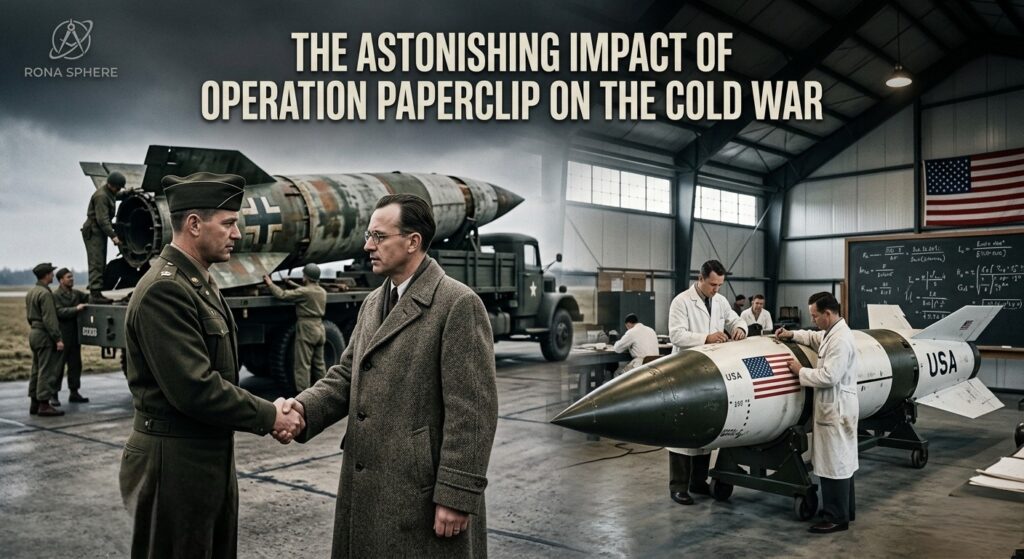
The Saturn V Masterpiece: Engineering the Moon Shot
The journey to the moon required a rocket of impossible size. Therefore, the Paperclip team spent the 1960s designing the Saturn V. This machine remains the most powerful rocket ever built.
It stood as tall as a 36-story building. Furthermore, it burned millions of pounds of fuel in just a few minutes. The engines created a force so loud it shook the ground for miles. In contrast to the early, unstable V-2 rockets, the Saturn V was incredibly reliable. It never suffered a major failure during a human flight.
The Triumph of Apollo 11
On July 16, 1969, the Saturn V launched from Florida. Subsequently, millions of people watched the rocket lift into the blue sky. Inside the capsule sat Neil Armstrong, Buzz Aldrin, and Michael Collins.
Four days later, humans walked on the moon for the first time. Consequently, the United States won the Space Race completely. In the control room, the Paperclip scientists celebrated with American flags. Thus, the technology born in enemy laboratories achieved the greatest feat in human exploration.
The Dark Legacy of Arthur Rudolph
The glory of the moon landing did not last forever. Eventually, journalists and lawyers began to look closer at the scientists’ pasts. Specifically, the case of Arthur Rudolph shocked the nation in the 1980s.
Rudolph was a key engineer for the Saturn V. Previously, he was the boss of the Mittelwerk factory in Germany. This underground factory used thousands of slave workers from concentration camps. Indeed, records proved Rudolph walked through the tunnels daily. He saw the dead bodies of starved prisoners. Nevertheless, he pushed the workers harder to hit his production goals.
The Office of Special Investigations
In 1979, the US Department of Justice formed a special unit. They called it the Office of Special Investigations (OSI). This team had a clear mission. They needed to find Nazi war criminals hiding in America.
Consequently, they uncovered Rudolph’s dark wartime record. They presented him with a harsh choice. He could face a public trial in America, or he could lose his citizenship and leave. Therefore, Rudolph signed a deal and moved back to Germany in 1984. Ultimately, this event shattered the myth of the innocent Paperclip scientist.
Hubertus Strughold: The Father of Space Medicine
Another major controversy involved Hubertus Strughold. In America, he was a medical pioneer. Specifically, he ran the School of Aviation Medicine for the US Air Force.
He conducted brilliant research on oxygen loss, cosmic rays, and sleep cycles. Consequently, his work kept the first astronauts safe from the dangers of space. NASA praised him as a true hero of science. However, his name appeared on dark lists after his death.
The Nuremberg Medical Trials
Investigative reports later linked Strughold to horrific human experiments. Specifically, during the war, German doctors put prisoners into freezing water to see how long they could survive. Other doctors put inmates into vacuum chambers to simulate high altitudes.
Many prisoners died in pure agony during these tests. Although Strughold always denied his direct involvement, records showed he attended meetings where these tests were planned. As a result, his legacy is deeply stained today. His name was removed from prestigious medical awards and buildings across America.
The Silent Complicity of the American Public
You might wonder why regular Americans accepted these men. Actually, the public chose comfort over truth. During the 1950s, the fear of communism was immense.
Therefore, regular citizens felt glad that these smart scientists worked for America instead of Russia. People watched Wernher von Braun on TV and saw a charming family man. They ignored the faint whispers about his past. Consequently, a culture of silence covered the entire project. The collective desire to win the Cold War created a giant moral blind spot for an entire generation.
The Role of the Media
Major magazines like Life and Time wrote glowing profiles of the German experts. Specifically, they painted them as pure men of science who hated politics. They claimed the scientists only joined the Nazi party because they were forced to. Indeed, this media campaign was highly effective. It sanitized their images completely. Ultimately, it allowed regular Americans to cheer for former enemies without feeling guilty.
FAQs About Operation Paperclip
People still ask tough questions about this hidden history. Below, we answer common questions about Operation Paperclip: How WWII scientists shaped the Cold War.
Did these scientists ever apologize for their wartime actions?
No, most of them never gave a formal apology. Instead, they claimed they were just patriots who served their country. They argued that science is neutral. They stated they only cared about building rockets, not how those rockets were used. Consequently, many historians view this defense as a hollow excuse to escape blame.
Did the program violate US law at the time?
Yes, it directly violated the official orders of President Truman. Specifically, Truman stated that ardent Nazis should not be let into the US. However, military intelligence officers bypassed this rule by rewriting the records. Therefore, the operation was technically an illegal conspiracy run by elements inside the US military.
How did the Soviet Union treat their captured German scientists?
The Soviet Union treated them much more harshly. Initially, they forced them to work under armed guard in secret locations. They squeezed all the information out of them for a few years. Subsequently, once the Soviet engineers learned the tech, they sent the Germans back to Europe. The Soviets never gave them high positions or medals.
Were there any German scientists who refused to work for the US?
Yes, a few scientists refused to cooperate with the Allies. Consequently, they were kept in prison camps or forced to do basic manual labor. However, the vast majority of experts were eager to sign American contracts. They knew America offered safety, wealth, and the best labs in the world.
What happened to the V-2 production blueprints after the war?
The German rocket team hid the blueprints in a secret mine shaft before surrendering. Subsequently, Wernher von Braun told the US military exactly where to find them. The Americans dug up fourteen tons of documents. Therefore, the US secured the complete technical history of the V-2 before the British or Soviets could find it.
Did the British run a similar program?
Yes, the British ran a small program called Operation Backfire. Specifically, they used captured German crews to launch three V-2 rockets over the North Sea in 1945. They wanted to study the launch procedures. However, Britain was too broke after the war to fund a long-term rocket program. Consequently, most of the top talent chose to go to America instead.
The Lessons We Must Carry Forward
The history of Operation Paperclip: How WWII scientists shaped the Cold War is a heavy mirror for humanity. It shows that progress and pain are often linked together. Undoubtedly, the modern world owes its space tech and jet speed to this secret mission. But we must never forget the price that was paid in human dignity.
As we step into new tech frontiers like advanced AI and genetic engineering, these lessons matter more than ever. Therefore, study the past with a sharp eye. Demand that your leaders balance technical growth with human morals. Indeed, true progress should never require a literal paperclip to hide the truth. Stay alert, question blind authority, and always watch the lines you cross for the sake of survival.
Final Review: Summary of Structural Impact
To close this master guide, let us look at the final data table. This tracks exactly how the project shifted world power lines.
| Technology Field | German Wartime Origin | Cold War Outcome in America |
| Heavy Rocketry | V-2 Terror Missile | Saturn V Moon Rocket & ICBMs |
| Aviation Design | Me 262 Jet Fighter | F-86 Sabre Jet & Modern Swept-Wings |
| Space Medicine | Concentration Camp Tests | Astronaut Life-Support Systems |
| Chemical Warfare | Sarin & Tabun Nerve Gases | Edgewood Arsenal Defensive Stockpiles |
Crucial Takeaway: This program proves that technical data often outlives the political regimes that created it. Consequently, the moral choices of today will shape the world of tomorrow.
About the Author