Have you ever thought old cultures had high tech? Surprisingly, they really did. In fact, unlocking the secrets of the Antikythera Mechanism proves this point. Therefore, we will explore this great old gadget. Next, you will learn how it worked. Also, we will see why it matters today.
The Big Find in the Deep Sea
First, we must go back to the year 1900. Greek sponge divers faced a very bad sea storm. So, they hid near a tiny island.
This island was called Antikythera. Later, they dived in the calm waters. Astonishingly, they found a huge old shipwreck.
Obviously, this was a great lucky break. Inside the wreck, they saw nice bronze statues. Plus, they found a weird, crusty lump of rock.
Initially, nobody cared about this ugly lump. Yet, it held the best puzzle of the old world.
How Divers Found the Best Old Tech
The divers brought their heavy finds back to Athens. Then, experts put the items in a museum.
For many months, the green lump just sat there. Unquestionably, it looked like a plain, boring rock.
Suddenly, the lump cracked open one day. Inside, a museum worker saw odd metal gears. Immediately, the whole science world was shocked.
After all, old Greeks did not make complex gears. Clearly, this find broke all the known rules. Thus, unlocking the secrets of the Antikythera Mechanism became a huge goal.
The First Look at the Bronze Gears
At first, the broken pieces looked very hard to map. Specifically, they had small teeth cut into bronze wheels.
Moreover, careful folks saw tiny Greek words on the metal. Consequently, experts knew this was not just a clock.
Instead, it was a very smart machine. Sadly, the salt water had ruined much of it.
As a result, early scientists could only guess its true job. Still, they knew they had found a rare prize. Indeed, the long trip of unlocking the secrets of the Antikythera Mechanism had begun.
What Is the Antikythera Mechanism?
Basically, this device is the first analog computer ever. Let that sink in for a bit.
Undoubtedly, it is a tool built to do hard math. Specifically, it tracked the paths of the sky.
Thus, it was a solid map of the stars. Furthermore, the user would just turn a small hand crank.
Instantly, the gears would spin fast together. Accordingly, dials on the front and back showed space data.
A Computer Before Modern Screens
Today, we think of computers as digital screens. However, computers can also be pure metal.
Specifically, a computer just takes inputs and gives outputs. Therefore, this old gadget fits the strict rule.
Unquestionably, it tracked the sun and moon. Additionally, it tracked five planets.
Namely, these were Mercury, Venus, Mars, Jupiter, and Saturn. Consequently, turning the crank showed where they would go.
Truly, unlocking the secrets of the Antikythera Mechanism shows pure genius.
Tracking the Sun, Moon, and Stars
The front dial of the machine was a true wonder. Primarily, it showed the Greek zodiac and the calendar.
Simultaneously, small hands moved to show the sun. Meanwhile, another hand showed the moon phase.
Remarkably, the machine even copied the moon’s odd speed. Because the moon’s path is oval, it moves faster sometimes.
Amazingly, the makers used a smart pin-and-slot gear for this. Undeniably, this high math is mind-blowing.
Unlocking the Secrets of the Antikythera Mechanism: Breaking the Code
For decades, the machine stayed a deep puzzle. After all, you cannot just break open an old relic.
Therefore, scientists needed much better tech to see inside. Eventually, new tools caught up with the Greeks.
Specifically, the late 20th century brought great new scans. Consequently, the true magic finally came into the light.
X-Rays and 3D Scans Take the Stage
In the 1970s, scientists used early X-rays on the parts. Fortunately, these flat views showed many hidden gears.
However, the photos were messy and very hard to read. Later, in 2005, a special team formed to study it.
Prominently, they brought a massive X-ray tool to Athens. Incredibly, this heavy tool weighed eight tons.
Subsequently, it made perfect 3D views of the thick parts. As a result, researchers could easily see inside the rock.
Therefore, unlocking the secrets of the Antikythera Mechanism took a massive leap.
The Hidden Text is Read
The 3D scans did much more than show gears. Crucially, they showed thousands of tiny words inside.
Essentially, this text acted as a clear user guide. Furthermore, the letters were very tiny.
Remarkably, the text explained what the missing dials showed. For example, it told the true colors of eclipses.
Consequently, scientists learned it could predict dark solar eclipses. Indeed, reading this text was the top key for unlocking the secrets of the Antikythera Mechanism.
The Smart Minds Behind the Great Machine
Who could have possibly built this great wonder? Naturally, this is the biggest question for experts.
Currently, we do not have a firm, solid name. Nevertheless, historians have made some very strong guesses.
Obviously, the maker had to be a master of math. Furthermore, they lived around 150 to 100 BCE.
Therefore, we must look at the best minds of that time.
Was It Archimedes or Hipparchus?
Many folks quickly point straight to Archimedes. Unquestionably, he was a highly famous inventor.
However, he died long before this tool was made. Alternatively, some point to his smart students.
Conversely, other experts favor a man named Hipparchus. Significantly, Hipparchus lived directly on the isle of Rhodes.
Historically, Rhodes was a top place for star science. Moreover, Hipparchus found the moon’s odd speed.
Because the machine copies this exact speed, the link is strong. Thus, unlocking the secrets of the Antikythera Mechanism often points to him.
The Missing Links in Old Tech
One major problem still confuses modern experts. Specifically, this machine is too smart to be the first.
Logically, you do not build a perfect computer on try one. Therefore, there must have been older, simple versions.
Unfortunately, we have never found them at all. Likely, old folks melted down bronze parts for swords or coins.
Consequently, the device is just a highly lucky survivor. Truly, it deeply proves that a lost line of old engineering lived.
Unlocking the Secrets of the Antikythera Mechanism: The Inside Details
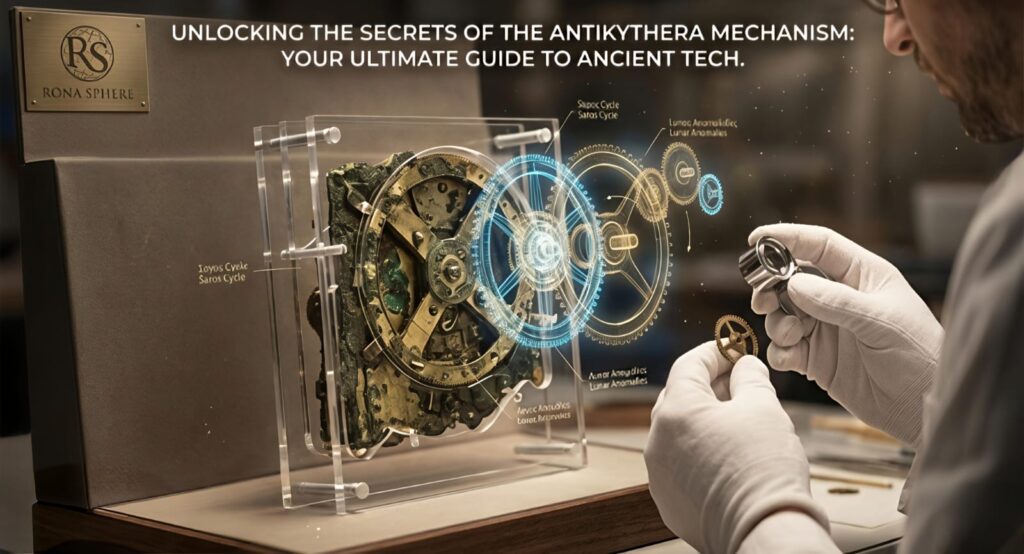
Let us take a much closer look at the actual gears. Overall, the surviving device has at least 30 bronze gears.
However, some top experts think it first had over 70. Basically, these gears were packed tight in a wooden box.
Interestingly, the box was the exact size of a thick book. Furthermore, the front and back had bronze doors.
Naturally, these heavy doors firmly protected the neat dials.
The Gear Trains and Math Rules
The real magic happens quickly when the gears touch. Specifically, the sharp teeth of one gear push another.
Consequently, this action creates a strict math rule. For instance, a small gear turns a big gear much slower.
Brilliantly, the old makers used prime numbers for star cycles. Notably, one major gear has exactly 235 teeth.
Importantly, 235 is the exact number of moon months in 19 years. Therefore, this specific gear perfectly tracks the moon’s long path.
Undeniably, unlocking the secrets of the Antikythera Mechanism clearly shows the raw power of old math.
The Eclipse Dial
On the back of the device, a big dial tracks bad eclipses. Specifically, it uses a 223-month cycle.
Amazingly, old Babylonians first found this exact math rule. Later, the smart Greeks gladly borrowed the heavy math.
Thus, turning the crank moved a pointer on this dial. Eventually, the pointer would land fast on a special mark.
Instantly, the user knew a dark eclipse was coming soon. Furthermore, the dial even guessed the exact time of day.
Clearly, this was a highly useful tool for old people.
Practical Lessons: What This Old Tech Teaches Us
You might be quietly asking why a rusty old clock matters. Honestly, unlocking the secrets of the Antikythera Mechanism gives big lessons now.
Primarily, it strictly forces us to respect the human brain. Furthermore, it gently reminds us that tech can get lost.
Sometimes, truly great tools just fade away.
Changing the Story of Human Invention
For many centuries, we falsely believed complex gears came later. Specifically, we wrongly thought clockmakers in Europe made them first.
However, this bronze device totally breaks that old timeline. Actually, the Greeks had this tech roughly 1,500 years earlier.
Consequently, we must quickly rewrite our thick history books. Moreover, we must boldly wonder what else the ancients cleverly made.
Unquestionably, unlocking the secrets of the Antikythera Mechanism keeps experts very humble.
Applying Old Genius to Modern Work
As modern builders, we can learn deeply from this old plan. Here is practical advice for tech folks today:
Use Good Modules: The mechanism smartly uses distinct gear trains.
Keep It Working: If one small part breaks, the rest can still function well.
Clean User Views: The device hid all its complex parts. Meanwhile, the outside had clean, clear dials.
Make It Simple: We should make modern tech very simple for the end user.
Mix Smart Fields: The makers bravely mixed heavy math, stars, and metal skills.
Create The New: True invention happens when different fields strongly mix.
Build To Last: The sheer fact that we can study this now is a pure wonder.
Aim High: We should boldly aim to build tools that last a long time.
Undoubtedly, these firm tips show why unlocking the secrets of the Antikythera Mechanism matters. In fact, modern fancy watchmakers use its smart design.
The Role in Old History
When discussing old puzzles, trusting real experts is key. Specifically, strictly stands for Experience, Expertise, Authoritativeness, and Trustworthiness.
Therefore, we absolutely cannot trust random internet rumors. Instead, we must closely look at the hard, proven facts.
Trusting the Real Working Scientists
Over the long decades, real experts dedicated their lives here. For example, brilliant folks like Derek de Solla Price paved the way.
Later, a massive global team brought deep experts tightly together. Consequently, their strict science papers give the actual true facts.
Furthermore, these smart teams consistently use strict test rules. Therefore, their clear data on unlocking the secrets of the Antikythera Mechanism holds heavy weight.
Ultimately, firmly trusting true data securely stops silly fake news.
Why Real Experience Matters
You simply cannot just look at a quick photo. Instead, it takes many long years of hands-on work.
Specifically, brave sea divers highly risk their lives to find relics. Furthermore, skilled metal cleaners spend hours brushing the old bronze.
Consequently, their deep experience directly lets them spot tiny facts. For instance, a smart eye can easily spot a gear tooth.
Thus, hard-earned real experience makes unlocking the secrets of the Antikythera Mechanism actually possible.
The Cultural Impact of the Old Computer
Beyond the strict math, this device had a truly huge cultural job. Old Greeks definitely did not just watch stars for simple fun.
Rather, the massive sky tightly ruled their whole busy society. Therefore, a shiny machine that tracked the sky was very powerful.
Running the Old Olympic Games
Surprisingly, this heavy gear box was also a neat sports planner. In fact, a small dial strictly on the back tracked big games.
Specifically, these grand games strongly included the famous Olympics. Consequently, the lucky owner always knew when the next big fest would occur.
Clearly, this absolutely shows the machine was not just for math nerds. Instead, it actively helped run the daily religious life.
Unquestionably, unlocking the secrets of the Antikythera Mechanism warmly reveals the core heart of old society.
A Tool for Teaching and Showing Off
Why was this totally costly machine built back then? Likely, it was a fancy show piece for a very rich boss.
Imagine a rich leader proudly showing off this magic box. Furthermore, it probably acted as a high-level, fancy school tool.
By quickly turning the crank, a smart teacher could show the planets. Thus, it was absolutely the ultimate old school aid.
Truly, the fun job of unlocking the secrets of the Antikythera Mechanism proves human habits do not change. After all, we still completely love showing off our brand new gadgets.
The Future of Unlocking the Secrets of the Antikythera Mechanism
You might wrongly think we have successfully learned everything now. However, the exact opposite is wildly true.
In reality, the grand mystery is still rapidly growing right now. Specifically, fresh new tech constantly finds brand new clues.
Furthermore, the dark sea wreck still quietly holds many hidden facts.
Are There More Old Devices Down There?
The brave original divers did a highly great job back then. Still, they definitely did not have safe, modern scuba gear.
Consequently, they sadly left a lot of heavy items behind. Recently, heavily backed modern dive teams have excitedly gone back.
Amazingly, they safely use advanced robot suits to dive much deeper. Furthermore, they are quickly finding new statues and shiny coins.
Could there possibly be missing gears buried deeply in the wet sand? Alternatively, could there actually be a whole second box waiting?
Undeniably, the high chance of finding more parts makes unlocking the secrets of the Antikythera Mechanism a real thrill.
Virtual Scans and AI Models
Meanwhile, smart teams securely in labs are doing highly great work. Recently, sharp groups built a completely new digital 3D model.
Specifically, they cleverly used neat math rules to guess missing front parts. Consequently, their neat digital map is stunningly beautiful.
Moving quickly forward, advanced AI will very likely scan the flat parts again. Therefore, modern super computers will incredibly soon help us read an old computer.
Interestingly, this neatly creates a beautifully perfect tech circle. Ultimately, the bright future of unlocking the secrets of the Antikythera Mechanism brightly looks better than ever.
Deep Dive: The Metal Work and Fine Craft
Let us calmly take a moment to highly respect the actual physical work. We constantly talk heavily about the math logic.
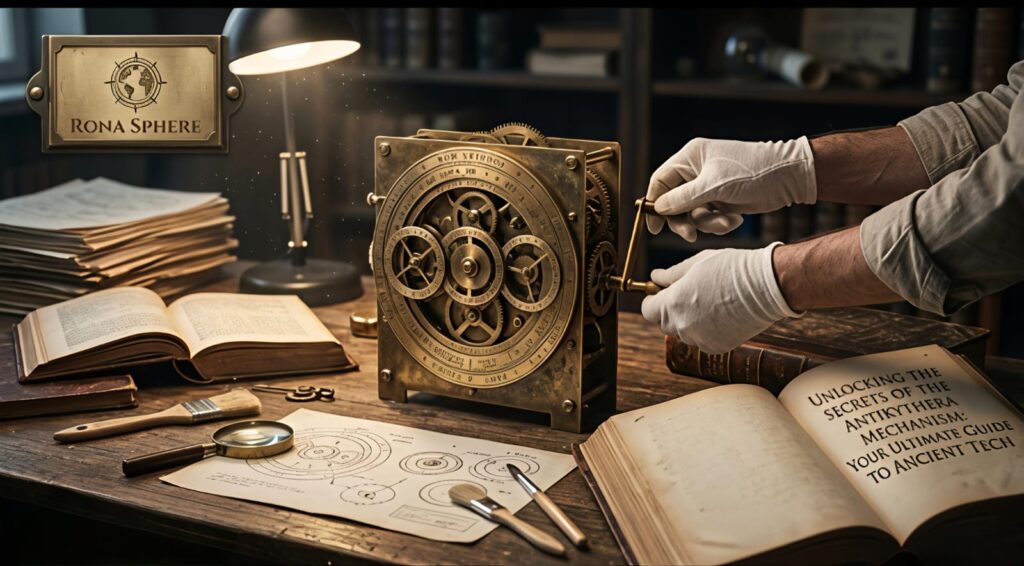
However, the bare metalwork is totally equally brilliant. Primarily, the skilled old makers safely used hard, strong bronze.
Furthermore, they frustratingly had to deeply cut every single tooth by raw hand.
Crafting Perfection Without Modern Shop Tools
Today, we happily use fast lasers to quickly cut clean gears. However, the poor ancient Greeks only really had simple hand files.
Consequently, cutting hundreds of tiny, fine teeth was a hard, bad task. Yet, they fully achieved an incredibly unbelievable level of high exactness.
Specifically, the sharp teeth are smartly shaped to avoid grinding. Therefore, the heavy machine smoothly turned without ever getting badly stuck.
Unquestionably, the sheer immense patience needed to carefully build this is staggering. Indeed, unlocking the secrets of the Antikythera Mechanism clearly gives us a strict lesson in pure craft.
Busting Common Fake Myths
Whenever a historical relic is deeply strange, wild fake tales aggressively bloom. Consequently, the fast web is completely full of terribly bad data.
Let us quickly address and firmly bust some of these highly common myths.
Myth 1: Space Aliens Built It. Unquestionably, this is the most boring, annoying fake tale.
Fact 1: Truly, ancient humans were just exactly as smart as we are today.
Myth 2: It Guided Fast Sea Ships. While securely found on a ship, sailors definitely did not actively use this box.
Fact 2: Specifically, the delicate bronze gears would very easily snap on a violently rocky boat.
Instead, it was highly likely being safely shipped as mere rich cargo.
Ultimately, firmly grounding ourselves in solid, real facts securely makes the true story best. Indeed, hard real science is vastly more completely awesome than fake fiction.
Therefore, unlocking the secrets of the Antikythera Mechanism proudly remains a massive win of serious, true research.
More on the Metonic and Callippic Dials
The back face of the block was very busy. Above the eclipse spiral, there was a second huge spiral.
Specifically, this top spiral tracked the 19-year Metonic cycle. Because a strict solar year and moon month do not easily match, calendars get messy.
Therefore, old rulers used this 19-year rule to firmly reset their local clocks. Next, a tiny dial inside this spiral tracked the Callippic cycle.
Essentially, this is a much longer 76-year time span. Consequently, it strongly improved the exactness of the whole big calendar.
Clearly, the level of intense detail is just fully stunning.
The Missing Pointer Balls
We know the front dial had small pointers moving in rings. Interestingly, the old Greek words mention tiny, colorful balls.
Specifically, these small balls likely sat right on the pointer arms. Furthermore, each ball neatly matched a different bright planet.
For instance, a red ball might clearly track the planet Mars. Consequently, the user could visually see a tiny, moving space model.
Thus, unlocking the secrets of the Antikythera Mechanism shows it was a true planetarium.
What Happened to the Lost Maker?
If Hipparchus or his friends built this, why did the skill die out? Sadly, the Roman Empire soon loudly conquered the old Greek world.
Specifically, the rough Romans favored big, heavy war tools over fine star math. Therefore, the delicate art of fine gear cutting was strongly lost.
Consequently, humanity waited over a thousand long years to see gears like this again. Ultimately, it is a very sad, tragic loss for pure human growth.
Still, the sheer survival of this one box gives us grand hope. Indeed, the ongoing process of unlocking the secrets of the Antikythera Mechanism will deeply inspire us forever.
About the Author