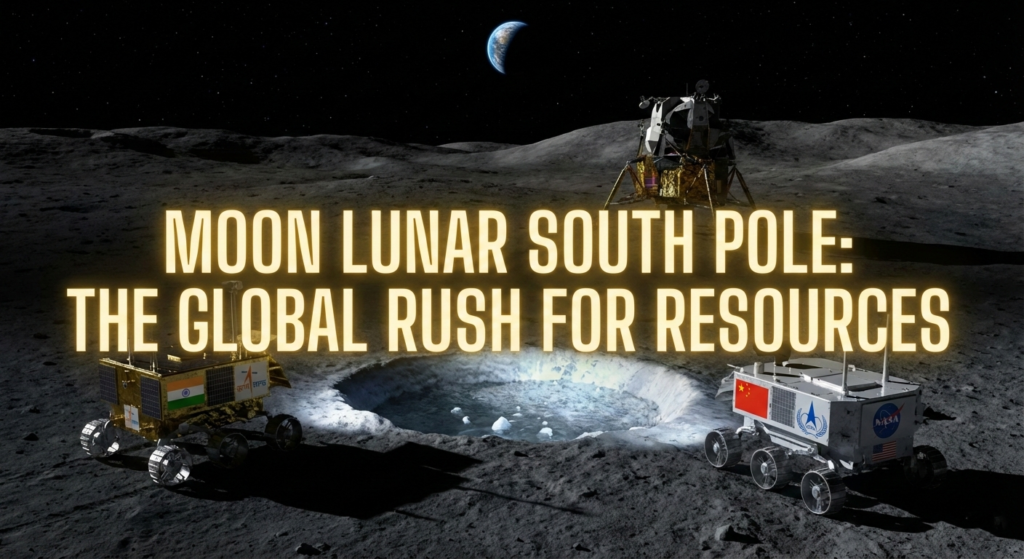
The moon is not just a light in the sky anymore. Instead, it is the new frontier for human life. Today is February 16, 2026, and the world is changing fast. We are currently in the middle of a huge contest. People call this contest The Next Space Race: Why India, China, and the US are Rushing to the Lunar South Pole.
But this is not like the old race in the 1960s. Back then, it was just about being first. Now, the goal is different. Specifically, countries want to live there. They want to mine the ground for riches. Therefore, the moon has become a place for business and survival. Because of this, the south pole is the most wanted spot in space.
Why the South Pole is a Treasure Map
Most of the moon is dry and hot. However, the south pole is very different. It has deep craters that never see the sun. Because of this, these spots are freezing cold. Scientists call them “cold traps.” Inside these dark holes, there is something very valuable: water ice.
The Power of Water
Actually, water is the key to everything in space. First, humans need it to drink. Second, we can turn it into air to breathe. Third, and most importantly, we can turn it into rocket fuel. Specifically, you can split water into hydrogen and oxygen. These are the two things you need to power a big rocket.
So, if you have water on the moon, you don’t have to bring it from Earth. Shipping water from Earth is very expensive. It costs thousands of dollars just to send one bottle. Consequently, finding water on the moon saves billions of dollars. This is why The Next Space Race: Why India, China, and the US are Rushing to the Lunar South Pole is so intense. Whoever finds the water first wins the “gas station” of the solar system.
Mountains of Light
But there is another reason to love the south pole. In fact, it has some mountains that almost always see the sun. These are called “peaks of eternal light.” On most of the moon, the sun goes away for two weeks. This makes it very hard to use solar panels.
Instead, at the south pole, you can get solar power almost all the time. Therefore, you have water in the shadows and power on the hills. This makes it the best place to build a house. Similarly, it is the best place to park a rover. Currently, every big space agency is looking for the best hill to claim.
The United States: The Artemis Plan
The US is working very hard right now. They have a big program called Artemis. The goal of Artemis is to put people back on the moon soon. Specifically, they want the first woman to walk on the lunar surface.
The Big Launch in 2026
Actually, right now is a very busy time for NASA. In just a few weeks, they will launch Artemis II. This is a massive mission for The Next Space Race: Why India, China, and the US are Rushing to the Lunar South Pole. Four astronauts will fly around the moon. They will test the ship to make sure it is safe for humans.
However, things are not always easy. Last week, engineers had to fix a small leak in the rocket. But they worked fast and fixed it. So, the mission is still a “go” for March. NASA is also working with private companies like SpaceX. In fact, Elon Musk’s Starship is a huge part of the plan. This giant rocket will land the astronauts right on the south pole.
Working with Friends
Furthermore, the US is not going alone. They have signed a deal with over 60 countries. They call this the Artemis Accords. Basically, it is a set of rules for being nice on the moon. For example, countries agree to help each other if someone gets hurt. But some people think these rules help the US more than others. Regardless, the US is moving fast to stay ahead.
China: The Steady Runner
In contrast to the US, China moves very quietly. But they are very consistent. They never miss a date. The China National Space Administration (CNSA) is a major player in The Next Space Race: Why India, China, and the US are Rushing to the Lunar South Pole.
The Jumping Robot
This year, China will do something amazing. In August 2026, they plan to launch Chang’e 7. This mission has many parts. It has a lander, a rover, and even a flying robot.
Actually, this flying robot is very cool. It is called a “hopper.” Instead of driving on wheels, it uses small rockets to jump. Specifically, it will jump into the dark craters to look for water. This is a very smart move. Rovers often get stuck in the dust. But a hopper can just fly over the rocks. Therefore, China might find the best water spots before anyone else.
Building a Moon Base
Also, China has a big dream for the 2030s. They want to build the International Lunar Research Station (ILRS). They are working with Russia and other countries to make this happen. Instead of just visiting, they want to stay. Consequently, they are testing how to make bricks out of moon dust right now. In fact, they have already sent a small brick-making machine to space.
India: The Smart Spender
India is the surprise hero of this story. For a long time, people did not think India could compete. But then, in 2023, they landed Chandrayaan-3 on the moon. It was a huge success. What’s more, they did it for very little money.
Recent Success in Feb 2026
Just this month, India did something else great. They finished a test called SpaDeX. This was a test where two ships found each other in space and connected. This is called docking. Why does this matter for The Next Space Race: Why India, China, and the US are Rushing to the Lunar South Pole?
Well, you need docking to bring moon rocks back to Earth. It also helps in building a space station. So, India has proven they have the skills. Currently, they are planning a new mission with Japan called LUPEX. This mission will use a big Japanese rover to dig deep for ice. Because India is so good at saving money, they are becoming a favorite partner for many countries.
The Dark Dangers of the South Pole
Going to the south pole is not like a trip to the beach. In fact, it is one of the hardest things humans have ever tried.
Extreme Cold
First, let’s talk about the temperature. In the dark craters, it is colder than anywhere on Earth. It can reach -230°C. At that temperature, regular batteries just stop working. Metals can also become brittle and snap like glass. Therefore, engineers have to use special heaters. Some of these heaters use tiny bits of nuclear material to stay warm.
Tricky Shadows
Second, the lighting is a nightmare. Because the sun is so low, the shadows are very long. This makes the ground look flat when it is actually a cliff. Consequently, rovers can “hallucinate” and drive off an edge. To fix this, the new rovers use lasers to see in the dark. These are called LiDAR. Specifically, they bounce light off the rocks to make a 3D map.
Dangerous Dust
Third, the moon dust is very mean. It is not like Earth dust. Earth dust is soft because of wind and water. Moon dust is sharp and jagged. Also, it has a static charge. This means it sticks to everything. It can ruin spacesuits and clog up engines. Because of this, scientists are making “invisible shields” using electricity to push the dust away.
The Prize: More Than Just Water
Why are we spending so much money on The Next Space Race: Why India, China, and the US are Rushing to the Lunar South Pole? It is not just about science. It is about the future of energy.
Helium-3: The Clean Fuel
Interestingly, the moon has something called Helium-3. This is a special kind of gas. On Earth, we almost have none of it. But on the moon, there is a lot. Specifically, it comes from the sun and sticks to the moon dust.
So, why do we want it? Well, Helium-3 can be used for nuclear fusion. This is a way to make power that is very clean. It does not create bad waste like regular nuclear plants. Some people say that one ship full of Helium-3 could power the whole world for a year. Therefore, whoever mines it first will be the richest country on Earth.
Rare Metals
Also, the moon has metals like gold, platinum, and lithium. We need these to make phones and electric cars. Currently, it is hard to find enough on Earth. But the moon is full of them. Consequently, the first moon mines will change the global economy forever.
How to Build a Moon House: A Simple Guide
If you want to live on the moon, you have to be smart. You cannot just bring a tent from Earth. Here is how India, China, and the US plan to do it.
1. Find a Good Spot
First, you need to be near water and light. Most likely, this will be on the rim of a crater like Shackleton. This crater is at the exact south pole. Its rim is almost always in the sun. But its floor is always in the dark. This is the perfect “real estate” for The Next Space Race: Why India, China, and the US are Rushing to the Lunar South Pole.
2. Use What You Have
Second, you have to use the moon’s dirt. This is called In-Situ Resource Utilization (ISRU). Instead of bringing bricks, we will use 3D printers. These printers will take the moon dust and melt it into walls. Specifically, the walls need to be very thick. This protects the astronauts from space radiation.
3. Grow Your Own Food
Third, you need to eat. Shipping pizza to the moon is not an option. So, we have to grow plants. Actually, last year, scientists grew plants in real moon dirt. They found that with a little help, things like lettuce and tomatoes can grow there. In fact, these plants will also help make fresh air for the base.
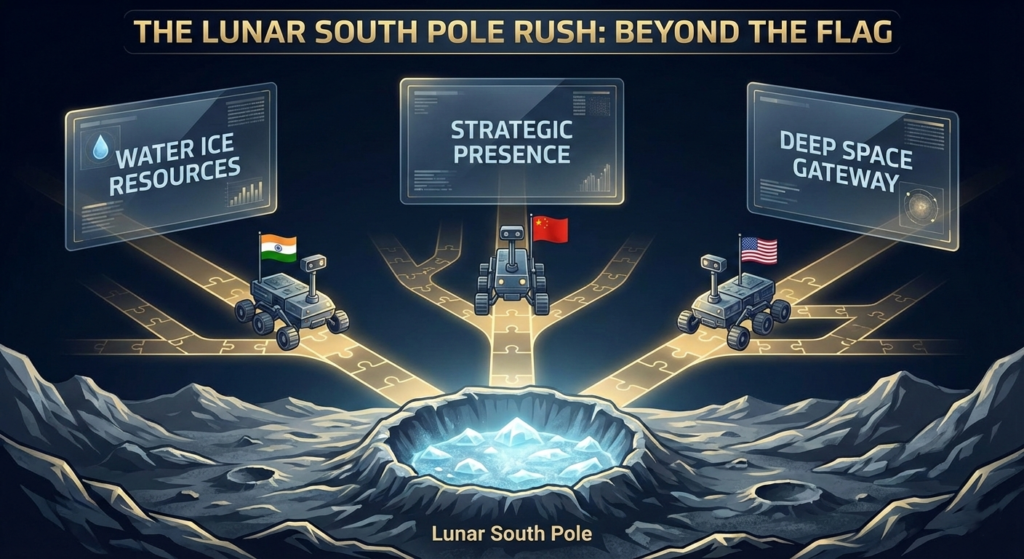
Who Owns the Moon?
This is a very big question. Right now, the answer is “no one.” In 1967, the world signed the Outer Space Treaty. It says that no country can own the moon. But there is a problem. The treaty does not say anything about mining.
The New Rules
Currently, the US is pushing for “Safety Zones.” They say that if you build a base, you should have a small area around it that is yours. This keeps people from crashing into each other. But China and Russia do not like this idea. They think it is just a way for the US to take land.
Consequently, there is a lot of tension. Will there be a “Moon War”? Hopefully not. But countries are already being very protective of their spots. This is a key part of The Next Space Race: Why India, China, and the US are Rushing to the Lunar South Pole. It is a race to set the rules.
Life on the Moon: A Day in 2035
Let’s imagine it is ten years from now. You are an astronaut at the south pole. What is your day like?
Specifically, you wake up in a room buried under the dust. This keeps you safe from the sun’s rays. First, you check the water machines. These machines are melting ice from the dark craters. Next, you check the solar farm on the hill. It is sending power down to your home.
Then, you go outside. But you have to be careful. The dust is everywhere. You get into a pressurized rover. It looks like a small van with big wheels. You drive to the mining site. Here, robots are digging for Helium-3. Finally, you come back and eat a salad grown in the lunar greenhouse.
Actually, this sounds like a movie. But because of The Next Space Race: Why India, China, and the US are Rushing to the Lunar South Pole, it is becoming real.
The Gateway to Mars
Why stop at the moon? Actually, the moon is just a practice run. It is much easier to leave the moon than to leave Earth. This is because the moon has less gravity.
So, we can build a giant ship on the moon. Then, we can launch it to Mars using fuel made from lunar water. This makes the trip to Mars much cheaper and faster. Therefore, the south pole is the “front door” to the rest of the solar system. If we can master living on the moon, we can live anywhere.
The Environmental Question
But should we be doing this? Some people are worried. They say that the moon is a beautiful, natural place. If we start mining it, we might ruin it. Specifically, the dust we kick up could travel all the way around the moon. This could hide the stars for scientists on Earth.
Also, the water ice is a record of history. It has been there for billions of years. If we drink it all, we lose that history forever. Consequently, some people want to make “Moon Parks” where no one can mine. This is a big debate in The Next Space Race: Why India, China, and the US are Rushing to the Lunar South Pole. We have to find a balance between using the moon and saving it.
Common Questions About the Race
Is it really a “race”?
Yes. Specifically, it is a race for resources. Whoever gets the best water spots will have the most power.
Why is India so important?
India is important because they are very efficient. They can do great things with less money. Also, they are a key partner for many other countries.
Will regular people go to the moon?
Eventually, yes. In fact, companies like Blue Origin want to build hotels in space. But for now, it is only for highly trained astronauts.
When will the first base be ready?
Most likely, we will see the first small bases by 2030 or 2032. However, it depends on how well the 2026 missions go.
The Importance of 2026
So, why is this year so special? Because 2026 is the year of testing.
February: India proves they can dock ships (SpaDeX).
March: The US launches Artemis II to fly humans around the moon.
August: China launches the hopper to find water (Chang’e 7).
These three events will decide the future. If they all succeed, the south pole will be very crowded soon. But if they fail, it might slow things down. Regardless, the momentum is too big to stop now. The Next Space Race: Why India, China, and the US are Rushing to the Lunar South Pole is the biggest story of our time.
What We Need to Watch For
Next, we should look at how these countries talk to each other. Right now, there is not much sharing. The US and China do not work together at all because of laws on Earth.
However, India works with almost everyone. They are the “bridge.” This makes India very powerful in a different way. Instead of just having technology, they have friends. In the future, this might be the most important thing.
Also, watch the private companies. Specifically, watch SpaceX and Blue Origin. They are building the “trucks” for this race. Without them, NASA cannot land on the moon. Therefore, the race is not just between countries. It is also between big corporations.
Final Thoughts: The New Era
Ultimately, we are entering a new age of discovery. It is like the time when people first sailed across the ocean. It is scary, but it is also very exciting.
The Next Space Race: Why India, China, and the US are Rushing to the Lunar South Pole is about expanding our home. We are learning how to live in a place that wants to kill us. But by doing that, we are becoming a stronger species. We are solving problems like energy and hunger in new ways.
In contrast to the past, this time we are going to stay. The moon is no longer a destination. It is a beginning. So, keep your eyes on the south pole. The first “Moon City” might be built in your lifetime.
Actually, the next few years will be full of surprises. Every month, we learn something new about the moon. Whether it is a new crater or a better way to grow plants, the progress is fast. Therefore, the world you see today will look very different in 2030.
Because of India, China, and the US, the moon is getting closer every day. Specifically, the south pole is the heart of this new world. It is where the water is, where the power is, and where our future begins.
Practical Tips for Following the Space Race
If you love space, here is how you can keep up.
Watch NASA TV: They always show the big launches live.
Follow ISRO on Social Media: They give great updates on their missions.
Read Space News Sites: They explain the science in easy ways.
Look at the Moon: Use a small telescope to find the south pole. You can see the craters where these ships will land!
Finally, remember that this race belongs to all of us. Even if you are not an astronaut, you are part of a generation that is going back to the moon. This is a historic moment. So, enjoy the journey.
Summary of the Big Three
| Country | Strategy | Major Mission in 2026 | Goal |
| USA | Private/Public Mix | Artemis II (Humans) | Return humans to the surface |
| China | State-Led Precision | Chang’e 7 (Hopper) | Find water and build a base |
| India | Frugal Engineering | SpaDeX (Docking) | Prove skills for sample return |
Consequently, the leaderboard changes every day. But one thing is for sure: the south pole is the ultimate prize.
The Next Space Race: Why India, China, and the US are Rushing to the Lunar South Pole is just getting started. It is a story of robots, humans, and a cold, dark place full of light.
Looking Ahead to 2027 and 2028
Once the 2026 missions are done, what happens next?
Actually, 2027 will be a year of building. Companies will start sending small “scout” missions to the south pole. They will bring tools and supplies. Then, in 2028, we might see the first long-term missions. These will stay for weeks instead of days.
Specifically, the US wants to land its first crew on the south pole in 2028. This will be the Artemis III mission. At the same time, India and Japan will be launching LUPEX. So, by 2028, the south pole will have several different missions working at the same time.
Therefore, we need to start thinking about communication. How will all these rovers talk to each other? Will there be a “Moon Internet”? Actually, Nokia is already working on putting a 4G network on the moon! Consequently, astronauts will be able to send videos and texts back to Earth just like we do here.
This shows how fast things are moving. From water ice to 4G networks, the moon is becoming more like Earth every day. This is the true meaning of The Next Space Race: Why India, China, and the US are Rushing to the Lunar South Pole. It is the “Earth-ization” of our neighbor.
Conclusion
In summary, the rush to the moon is real and it is happening now. India, China, and the US are all leading the way in their own style. Whether it is through big rockets, jumping robots, or smart spending, the goal is the same: the south pole.
The water, the light, and the Helium-3 are waiting. And as we head into the rest of 2026, the world will be watching every launch and every landing. The next space race is not just a game. It is the start of our future in the stars.
About the Author