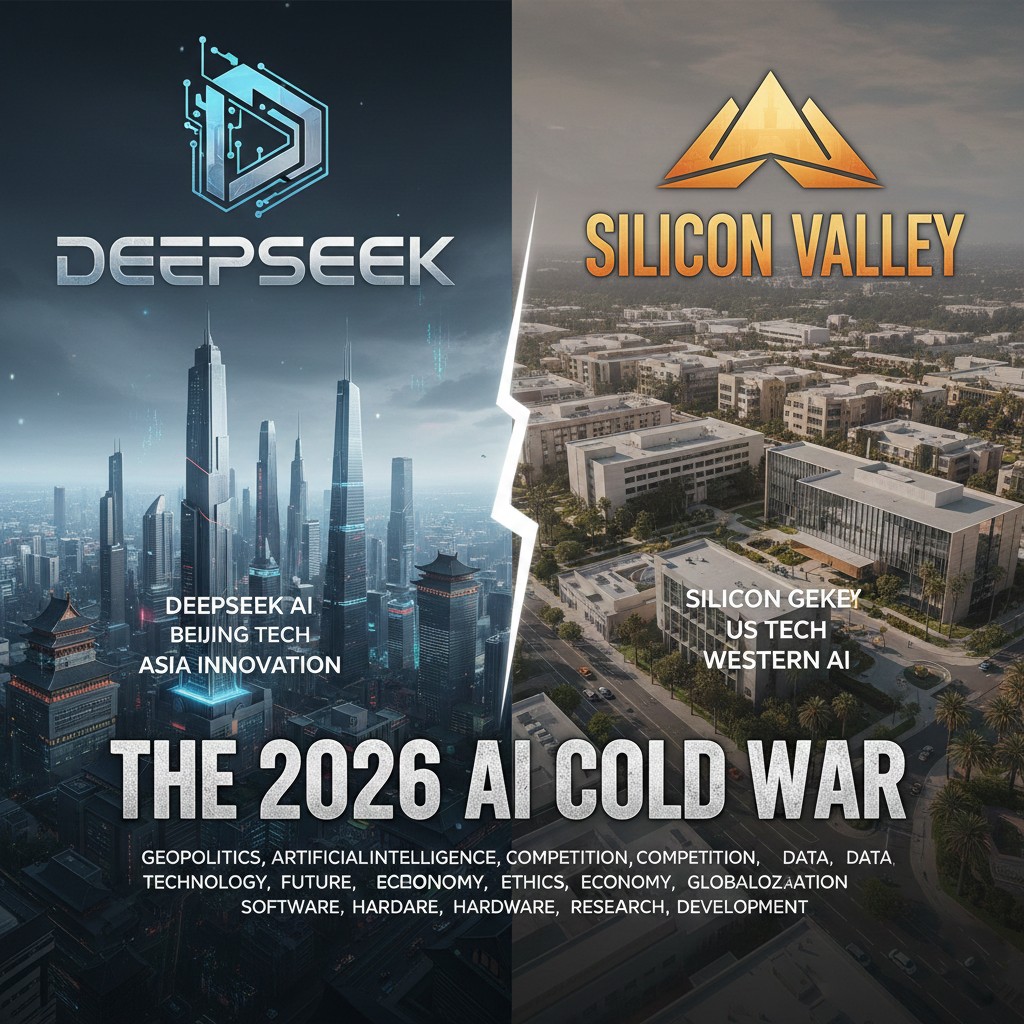
The global tech landscape changed forever in early 2026. Specifically, the old rules of the industry no longer apply. For years, experts believed that more money equaled more intelligence. They thought that owning more chips meant winning the future. However, a lean team from Hangzhou proved them wrong. Consequently, we are now
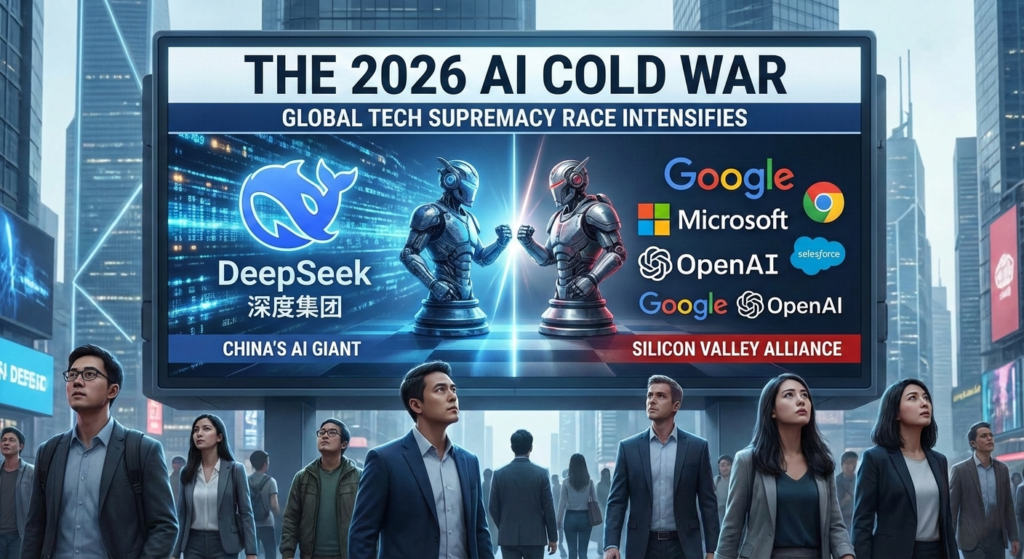
Currently, we see a massive shift in how the world builds software. On one side, Silicon Valley spends billions on power plants. On the other side, DeepSeek uses elegant math to do more with less. Therefore, every company must now rethink its strategy. This deep dive explores the front lines of this historic struggle.
The Day the Compute Moat Collapsed
To start, let’s look at the “Compute Moat.” For a long time, US giants held a monopoly on power. They owned the fastest GPUs and the largest data centers. Indeed, they used this scale to block competitors. But the DeepSeek vs. Silicon Valley: The 2026 AI Cold War started when that moat dried up.
The Rise of the Lean Model
DeepSeek released its V3 model and shocked the world. Surprisingly, it performed like a $1 billion model but only cost $6 million to train. This event truly signaled the start of the war. Suddenly, the “money wall” was gone.
Furthermore, this change allowed smaller nations to join the race. If you do not need a billion dollars, anyone can play. Consequently, the power centers are shifting. Silicon Valley is no longer the only game in town.
Technical Warfare: The Magic of MLA and MoE
Actually, the secret to DeepSeek’s success is not more hardware. Instead, it is better architecture. Specifically, two technologies define this war: Multi-head Latent Attention (MLA) and Mixture-of-Experts (MoE).
How MLA Saves Your Memory
First, consider how most AI models remember facts. Usually, they need massive memory to store a conversation. This is very expensive. However, DeepSeek invented MLA. This technology compresses that data by 90%.
As a result, the model runs faster and costs less. In the DeepSeek vs. Silicon Valley: The 2026 AI Cold War, MLA is like a super-efficient engine. While Silicon Valley builds bigger gas tanks, DeepSeek builds a car that barely needs fuel. Thus, efficiency is winning over raw power.
Mixture-of-Experts: The Specialist Strategy
Second, DeepSeek uses a “sparse” MoE design. Imagine a hospital with 1,000 doctors. If you have a broken leg, you only need the bone doctor. You do not need the heart doctor to help.
In contrast, Silicon Valley models often wake up all 1,000 doctors for every query. This wastes a huge amount of energy. Therefore, DeepSeek’s sparse design is much greener. This technical edge is a primary pillar of the conflict.
Geopolitical Chess: Sanctions and the Export War
Notably, the US government tried to slow China down. They banned the sale of the newest Nvidia chips. Yet, this plan actually helped DeepSeek. Because they had fewer chips, they had to be more creative.
The Backfire Effect
Specifically, Chinese engineers learned how to get 10x more power out of old hardware. This is a fascinating part of the DeepSeek vs. Silicon Valley: The 2026 AI Cold War. While the US focused on building walls, China built better tools to climb them.
Moreover, this has created a new global divide. Many countries now prefer Chinese models because they are “sanction-proof.” If a country uses an American API, the US can turn it off anytime. Consequently, the war is about who controls the digital “on-off” switch.
The Token Price Crash: Intelligence Becomes Free
Actually, the most visible part of this war is the price of a token. In 2024, high-end AI was for the rich. But by 2026, prices have dropped by 99%.
The Dollar-a-Million Revolution
Currently, DeepSeek offers tokens for pennies. In response, Silicon Valley giants had to cut their prices too. But their models are still more expensive to run. Therefore, they are losing money on every query.
Indeed, this is a “war of attrition.” DeepSeek is waiting for Silicon Valley to run out of cash. Meanwhile, developers are switching sides. This shift is a core part of the DeepSeek vs. Silicon Valley: The 2026 AI Cold War.
Silicon Valley’s Counter-Strike: The $100 Billion Stargate
Of course, California is fighting back. Microsoft and OpenAI are building “Stargate.” This is the largest supercomputer ever made. It is their final stand in the war.
Can Size Win?
Specifically, Stargate is a bet on “Scaling Laws.” They believe that bigger models will become smarter than humans. However, many experts now doubt this. They see that DeepSeek is catching up without a $100 billion machine.
Furthermore, Stargate needs its own nuclear power plant. This shows the desperation of the American side. In the DeepSeek vs. Silicon Valley: The 2026 AI Cold War, the US is choosing “Giant AI” while China chooses “Smart AI.”
Cultural Shifts: 996 vs. Founder Mode
Actually, the war is also about how people work. In China, the “996” culture is the standard. This means employees work 12 hours a day, six days a week.
The Return of the Hardcore
Meanwhile, Silicon Valley is moving toward “Founder Mode.” CEOs are firing middle managers to speed things up. Notably, they are trying to match the speed of the Hangzhou team.
As a result, the tech world is becoming much more intense. If you want to survive the DeepSeek vs. Silicon Valley: The 2026 AI Cold War, you have to work faster. There is no room for slow companies in 2026.
The Reasoning Revolution: DeepSeek-R1 and Beyond
Specifically, 2026 is the year of “Reasoning Models.” In the past, AI just guessed the next word. But now, it actually “thinks.” This is a major front in the struggle.
Thinking in Public
DeepSeek-R1 allows you to see the model’s “Chain of Thought.” You can watch it solve a math problem step-by-step. Interestingly, it often corrects its own mistakes.
In contrast, Silicon Valley models are often hidden. They give you an answer but don’t show the work. Consequently, many researchers prefer DeepSeek. They want to see how the “brain” works. This transparency is winning fans in the DeepSeek vs. Silicon Valley: The 2026 AI Cold War.
The Energy Front: The War for Electricity
By now, we all know that AI eats power. In fact, electricity is now more valuable than chips. This is where the war meets the real world.
The Power Grid Crisis
Specifically, the US power grid is failing. It cannot handle the massive data centers in Virginia and Iowa. On the other hand, China is building solar and nuclear power at record speed.
Thus, the DeepSeek vs. Silicon Valley: The 2026 AI Cold War might be decided by batteries. If you can’t plug in your computer, your AI doesn’t matter. Indeed, China’s lead in green energy is a huge advantage.
Industry Use Case: Healthcare in 2026
Let’s look at a real-world example. In this war, hospitals are the big winners. Why? Because they can now afford to run their own AI.
Local AI for Patient Privacy
Actually, doctors do not want to send patient data to a cloud. They fear for privacy. But because DeepSeek is “open weights,” they can run it on a local server.
As a result, hospitals are building their own “Medical AI.” They use DeepSeek as the base and add their own data. Therefore, the DeepSeek vs. Silicon Valley: The 2026 AI Cold War is making healthcare private and cheap.

Industry Use Case: The Future of Coding
Furthermore, software engineering has changed. Today, a single coder can do the work of 50 people. Specifically, they use DeepSeek’s coding models because they are ultra-fast.
The End of the Junior Developer?
Unfortunately, this is hurting entry-level jobs. If an AI writes code for $0.01, why hire an intern? This is a dark side of the DeepSeek vs. Silicon Valley: The 2026 AI Cold War.
Nevertheless, it allows for amazing creativity. One person can now build a whole social network in a weekend. Clearly, the war is the ultimate power-up for the solo founder.
The Open Weights vs. Closed Source Debate
Actually, this is a philosophical war. Silicon Valley wants a “Black Box” world. They want to control the intelligence. But DeepSeek believes in “Open Weights.”
Why Openness Wins
Specifically, when you open the weights, the whole world helps you. Millions of developers are currently improving DeepSeek for free. In contrast, OpenAI has to pay for every developer.
Consequently, the DeepSeek vs. Silicon Valley: The 2026 AI Cold War is a test of two systems. One is a closed empire. The other is a global community. History shows that open systems usually win.
Financial Impact: The AI Bubble or the AI Boom?
Notably, investors are nervous. They have poured trillions into US tech. But if DeepSeek can do the same for 1% of the cost, where is the profit? This question is at the heart of the conflict.
The Price War’s Victim
First, many AI startups are going bust. They cannot compete with DeepSeek’s prices. Second, even big tech firms are seeing their margins shrink.
Thus, the DeepSeek vs. Silicon Valley: The 2026 AI Cold War is deflating the AI bubble. Only the most efficient companies will survive. This is a healthy but painful shift.
Practical Strategy: How Your Business Can Survive
If you are a CEO, you need a plan. Do not just pick one side. Instead, be smart and use both.
The Hybrid Model
Specifically, you should use DeepSeek for 90% of your work. It is cheap and fast. However, use Silicon Valley models for high-stakes creative work. This “multi-cloud” approach is the best way to stay safe.
Furthermore, you must own your own data. In the DeepSeek vs. Silicon Valley: The 2026 AI Cold War, the models are a commodity. Your data is the only thing that is truly yours. Therefore, protect your data like it is gold.
The “Sovereign AI” Trend in 2026
Actually, countries like India and France are now building their own models. They use DeepSeek as a starting point. This is a major trend in the struggle.
National Intelligence
Notably, no country wants to be a “digital colony.” They want an AI that knows their laws. Consequently, they are using open weights to build “Sovereign AI.”
Beyond that, this makes the world more stable. If one side turns off the internet, the other side still has its own AI. Thus, the war is actually helping world peace by spreading power around.
15. The Role of Agentic AI
Specifically, we are now in the age of “Agents.” These are AI programs that can act. They don’t just talk. This is the new front in the DeepSeek vs. Silicon Valley: The 2026 AI Cold War.
Who Builds the Best Worker?
DeepSeek agents are excellent at logic. Silicon Valley agents are better at talking to humans. Currently, the race is to build the best “AI Employee.”
Imagine an agent that can handle your taxes and your calendar. Clearly, this is the goal of the war. The winner will control the personal lives of billions.
The Hardware Shift: Beyond the GPU
Interestingly, we are seeing new kinds of chips. While Nvidia is still king, new players are arriving. This shift is a key part of the struggle.
The Rise of LPUs
Specifically, companies are building “Language Processing Units.” These chips are designed only for AI text. Consequently, they are much faster than general GPUs.
In the DeepSeek vs. Silicon Valley: The 2026 AI Cold War, the side with custom chips will have the lowest costs. Thus, the war is moving from the lab to the factory.
The Privacy Paradox in 2026
Actually, privacy has become a huge selling point. Silicon Valley models are often “always listening.” They want your data to improve. But in this war, privacy is a weapon.
Air-Gapped Intelligence
Because you can run DeepSeek on your own hardware, you can keep it offline. Specifically, this is a dream for banks.
Therefore, they are choosing Chinese-designed models for security. It sounds strange, but “offline” AI is the most secure AI. This irony is a highlight of the DeepSeek vs. Silicon Valley: The 2026 AI Cold War.
Education and the Global South
Notably, the war is helping students in poor countries. Because AI is now cheap, every child can have a tutor.
Closing the Gap
Specifically, a student in Nigeria can use DeepSeek-R1 for almost nothing. They get the same help as a student at Stanford. Thus, the DeepSeek vs. Silicon Valley: The 2026 AI Cold War is the greatest tool for equality.
Furthermore, this is creating a massive new pool of talent. Millions are learning to code. Consequently, the next big tech company might come from Lagos.
The Ethical Divide: Safety vs. Utility
Finally, we must talk about ethics. Silicon Valley models are very “polite.” They have many safety layers. But sometimes, they refuse to answer helpful questions.
The “Unfiltered” Logic
In contrast, DeepSeek models are more practical. They focus on getting the job done. This difference is a major talking point in the DeepSeek vs. Silicon Valley: The 2026 AI Cold War.
Actually, many users are tired of “woke” AI. They want an AI that just gives the facts. Therefore, DeepSeek is winning users who value truth over politeness.
Conclusion: The Winner is… You?
In conclusion, the DeepSeek vs. Silicon Valley: The 2026 AI Cold War has no single winner. But the user is winning. We now have smarter and cheaper AI than we ever imagined.
Ultimately, Silicon Valley taught us scale. DeepSeek taught us efficiency. Together, they pushed the boundaries. Indeed, this war is the engine of the new digital age.
Specifically, we should be thankful for the competition. Without DeepSeek, AI would still be a toy for the elite. Because of this war, intelligence is now a human right. Thus, let the race continue.
Comparison Table: DeepSeek vs. Silicon Valley
| Feature | Silicon Valley (2026) | DeepSeek (2026) |
| Philosophy | Brute Force & Scale | Algorithmic Efficiency |
| Business Model | Closed API | Open Weights |
| Training Cost | $100M – $1B+ | $5M – $50M |
| Key Strength | Creative & Visuals | Coding, Math & Logic |
| Power Source | Huge Nuclear Plants | Optimized Sparse Design |
FAQ: DeepSeek vs. Silicon Valley: The 2026 AI Cold War
Q1: Is DeepSeek’s code better?
Actually, yes. Their MLA and MoE designs are the most efficient. They prove that smart math beats a big budget.
Q2: Will the US ban DeepSeek?
Notably, it is hard to ban “weights” on the internet. Even if they ban the site, you can run it locally. This is the power of open source.
Q3: Which AI should I use?
Specifically, use DeepSeek for logic. Use Silicon Valley for creative work.
About the Author