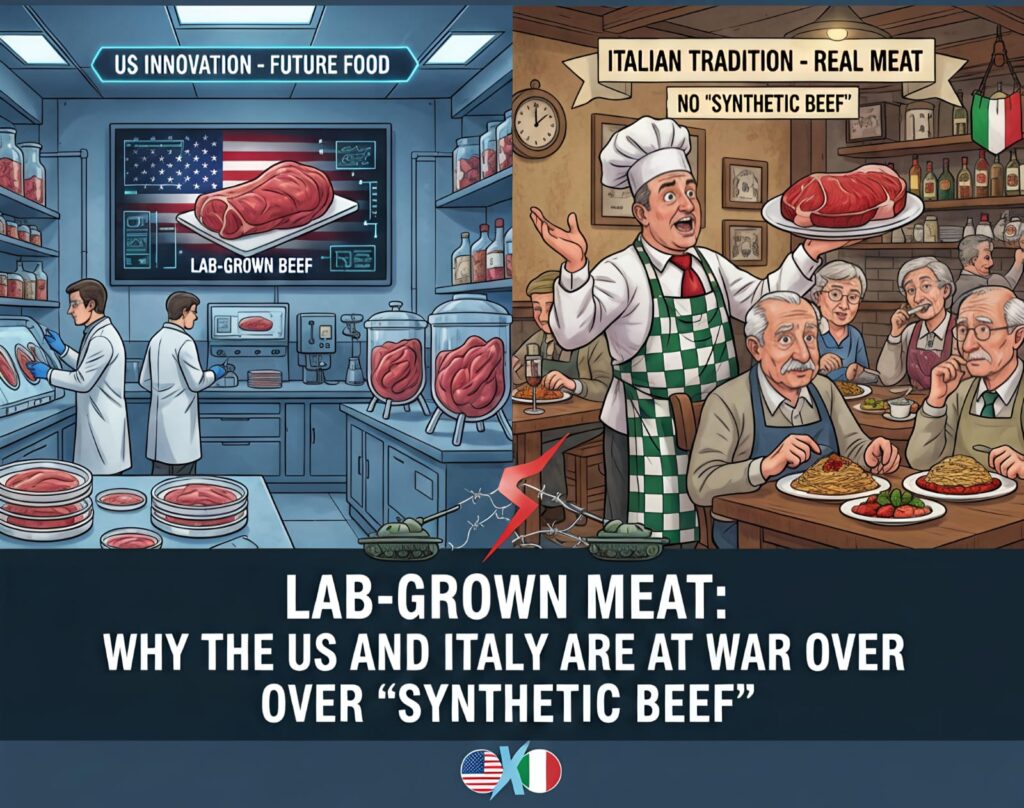
The modern dinner plate has transformed into a high-stakes geopolitical battlefield. While Silicon Valley investors pour billions into shimmering stainless steel bioreactors, the rolling hills of Tuscany echo with a fierce, ancestral resistance. This isn’t merely a disagreement about food technology or agricultural subsidies; it is a fundamental clash of civilizations. Consequently, the rise of lab-grown meat has sparked a literal “food war” between the United States and Italy over the future and legitimacy of synthetic beef.
The Great Divide: Innovation vs. Tradition
To understand this conflict, we must first examine how these two nations perceive the concept of progress. The United States generally views food through the lens of innovation, efficiency, and venture capital. In contrast, Italy views food as the very soul of its national identity and cultural heritage. Furthermore, the term synthetic beef itself has become a weaponized phrase used to sway public opinion.
In Washington D.C., proponents often use the term “cultivated protein” to make the product sound natural and scientifically advanced. Meanwhile, in Rome, politicians and farmers use the phrase synthetic beef to evoke images of cold, sterile laboratories and artificial chemicals. This linguistic divide reflects a much deeper chasm in values. Because the US prizes the “disruption” of old industries, lab-grown meat is seen as an inevitable evolution. Conversely, because Italy prizes the “preservation” of tradition, it views synthetic beef as an existential threat.
Why the US is Betting Big on Lab-Grown Meat
The American approach to lab-grown meat focuses heavily on sustainability, scalability, and market disruption. Because the global population continues to soar toward 10 billion, the US Department of Agriculture (USDA) and the FDA have already cleared the path for commercial sale.
Environmental Impact: Traditional cattle ranching requires vast amounts of land and water. Proponents argue that synthetic beef could reduce land use by over 90%.
Ethical Concerns: Cultivating lab-grown meat eliminates the need for large-scale animal slaughter, appealing to a growing demographic of ethically conscious consumers.
Capital Investment: Major American tech moguls and venture capital firms see lab-grown meat as the “Tesla of Food,” a high-growth sector capable of generating trillions in returns.
Food Security: By producing protein in controlled indoor environments, the US hopes to insulate its food supply from climate change and droughts.
Italy’s Hardline Stance Against Synthetic Beef
In a move that shocked the European Union, the Italian parliament passed a comprehensive ban on synthetic beef in late 2023. This law prohibits the production, sale, or import of food derived from cell cultures.
Cultural Protection: Italy fears that lab-grown meat will destroy the Mediterranean diet, which is recognized by UNESCO as an intangible cultural heritage.
Economic Survival: Small-scale farmers argue that synthetic beef threatens the livelihood of traditional ranchers who produce world-renowned products like Chianina beef.
Health Uncertainty: Italian officials claim we lack long-term data on the biological effects of consuming cells grown via accelerated chemical signaling.
Sovereignty: For Italy, defending the plate is synonymous with defending the nation’s borders against “food imperialism” led by giant tech corporations.
The Science of Synthetic Beef: How It’s Actually Made
Transitioning from a farm to a lab requires a complex biological process that sounds like science fiction. Initially, scientists take a small biopsy of stem cells from a living cow, often using a local anesthetic so the animal remains unharmed. Consequently, these cells go into a bioreactor—a large stainless steel tank filled with a nutrient-rich “soup” known as culture media.
The Bioreactor Process in Detail
Cell Selection: Scientists choose “immortalized” cells or pluripotent stem cells that can multiply rapidly without dying off.
Feeding the Cells: The “broth” contains amino acids, sugars, and vitamins. Historically, this required fetal bovine serum, but modern lab-grown meat companies are moving toward plant-based growth media to remain ethical.
Structuring and Scaffolding: To create the texture of synthetic beef, researchers use “scaffolds” made of collagen or plant-based fibers. This helps the cells grow into organized muscle fibers rather than a shapeless mush.
Harvesting: Once the cells have reached sufficient density, they are harvested, pressed together, and prepared for culinary use.
Furthermore, this process allows for the creation of lab-grown meat that is molecularly identical to traditional meat at a cellular level. However, critics in Italy argue that the lack of bone, natural fat distribution, and the absence of a cow’s complex endocrine system makes synthetic beef a pale, hollow imitation of the real thing.
The Economic Impact: A Trillion-Dollar Global War
Money often dictates the direction of public policy, and the stakes here are astronomical. The United States recognizes that the global meat market is worth over $1.4 trillion. Therefore, capturing even a small percentage of that market with lab-grown meat represents a massive economic opportunity for American exports.
Conversely, Italy’s economy relies heavily on “Made in Italy” food exports, which contribute billions to its GDP. If synthetic beef becomes the global standard, famous Italian culinary exports could lose their prestige and market share. Consequently, Italy is fighting to ensure that the definition of “meat” remains legally tied to an animal that lived on a farm, not a cell in a vat.
Comparison Table: US vs. Italy Perspectives
| Feature | United States Position | Italy’s Position |
| Primary Goal | Market Innovation & ESG Goals | Cultural Preservation & Health |
| Legal Status | Approved for Sale (FDA/USDA) | Strictly Banned (Law No. 172/2023) |
| Terminology | Cultivated/Cell-Based Meat | Synthetic Beef / Artificial Food |
| Economic Driver | Venture Capital & Tech Giants | Family Farms & Heritage Brands |
| Environmental View | Solution to Carbon Emissions | Threat to Biodiversity & Landscapes |
Public Perception: The Battle for the Consumer’s Heart
Consumer psychology plays a massive role in this war. In the US, younger generations—Gen Z and Millennials—are often willing to try lab-grown meat if it helps the planet. They see synthetic beef as a rational, tech-forward solution to climate change and animal cruelty. To them, the “gross factor” of a lab is outweighed by the “gross factor” of a slaughterhouse.
In contrast, Italian consumers generally hold a deep-seated skepticism toward ultra-processed foods. Furthermore, the Italian government has successfully framed synthetic beef as an “elite” product that disconnects humans from nature. Because food is so central to Italian social life—think of the Sunday family dinner—the idea of eating something grown in a sterile vat feels deeply unnatural and even offensive to many.
The “Frankenfood” Argument
Opponents of lab-grown meat often use the term “Frankenfood” to describe synthetic beef. They argue that:
The growth factors and hormones used to stimulate cell division might have unforeseen long-term health side effects.
The high energy consumption required to keep bioreactors at a constant temperature might offset any environmental benefits.
Large corporations will eventually monopolize the global food supply, leaving local farmers and rural communities in the dust.
The “bloodless” nature of synthetic beef removes the sacred connection between the land, the animal, and the eater.
Environmental Reality Check: Is it Actually Greener?
Proponents of lab-grown meat frequently claim it is the only way to save the Earth from the “methane bomb” of cattle ranching. They point out that traditional livestock contributes significantly to greenhouse gas emissions. However, the environmental reality of synthetic beef is more nuanced than a marketing brochure might suggest.
Research from institutions like UC Davis suggests that the pharmaceutical-grade purification processes required to produce lab-grown meat at scale require immense amounts of energy. Consequently, unless these massive factories run on 100% renewable energy, the carbon footprint of synthetic beef might actually be higher than traditional beef in the short term. Furthermore, the waste products from the cell-culture process, including spent media and chemical cleaners, must be managed carefully to avoid biological contamination. Italy uses these arguments to suggest that lab-grown meat is “greenwashing” at its finest.
The Legal Battle: Can Italy Really Ban a Future Industry?
Italy’s ban on synthetic beef has created a significant legal headache for the European Commission in Brussels. Because the EU operates as a single market, one country generally cannot ban a product that has been deemed safe by The European Food Safety Authority (EFSA).
Therefore, Italy is currently walking a tightrope. If the EFSA eventually rules that lab-grown meat is safe for human consumption, Italy may face heavy fines or trade sanctions from the EU. Nevertheless, the Italian government remains defiant. They argue that “precautionary principles” allow them to protect their citizens from the perceived risks of synthetic beef even if the central EU government disagrees. This creates a fascinating legal precedent: Does a nation have the right to choose its own biological future?
Key Legal Conflicts to Watch:
Trade Barriers: Can a nation block a product based on “cultural” and “moral” grounds rather than just safety?
Labeling Laws: Should lab-grown meat even be allowed to use the word “beef” or “steak”? The US and Italy are both fighting over these definitions.
Intellectual Property: Who owns the DNA sequences used to create synthetic beef? If a company grows meat from a Wagyu cow’s cells, does the original breeder get a royalty?
Storytelling: A Tale of Two Kitchens
To truly grasp why this war is so heated, we must look at the human element.
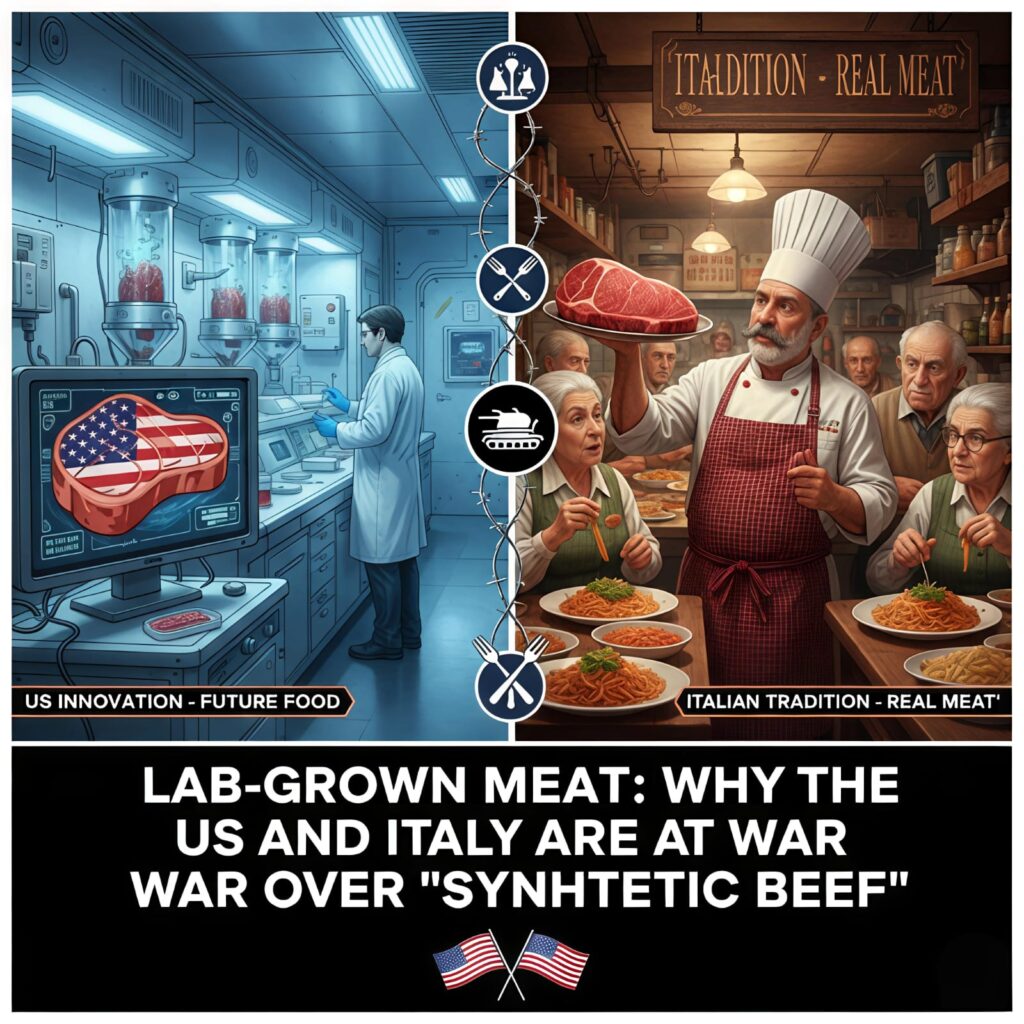
Imagine a sleek, minimalist kitchen in a San Francisco high-rise. A young tech executive carefully sears a patty of lab-grown meat. He talks excitedly about the precision of the protein and the fact that no methane was released into the atmosphere for his lunch. To him, this synthetic beef represents a bright, clean, and rational future where humanity finally solves the hunger crisis without destroying the planet. It is the ultimate expression of human ingenuity.
Now, imagine a sun-drenched kitchen in a small village outside of Siena. An elderly woman, whose hands are stained with flour and olive oil, prepares a traditional ragù. She uses beef from a local Maremmana cow that grazed on the wild grasses of the valley. To her, the idea of synthetic beef is an insult to the very concept of life. She believes that the flavor of the meat comes from the sun, the soil, the rain, and the life the animal lived. To her, meat grown in a tank has no “soul.”
These two scenes perfectly encapsulate why the US and Italy are at war. This isn’t just a trade dispute over lab-grown meat; it is a fight over what it means to be human and how we relate to the natural world. One side sees the lab as a sanctuary of progress; the other sees it as a prison for nature.
Practical Insights: Navigating the Future of Your Plate
If you are a consumer, a chef, or an investor, how should you navigate this escalating war over lab-grown meat? Understanding the nuances of synthetic beef requires looking beyond the sensationalist headlines.
For the Conscious Consumer:
Read the Labels Carefully: In the US, look for terms like “cell-cultivated” or “cell-propagated” to identify lab-grown meat. The terminology is still evolving.
Evaluate Your “Why”: Are you eating synthetic beef for the environment, for animal ethics, or for health? The answers may lead you to different brands or even back to traditional grass-fed beef.
Taste the Texture: Many early adopters report that lab-grown meat excels in ground forms (like burgers or nuggets) but currently struggles to replicate the complex “mouthfeel” of a ribeye steak.
For the Industry Strategist:
Watch the Regulators: The battle in Italy is just the beginning. Other nations like France and Hungary are also debating bans on synthetic beef.
Follow the Cost Curve: For lab-grown meat to truly win, it must reach price parity with traditional beef. Currently, it remains a premium, expensive product.
Monitor the Farmers: Traditional agricultural lobbies are incredibly powerful. Expect more legislation in the US requiring synthetic beef to be clearly distinguished from “farmed meat” to prevent consumer confusion.
The Nutritional Debate: Is Synthetic Beef Identical?
One of the most contentious points in the US-Italy war is the nutritional profile of the product. The US companies claim they can “engineer” lab-grown meat to be even healthier than the real thing. For example, they can theoretically reduce saturated fats and increase Omega-3 fatty acids within the bioreactor.
However, Italian health advocates argue that meat is a “complex food matrix.” They believe that the interaction between minerals, vitamins, and proteins in a natural animal cannot be perfectly replicated in a lab. Consequently, they fear that synthetic beef will be another form of “ultra-processed food” that contributes to the global rise in metabolic diseases. Because Italy has one of the highest life expectancies in the world, they are understandably protective of their current dietary habits.
The Role of “Big Food” and Corporate Monopoly
A significant underlying fear in the Italian resistance is the centralization of the food supply. Currently, millions of independent farmers around the world produce beef. However, the technology to produce lab-grown meat is protected by complex patents held by a handful of massive corporations.
Italy argues that if synthetic beef replaces traditional ranching, the world’s protein supply will be controlled by a few CEOs in Silicon Valley or New York. This shift would strip away “food sovereignty” from nations and put the world’s nutrition at the mercy of corporate profit margins. Consequently, the ban in Italy is also a populist stand against the perceived overreach of “Big Tech” into the most intimate part of our lives: our food.
Conclusion: The Future of the Global Dinner Table
As we look toward the next decade, the tension between the US and Italy over lab-grown meat will likely intensify rather than fade. The United States will continue to push the boundaries of biotechnology, hoping to export synthetic beef as a global commodity. Meanwhile, Italy will likely remain a fortress of traditionalism, defending the sanctity of “real” food against the rising tide of laboratory innovation.
Consequently, the winner of this war will ultimately be determined by the global consumer. If the world continues to prioritize convenience, cost, and climate impact above all else, lab-grown meat will flourish and eventually become a staple of the human diet. However, if the world decides that cultural heritage, rural landscapes, and “naturalness” are more important, synthetic beef may remain a niche product for the tech-obsessed elite.
Furthermore, we must ask ourselves: can these two worlds coexist? Perhaps there is room on the global table for both the ancient, sun-drenched traditions of Italy and the bold, sterile innovations of the United States. Only time will tell if lab-grown meat becomes the savior of our planet or a footnote in culinary history. One thing is certain: the war over synthetic beef has only just begun.
Summary of Key Takeaways
The US views lab-grown meat as a vital technological solution for a hungry, warming planet.
Italy has officially banned synthetic beef to protect its economy, health, and culinary identity.
The production of synthetic beef involves complex bioreactor technology that multiplies animal cells in a nutrient broth.
The environmental benefits of lab-grown meat are still being debated due to the high energy requirements of sterile labs.
This conflict is a legal and cultural landmark that will define “food sovereignty” for the 21st century.
About the Author