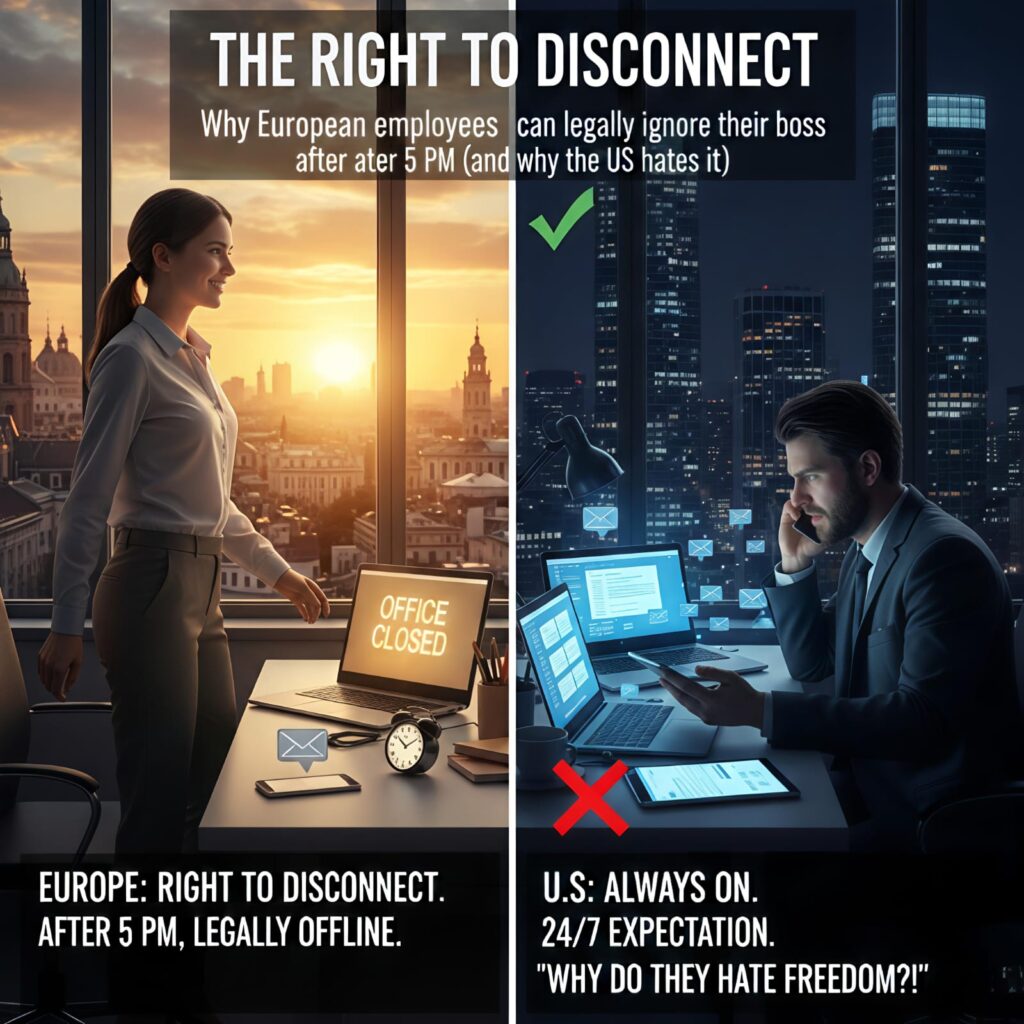
Imagine a world where your smartphone remains silent after you leave the office. Picture a Friday evening where no “urgent” emails interrupt your dinner, and your weekend remains entirely your own. For millions of workers across Europe, this isn’t a fantasy; it is a legally protected reality known as the Right to Disconnect.
While European legislators actively move to protect the sanctity of personal time, the United States continues to view the “always-on” culture as a badge of honor. Consequently, a massive cultural and legal chasm has opened between the two continents. This article explores the mechanics of these laws, the psychological benefits of unplugging, and the fierce resistance these policies face in the American corporate landscape.
What Exactly Is the Right to Disconnect?
At its core, the Right to Disconnect refers to a worker’s legal ability to refrain from engaging in work-related electronic communications—such as emails, texts, or calls—outside of their official working hours. Furthermore, these laws ensure that employees face no professional repercussions or “retaliation” for simply being unavailable.
The French Revolution of Labor
France pioneered this movement in 2017. Under the French Labor Code, companies with more than 50 employees must negotiate agreements with staff regarding their right to switch off. If negotiations fail, the employer must publish a charter clarifying the demands on and rights of employees. Since then, countries like Italy, Spain, Ireland, and Portugal have followed suit, each adding their own layers of protection. In Portugal, for example, the Right to Disconnect is so strictly enforced that bosses can face financial penalties just for sending a text message after hours.
Beyond Just “Turning Off”
Interestingly, the Right to Disconnect is not just about ignoring a ping. It represents a fundamental shift in how we view the employment contract. In the digital age, the “factory whistle” has been replaced by a pocket-sized tether. Therefore, these laws aim to rebuild the wall between “who you are” and “what you do.” They serve as a legal shield against the encroaching tide of digital exhaustion.
Why Europe Is Leading the Charge
European labor philosophy generally treats leisure time as a human right rather than a luxury. Consequently, their legislative approach prioritizes the long-term health of the workforce over short-term output spikes.
1. Combating Digital Burnout
Psychologists have long warned that “anticipatory stress”—the anxiety of waiting for a work email—is just as damaging as the work itself. Because workers never truly relax, their cortisol levels remain elevated. European governments recognize that a burnt-out workforce eventually leads to higher healthcare costs and lower national productivity. The Right to Disconnect acts as a preventative medicine for the modern mind.
2. The Preservation of Family Life
In many European cultures, the evening meal and social gatherings are sacred. By codifying the Right to Disconnect, the law protects these social structures from corporate intrusion. For instance, the French concept of la vie sociale is considered a pillar of national identity. When work bleeds into the dinner hour, it isn’t just an inconvenience; it is a violation of social norms.
3. Boosting Genuine Productivity
Surprisingly, working fewer hours often leads to higher quality output. Employees who have a clear “off” switch return to work refreshed and more focused. Thus, the Right to Disconnect acts as a tool for efficiency, forcing managers to plan better during the 9-to-5 window rather than relying on after-hours fixes. It encourages a “work smarter, not longer” mentality that favors deep work over constant, shallow availability.
The American Perspective: Why the US Hates It
In contrast to Europe, the United States remains the only advanced economy without a federal “Right to Disconnect” law. While a few states like California have toyed with the idea, the backlash from the business community is usually swift and severe.
The Cult of “Always-On”
American corporate culture often equates presence with performance. If you answer an email at 11 PM, you are seen as a “team player” or a “hustler.” Consequently, many Americans fear that a Right to Disconnect would make them look lazy or replaceable in a hyper-competitive market. The “grind” is romanticized, even when it leads to diminishing returns.
The “At-Will” Employment Barrier
Unlike Europe, where strong labor unions and rigid contracts protect workers, the US operates largely on “at-will” employment. This means an employer can fire a worker for almost any reason. Because of this power imbalance, workers feel pressured to stay connected even without a direct order to do so. In this environment, the Right to Disconnect feels like a risk many are unwilling to take.
The Innovation Argument
Opponents of the Right to Disconnect in the US argue that such laws stifle innovation. They claim that in a global economy where business happens 24/7, being unable to reach a colleague in New York while it’s morning in Tokyo creates a massive bottleneck. Silicon Valley, in particular, views these regulations as “productivity killers” that prevent the rapid iteration required for tech dominance. To them, the ability to pivot at 2 AM is a competitive advantage that shouldn’t be legislated away.
The Psychological Toll of Constant Connectivity
If we ignore the Right to Disconnect, what are we actually losing? The price of a 24/7 work cycle is rarely found on a balance sheet, but it is deeply felt in society.
Sleep Deprivation: The blue light from screens and the mental stimulation of work tasks keep the brain in a state of high alert. Consequently, workers struggle to reach deep REM sleep.
Relationship Strain: “Phubbing” (phone snubbing) family members to answer a boss’s Slack message erodes domestic intimacy. Over time, this leads to higher rates of divorce and household conflict.
Decision Fatigue: When you never stop working, your ability to make high-level strategic decisions diminishes. Furthermore, your creativity suffers because the brain needs idle time to form new connections.
The Gender Gap: Since women still perform a disproportionate amount of unpaid domestic labor, the lack of a Right to Disconnect makes it harder for them to balance professional and personal spheres.
The Economic Argument: Why Unplugging Saves Money
Business owners often worry that the Right to Disconnect will hurt their bottom line. However, the data suggests a different story.
Reducing Employee Turnover
Replacing a skilled employee is incredibly expensive. Generally, it costs 1.5 to 2 times a worker’s annual salary to recruit, hire, and train a replacement. By allowing workers to disconnect, companies reduce the “burn and turn” cycle. Consequently, they retain institutional knowledge and save millions in recruitment costs.
Lowering Healthcare Premiums
In the US, employers often foot the bill for healthcare. Burnout leads to chronic illnesses such as hypertension, heart disease, and depression. Therefore, a company that respects the Right to Disconnect will likely see lower insurance claims and fewer sick days. It is a long-term investment in the company’s most valuable asset: its people.
Superior Talent Attraction
As the global war for talent intensifies, workers are looking for more than just a paycheck. They want a lifestyle. Companies that voluntarily adopt a Right to Disconnect policy find themselves flooded with high-quality applicants who are tired of the toxic hustle culture. In this way, the policy becomes a powerful branding tool.
How to Implement a “Right to Disconnect” in Your Life (Even Without a Law)
Even if you live in a country without legal protections, you can still advocate for your own Right to Disconnect. Here is a practical guide to reclaiming your time.
Step 1: Set Clear Boundaries Early
During your onboarding or performance reviews, discuss communication expectations. Ask directly: “What constitutes an emergency that requires an after-hours response?” Establishing these definitions early prevents “expectation creep” later on. Furthermore, get these expectations in writing if possible.
Step 2: Utilize Technology
Most smartphones now feature “Work Profiles” or “Do Not Disturb” schedules. Use them! Set your phone to automatically silence work apps at 5:30 PM. Furthermore, add a line to your email signature stating: “I typically respond to emails between 9 AM and 5 PM. If you send a message outside these hours, I will catch up with you on the next business day.” This manages expectations without you having to say a word.
Step 3: Lead by Example
If you are in a leadership position, do not send non-urgent emails to your subordinates on weekends. Even if you prefer to work on Saturday, use the “Schedule Send” feature so the email arrives on Monday morning. Your team will mirror your behavior; therefore, your silence is their permission to rest. True leadership involves protecting your team’s capacity to work, not just their output.
Step 4: Focus on Results, Not Hours
Shift the conversation from “how long you were logged in” to “what you achieved.” When you deliver high-quality work on time, your boss is less likely to care that you weren’t available for a trivial chat at 8 PM. High performance is the best currency for buying your freedom.
Case Studies: Success Stories from the Front Lines
To truly understand the impact of the Right to Disconnect, we must look at the companies and countries that have embraced it.
Volkswagen’s Server Shutdown
As early as 2011, Volkswagen in Germany implemented a policy where company servers stopped delivering emails to employees’ smartphones from 6:30 PM to 7:30 AM. Consequently, the “ping” of a new message became a non-issue. The result? A more focused workforce and a significant decrease in reported stress levels among junior managers.
Ireland’s Code of Practice
In 2021, Ireland introduced a Code of Practice on the Right to Disconnect. While not a “hard law” with fines like in France, it gives employees the right to take a case to the Workplace Relations Commission if they are penalized for disconnecting. This “soft law” approach has encouraged a national dialogue and forced companies to rethink their digital etiquette.
The “Quiet Quitting” Phenomenon
In the US, the absence of a legal Right to Disconnect led to the “Quiet Quitting” movement. Workers didn’t leave their jobs; they simply stopped doing extra work outside of their paid hours. This grassroots rebellion proves that the desire to disconnect is universal, even if the legal framework is missing.
The Global Shift: Is Change Coming to the US?
The tide might finally be turning. Following the COVID-19 pandemic, the lines between home and office blurred beyond recognition. This “work-from-home” revolution triggered a massive wave of burnout, leading to the “Great Resignation.”
The California Experiment
In 2024, California Assemblyman Matt Haney introduced a bill that would have mandated the Right to Disconnect for all employees in the state. Although the bill faced heavy lobbying from tech giants and was eventually stalled, it sparked a national conversation. It proved that American workers are increasingly hungry for the same protections enjoyed by their European counterparts. Furthermore, it signaled to employers that the “always-on” status quo is no longer sustainable.
Gen Z and the Future
The younger generation of workers is less interested in the “hustle culture” of their parents. They view the Right to Disconnect not as a radical demand, but as a basic requirement for mental health. As Gen Z takes up more space in the workforce, companies may find that they must offer these protections to attract top talent. For them, a job that doesn’t respect their time is a job they don’t want.
Summary Table: Global Perspectives
| Feature | European Union (General) | United States |
| Legal Status | Codified in many national laws. | No federal law; purely based on company policy. |
| Enforcement | Fines for employers who breach “quiet hours.” | No legal recourse for after-hours contact. |
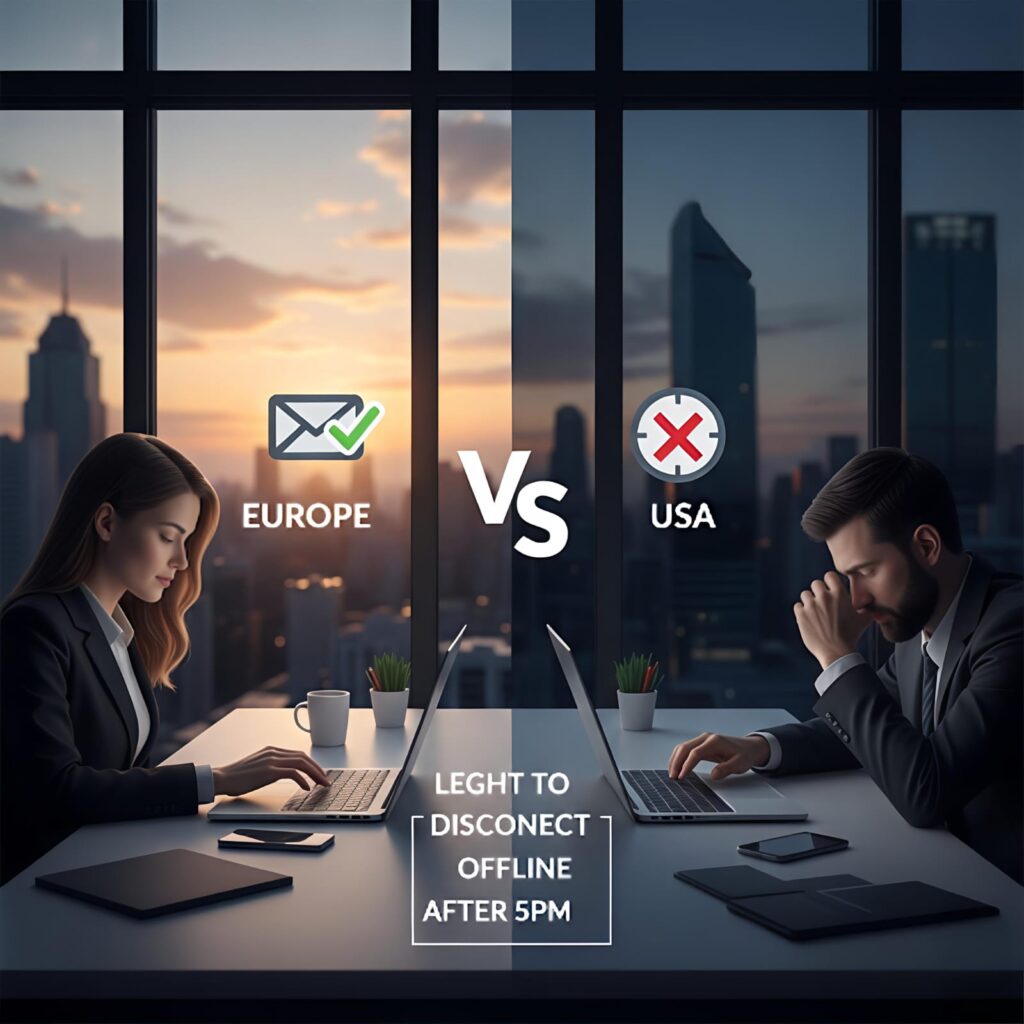
| Cultural View | Rest is a right; “Work to Live.” | Productivity is a virtue; “Live to Work.” |
| Managerial Impact | Managers must plan better and respect boundaries. | Managers expect 24/7 availability for “emergencies.” |
| Mental Health | Prioritized as a public health issue. | Viewed as an individual responsibility. |
| Economic Logic | Focus on long-term stability and health. | Focus on short-term quarterly gains. |
Reclaiming the Night: A Call to Action
The Right to Disconnect is not merely a legal curiosity; it is a battle for the soul of the modern worker. We live in an era where technology has made it possible to work anywhere, but that doesn’t mean we should work everywhere.
For the Employee
Do not wait for a law to change your life. Start small. Turn off your notifications for one hour after work tonight. Consequently, you will notice a shift in your mood. Increase that window gradually. Your worth is not defined by your responsiveness to a digital notification.
For the Employer
Recognize that a tired brain is a useless brain. By enforcing a Right to Disconnect, you are not losing productivity; you are protecting your investment. Build a culture where “off” means “off.” Your employees will thank you with their loyalty and their best ideas.
For the Legislator
Look at the European model not as a threat, but as a blueprint. A healthy society requires boundaries. When we allow work to consume every waking moment, we lose the very things that make life worth living: community, family, and rest.
The Long-Term Impact on Global Business
If the Right to Disconnect becomes a global standard, we will see a massive shift in how projects are managed.
Asynchronous Communication: Teams will become better at documenting work so that others can pick it up without a phone call.
Better Goal Setting: Instead of rewarding “busyness,” companies will reward “outcomes.”
Improved Public Health: A society that rests more is a society that costs less to maintain.
Ultimately, the Right to Disconnect is about human dignity. It is the recognition that when the clock strikes 5 PM, the person belongs to themselves, not to their corporation. Europe has shown us that this is possible. It is now up to the rest of the world to decide if they value their people as much as their profits.
Conclusion: The New Frontier of Workers’ Rights
The history of labor is a history of boundaries. From the five-day workweek to the abolition of child labor, every major advancement was once considered “radical” or “bad for business.” The Right to Disconnect is simply the next step in this evolution.
In Europe, the law acknowledges that the digital age requires new rules. In the US, the struggle continues between a deep-seated work ethic and a growing mental health crisis. However, the data is clear: those who disconnect are more likely to thrive in the long run.
Whether you are a freelancer in New York or a corporate executive in Berlin, the lesson is the same. Protecting your time is not an act of rebellion; it is an act of survival. By embracing the Right to Disconnect, we ensure that technology serves us, rather than the other way around. Let the after-hours silence be a reminder that you are more than your job.
About the Author