Imagine you are sitting in a cozy café in Paris. You sip your espresso. Next, you open your laptop. Then, you try to visit a local news website from Chicago to check on your hometown sports team. Suddenly, a blank white screen stares back at you. It displays a stark message: “451: Unavailable due to legal reasons.” You haven’t moved to a restrictive regime. Yet, you cannot access the information you want.
Welcome to the new digital reality of 2026. Consequently, you have just encountered the “Splinternet.”
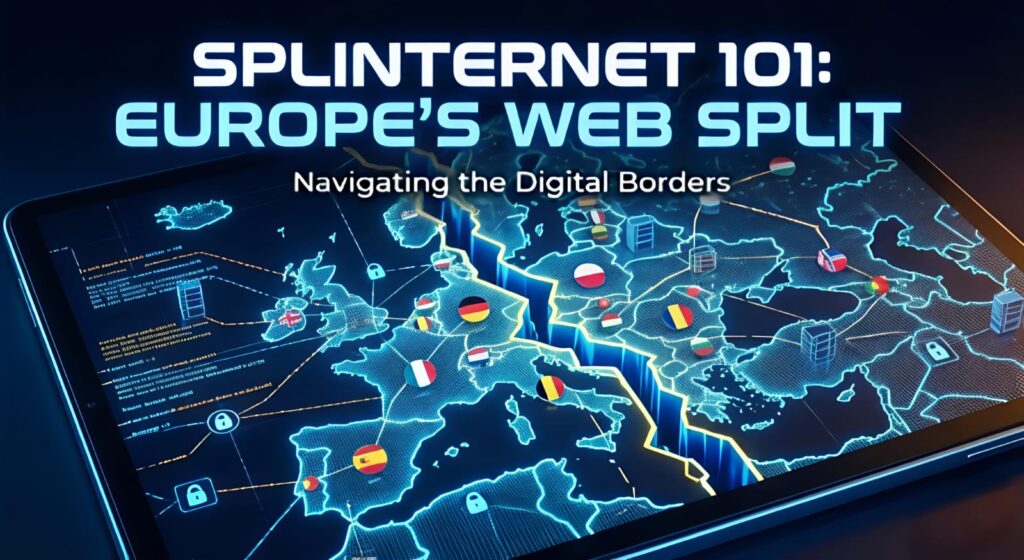
For decades, we believed the World Wide Web was truly worldwide. However, that dream is fading fast. Specifically, a massive divide is forming between the internet in Europe and the internet in the USA. This isn’t just about language or culture. Rather, it is about fundamental laws and privacy rights.
In this guide, we will get the Splinternet explained clearly. We will explore why your online experience in Berlin is becoming radically different from your experience in Boston. Furthermore, we will look at what this means for your future in a fractured digital world.
What is the Splinternet? A Simple Breakdown
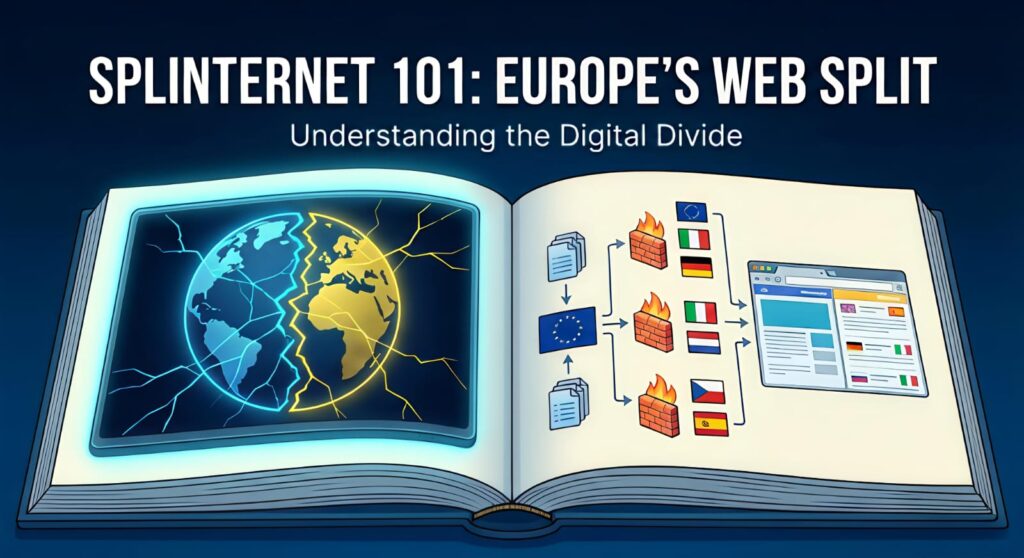
So, what exactly is this phenomenon? Broadly speaking, the Splinternet describes the fragmentation of the global internet. Instead of one unified network, we now have distinct, bordered digital zones. Consequently, the “World Wide Web” is becoming a collection of local networks.
Think of it like international travel. Previously, the internet was like an open ocean. You could sail anywhere. Now, however, it is becoming a series of walled gardens. You need the right “digital passport” to enter.
The Core Conflict: Values vs. Commerce
To understand why the web is splitting, you must first understand the disagreement driving it.
The USA Model: This model prioritizes free speech and market forces. It allows companies to collect and sell data with few restrictions. It is a “wild west” approach. Therefore, innovation moves fast while rules move slowly.
The European Model: This model prioritizes individual privacy and human dignity. Here, the government sets strict, binding rules. They view data privacy as a fundamental human right. Consequently, companies must ask for permission first.
The “Access Denied” Phenomenon: Why It Happens
You might wonder why a US newspaper would block a European reader. The answer lies in the massive cost of legal compliance.
When the European Union introduced the General Data Protection Regulation (GDPR) in 2018, everything changed. Suddenly, any website collecting data on EU citizens had to follow strict rules. They had to ask to track you. Furthermore, they had to delete your data if you asked.
Consequently, many American publishers panicked. They looked at the cost of building new systems. Then, they compared it to the low revenue from European visitors. For many sites, the math didn’t work.
So, they simply pulled the plug.
Even today in 2026, you remain blocked from many sites. This is the Splinternet explained in real time. It is a harsh reminder that the internet has physical borders defined by law.
The Legal Wrench: GDPR, DMA, and DSA
To truly see the Splinternet explained, we must look at the laws. The European Union is now the world’s most aggressive tech regulator. This creates a regulatory fortress that US companies must either enter or avoid.
1. GDPR: The Privacy Shield
GDPR forces companies to be transparent about data.
In the USA: Companies track your location by default. You have to hunt for a way to stop it.
In Europe: Companies must ask you to “Opt-In.” Consequently, you see “Cookie Consent” pop-ups on every page.
Furthermore, penalties are severe. Fines can reach billions of dollars. Therefore, tech giants treat European data differently to avoid these massive costs.
2. The Digital Markets Act (DMA)
If GDPR was a crack, the Digital Markets Act (DMA) is a sledgehammer. It targets “gatekeepers” like Apple, Google, and Meta.
Here is how the experience diverges in 2026:
App Stores: In Europe, Apple must allow “sideloading.” This means you can install apps from outside the App Store. In the USA, Apple keeps its “walled garden” tight for security.
Messaging: The DMA wants WhatsApp to work with smaller apps. This concept is alien to the US market.
Browsers: When a European sets up an iPhone, they get a mandatory choice of browsers. An American user is often nudged toward Safari.
Consequently, an iPhone in Paris works differently than an iPhone in New York.
3. The Digital Services Act (DSA)
The Digital Services Act (DSA) handles content moderation. In the US, platforms are largely not responsible for what users post. However, in Europe, the DSA demands that platforms remove hate speech and disinformation quickly.
Thus, a user in Texas might see a post that a user in Berlin is protected from seeing. Your digital “truth” depends on your zip code.
Social Media: Two Different Worlds
Social media is the most visible part of the Splinternet. The divide affects what apps you can even download.
The Case of Threads and New Tech
Take the launch of Threads by Meta. It exploded in the USA. However, if you lived in the EU, you couldn’t download it for months. Why? Meta was afraid of EU laws. They needed time to ensure the app was legal.
Key Differences You Will Notice:
| Feature | Experience in the USA | Experience in Europe |
| Algorithms | You see what the AI wants you to see. | You can turn off the AI for a simple list. |
| Ads | Highly specific ads are the norm. | You can often pay a fee to see no ads. |
| Hate Speech | Moderation is often loose. | Moderation is strict and required by law. |
| Dark Patterns | Sites try to trick you into staying. | Tricking users is explicitly banned. |
Consequently, your social media feed is a reflection of your local laws.
The AI Chasm: The Next Frontier
Artificial Intelligence is the next part of the Splinternet explained. The EU AI Act is the first law of its kind.
This Act categorizes AI by risk:
Unacceptable Risk: Banned completely (like social scoring or facial recognition).
High Risk: Heavily regulated (like AI in hiring or healthcare).
Limited Risk: Requires transparency.
In contrast, the USA is taking a “wait and see” approach. They want to foster innovation and security.
What does this mean for you?
Powerful AI tools might be available in San Francisco but illegal in Berlin. Furthermore, US companies might hesitate to launch tools in Europe. They fear fines of up to 7% of their global earnings. Therefore, the Splinternet is moving from simple websites to the very intelligence of the future.
The Cost of Doing Business
Business leaders face a difficult choice. Do they build one product for the world? Or do they build two separate versions?
Increasingly, they choose the latter. This is called “Geo-fencing.”
For small startups, this is a nightmare. Previously, you released an app globally. Now, you might skip Europe entirely. You need a legal team just to launch there.
The Result:
Delayed Tech: Europeans get new features much later.
Higher Costs: Companies pass legal fees to the users.
Stripped-Down Sites: Some US sites offer a “lite” version to Europe. It has no tracking but also fewer features.
However, there is a benefit. European users are safer. They have less identity theft. Therefore, the “cost” buys security and peace of mind.
The “Brussels Effect”
There is a twist in this story. It is called the “Brussels Effect.” This theory says that because the EU is so large, companies will just follow their rules everywhere. It is cheaper to have one high standard.
We saw this with USB-C chargers. The EU forced Apple to change. Apple didn’t make a special US phone. They changed the phone for everyone.
Could this happen with the web?
Perhaps. However, data is more valuable than cables. US companies make billions selling data. They will fight to keep that revenue in the USA. Consequently, the gap is likely to grow wider as data sovereignty becomes a priority.
How to Navigate the Splinternet
You now have the Splinternet explained. But how do you live with it? If you travel or work globally, you need a plan.
1. Use a Reputable VPN
A VPN is no longer just for geeks. It is a tool for digital freedom.
Why: It lets you change your location. If you are in Europe, you can “pretend” to be in New York to read the news.
Caution: Avoid free VPNs. They often sell your data, which defeats the purpose.
2. Know Your Rights
Your rights change when you land in a new country.
In Europe: You can ask Google to delete your data. You can see everything they know about you.
In the USA: Laws are weaker. Only some states, like California or Colorado, have strong privacy rules.
3. Diversify Your Apps
Don’t rely on just one app. Since laws change, features might break across borders. Having Signal or Telegram as backups is smart. These apps focus on privacy first. Consequently, they are more resilient to legal shifts.
Why This Matters for the Future
The Splinternet is not just a technical problem. It is a cultural one. When we see different news and use different apps, we stop understanding each other.
The internet was supposed to bring us together. Instead, it is being sliced into pieces. This affects:
Education: Students in different countries see different search results.
Business: It is harder for small brands to sell products globally.
Politics: Governments can control the flow of information more easily.
Consequently, the “Global Village” is becoming a series of gated communities.
Deep Dive: The Data Sovereignty Movement
Furthermore, we must discuss Data Sovereignty. This is the idea that data should be subject to the laws of the country where it is collected.
Previously, data flowed freely across the Atlantic. However, the “Schrems II” ruling by the EU Court of Justice changed that. It invalidated the “Privacy Shield” agreement. Consequently, transferring data from Europe to the USA became legally risky.
Now, many European companies prefer local cloud providers. They avoid Amazon (AWS) or Microsoft Azure when possible. Instead, they use European alternatives like OVHcloud or T-Systems. This is a major part of the Splinternet explained. It creates a physical separation of the servers that power our world.
The Impact on Global Trade
Consequently, small businesses suffer the most. A small bakery in Oregon might want to ship cookies to Germany. But to have a website accessible in Germany, they must follow GDPR.
If they use a simple tracking pixel for ads, they might be in violation. Therefore, many small US businesses simply block European traffic entirely. This hurts trade. It reduces choice for consumers.
In contrast, large companies like Google can afford thousands of lawyers. They can navigate the split. Thus, the Splinternet actually helps big monopolies stay big. They are the only ones who can pay the “compliance tax.”
Security and Espionage: The Dark Side
Furthermore, governments use the Splinternet for control. While the EU focuses on privacy, other regions focus on security.
In the USA: The government can sometimes force tech companies to provide “backdoors” for national security.
In Europe: Strong encryption is protected as a right. Governments are currently debating this with tech giants.
If a government can see what you do online, the internet is no longer private. Consequently, different regions are building “national firewalls.” This is most famous in China. However, we see lighter versions of this appearing in the West through data localization rules.
The Role of Quantum Computing
As we move toward the late 2020s, technology like Quantum Computing will change the game.
Quantum computers could break current encryption. Consequently, countries are racing to build “Quantum-Safe” networks. If Europe builds one standard and the USA builds another, the split will be permanent. You won’t just be blocked by a law. You will be blocked by the very physics of the network.
User Experience: A Day in the Life
Let us look at a typical day for a user in 2026.
Morning in London:
Initially, you check your phone. Next, you see a “Transparency Report” from your ISP. Then, it shows you exactly which apps tracked you yesterday. Finally, you click “Delete all data” with one button.
Morning in New York:
Initially, you check your phone. Next, you are shown ten ads for products you talked about at dinner. Then, you realize you have no idea which app was listening. Finally, you find you have no easy way to stop it without deep menu diving.
This difference in daily life is what happens when you have the Splinternet explained. It is not just about big laws. It is about your morning routine and your peace of mind.
The Future of Content Creation
Furthermore, creators are feeling the pinch. A YouTuber in California might use a song that is legal in the US. However, due to the EU Copyright Directive, that video might be blocked in Paris.
Creators now have to check multiple rulebooks. Consequently, some creators are choosing to ignore certain markets. They make content only for “Zone A” or “Zone B.” This limits the global reach of art and ideas.
Why Web Sovereignty Matters
Moreover, we must address the concept of Web Sovereignty. This refers to a nation’s ability to govern its digital space. While the US believes in a global open market, Europe believes in a regulated one.
Specifically, this means that the software you use is now a political choice. If you choose an American app, you accept American data rules. If you choose a European app, you accept European privacy rules. Consequently, your phone becomes a map of your political preferences.
Conclusion: The End of the Open Web?
Ultimately, the era of a borderless internet is over. The Splinternet is the new reality. The internet in Europe is a safe, regulated garden. The internet in the USA is a fast, commercial marketplace.
Neither side is perfect. The European model offers safety. However, it slows down new tech. The American model offers speed. However, it sacrifices your privacy.
Ultimately, you must learn to navigate both. The map of the web has been redrawn. We are all just learning how to cross the new borders. Understanding the Splinternet explained here is your first step toward digital literacy in 2026.
About the Author