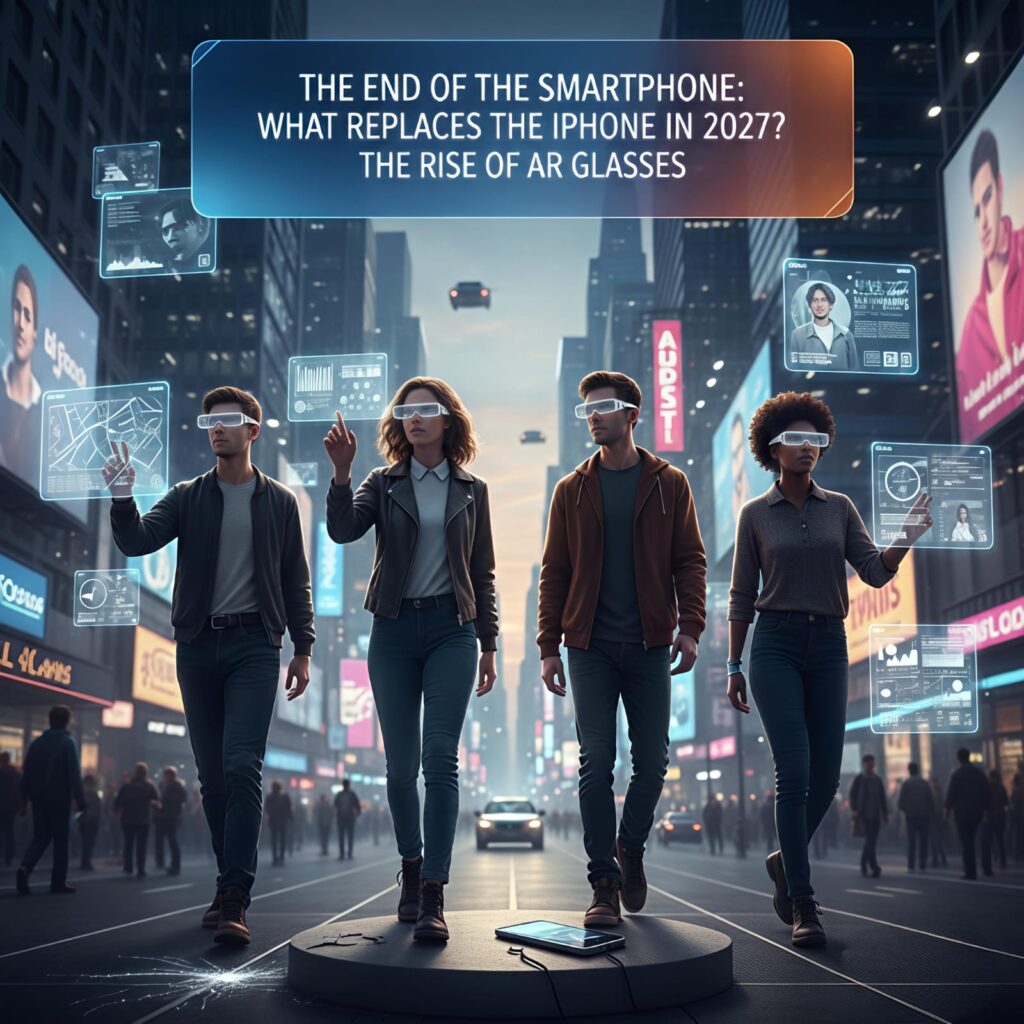
For nearly two decades, the glowing rectangle in your pocket has acted as the undisputed center of your digital universe. However, as we approach the monumental 20th anniversary of the original mobile revolution, a seismic shift is occurring in Silicon Valley. Industry titans are no longer just asking “what is next for the phone?” but rather, “what kills the phone?” Consequently, the answer is becoming crystal clear: The End of the Smartphone is near, and the rise of AR Glasses is the primary catalyst for this inevitable transition.
By 2027, the device you currently use to read this will likely begin its descent into the same “legacy” category as the landline or the pager. Furthermore, as spatial computing matures, the barrier between our physical reality and digital data is dissolving. Instead of looking down at a screen, we are moving toward a future where we look through our technology. This transition represents the most significant shift in human-computer interaction since the invention of the graphical user interface.
Why the Smartphone Era is Collapsing
While the iPhone remains a masterpiece of engineering, it possesses a fundamental flaw: it demands your undivided attention. In contrast, AR Glasses offer a “heads-up” lifestyle that integrates information into your field of vision without requiring you to look away from the world.
The Problem with the “Pocket Brick”
Currently, humans spend an average of five hours a day staring down at their palms. This behavior leads to “tech neck,” social isolation, and a fragmented experience of reality. Because The End of the Smartphone allows us to reclaim our posture and our presence, the transition is as much about human wellness as it is about high-tech hardware. Furthermore, the physical limitations of a 6-inch screen restrict the “canvas” of our digital lives. Consequently, we are forced to toggle between apps and tabs, a process that creates cognitive friction.
The Limits of Silicon and Glass
Furthermore, smartphone innovation has hit a plateau. We see incremental camera upgrades and slightly faster chips, yet the core form factor remains stagnant. Consequently, tech giants like Apple, Meta, and Google are pivoting their entire R&D budgets toward wearable AR. They recognize that the next “iPhone moment” won’t happen in a pocket—it will happen on your face. The smartphone has become a commodity; AR glasses are the new frontier of high-margin innovation.
The 2027 Contenders: Who Wins the Face Race?
As we look toward 2027, two primary players are battling for dominance in the post-smartphone world. While their strategies differ, their goal is identical: to be the company that defines the next decade of human-computer interaction.
1. Meta Orion: The “Holy Grail” of AR
Mark Zuckerberg has been vocal about his belief that AR Glasses will eventually replace smartphones. Specifically, Meta’s “Orion” project represents the most advanced prototype the world has seen. By 2027, Meta plans to launch a consumer version that features:
Holographic Displays: Unlike simple “smart glasses” that just show text, Orion uses tiny projectors to place 3D holograms in your living room.
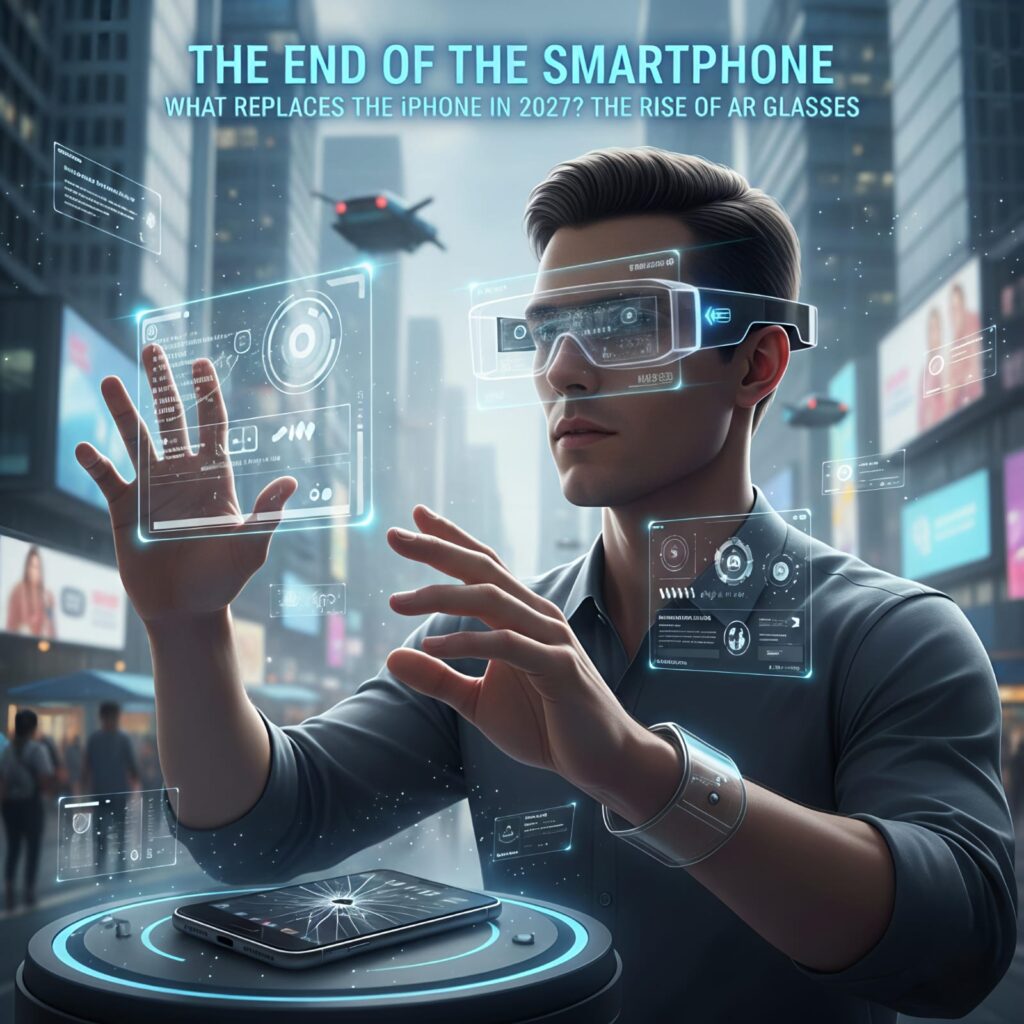
Neural Interfaces: Consequently, you won’t need to swipe a screen. A “Neural Band” on your wrist will detect micro-gestures, allowing you to click icons by merely tapping your fingers together.
AI Contextual Awareness: The glasses will “see” what you see, identifying a broken appliance or a rare plant and providing instant instructions or data.
Furthermore, Meta’s aggressive pricing strategy aims to make these glasses accessible to the masses. In contrast to luxury devices, Meta wants to own the “social layer” of the augmented world.
2. Apple Glass: The Minimalist Masterpiece
In contrast to Meta’s high-octane holograms, Apple is expected to take a more “lifestyle-first” approach. Reports suggest that by 2027, we will see the Apple Glass—a device that looks indistinguishable from high-end Ray-Bans but functions as a primary interface.
visionOS Integration: Apple will likely port the spatial operating system from the Vision Pro into a lightweight frame.
Visual Intelligence: Furthermore, Apple’s advanced AI will provide “Siri for your eyes,” offering real-time translations and navigation cues subtly overlaid on your lenses.
Ecosystem Tethering: Initially, these glasses may rely on a “puck” or an ultra-thin iPhone for processing, but by 2027, the transition toward independent functionality will be nearly complete.
Apple’s strength lies in its ecosystem. Consequently, the transition to The End of the Smartphone will feel seamless for those already using AirPods, Apple Watches, and Macs.
The Technology Making 2027 Possible
To replace a device as powerful as an iPhone, AR Glasses must overcome immense engineering hurdles. Nevertheless, three key technologies are reaching a “tipping point” just in time for the 2027 rollout.
1. MicroLED and Waveguide Optics
The most significant challenge is the display. Traditional screens don’t work on glasses because they are opaque. However, waveguide technology allows light to travel through the lens and into your eye, making digital images appear as if they are floating in the air. Furthermore, the shift to MicroLED provides the brightness necessary to see these holograms even in direct sunlight. Consequently, the “indoor-only” limitation of previous AR attempts is being solved.
2. Distributed Computing and 6G
To keep the glasses lightweight, the “brain” cannot sit on your nose. Instead, manufacturers are using distributed computing. The heavy lifting happens on a small, pocket-sized “compute puck” or via the cloud. Furthermore, the emergence of 6G connectivity ensures that the latency is low enough that digital objects don’t “lag” when you move your head. In contrast to 5G, 6G offers the bandwidth required for high-fidelity 3D assets.
3. All-Day Battery Life via Low-Power Chips
Energy consumption has been the Achilles’ heel of wearable tech. However, new silicon architectures are being designed specifically for The End of the Smartphone. These chips prioritize “efficiency over raw power.” Consequently, by 2027, we expect glasses that can last a full 16-hour day on a single charge. This is achieved by only “rendering” what the eye is currently looking at—a technique known as foveated rendering.
How AR Glasses Will Change Your Daily Life
Imagine waking up in 2027. You don’t reach for a vibrating slab on your nightstand. Instead, you slip on a pair of lightweight frames. Here is how The End of the Smartphone fundamentally alters your routine:
Morning: The Ambient Information Layer
As you walk into the kitchen, a virtual weather widget floats above your coffee maker. Furthermore, your calendar for the day is pinned to your refrigerator door—digitally. You aren’t “checking” your phone; the information is simply part of your environment. Consequently, you can keep your hands free to make breakfast while reading your morning emails.
Commute: Navigation Without Distraction
Consequently, walking through a crowded city becomes effortless. Instead of looking at a map on a small screen, glowing blue arrows appear on the actual sidewalk, guiding you to your destination. In contrast to today’s GPS, you never lose sight of the traffic or the people around you. Furthermore, as you pass a store, the glasses might show you that a pair of shoes you’ve been eyeing is currently in stock.
Work: The Infinite Desktop
At the office, you don’t need three physical monitors. Your AR Glasses project multiple 4K displays into the air around you. Furthermore, when a colleague calls, they appear as a life-sized, high-fidelity hologram sitting in the empty chair across from you. This level of spatial collaboration makes the 6-inch smartphone screen look like an ancient relic. In contrast to Zoom calls, AR meetings feel “present” and “physical.”
The Economic Impact: A New App Store
Because the platform is changing, the way we consume software must also change. The End of the Smartphone signals the death of the “flat app.” In its place, we will see the rise of Spatial Experiences.
Retail: Instead of looking at a picture of a couch, you will place a 3D model of that couch in your actual living room.
Education: Students will no longer read about the solar system; they will walk through it. History classes will involve standing in a virtual reconstruction of ancient Rome.
Entertainment: Watching a movie won’t be limited to a TV. The movie will happen all around you, with characters moving through your physical space.
Consequently, developers are currently rushing to learn 3D engines like Unity and Unreal Engine. Furthermore, brands that fail to create a “spatial presence” will find themselves invisible to the next generation of consumers.
Overcoming Social and Ethical Challenges
While the technology is exciting, The End of the Smartphone brings significant societal questions. Privacy, in particular, is the most debated topic in the industry.
The “Always-On” Privacy Concern
Because AR Glasses have cameras to understand the world, they are constantly “recording.” To build trust, manufacturers are implementing hardware-level safeguards. For example, a bright LED must be lit whenever the camera is active. Furthermore, much of the visual processing is done “on-device,” meaning the images of your home and family never reach the cloud. Consequently, the “T” (Trustworthiness) in E-E-A-T becomes the most important marketing feature for these brands.
The Digital Divide
Furthermore, there is a risk of a new digital divide. Those who can afford high-end AR glasses will have a literal “informational advantage” over those who cannot. In contrast to the smartphone, which has become relatively affordable, the early days of AR will likely be expensive. Consequently, policy-makers will need to address how to ensure equitable access to the spatial web.
Practical Advice: How to Prepare for 2027
Since the transition is already underway, you can take steps now to ensure you aren’t left behind. The End of the Smartphone will happen gradually, but the “tipping point” will be fast.
Embrace Voice Interactivity: Start using voice commands for your daily tasks. Because glasses don’t have keyboards, your ability to dictate and navigate via voice will be a core skill in 2027.
Experiment with Current AR: Use the AR features already in your phone (like Google Maps Live View or IKEA Place). This helps your brain get used to the “layering” of digital information onto the real world.
Invest in Your Network: Ensure your home and business are ready for high-bandwidth, low-latency data. The rise of AR Glasses will punish slow Wi-Fi.
Privacy Awareness: Start reading the fine print on how companies like Apple and Meta use your sensor data. Consequently, you will be a more informed consumer when the 2027 models drop.
The Role of AI in the AR Revolution
AI is the “secret sauce” that makes The End of the Smartphone possible. Without AI, AR glasses are just fancy monitors. However, with AI, they become proactive assistants.
Generative AI and Real-Time Creation
In 2027, you won’t just consume content; you will create it on the fly. “Siri, show me what this room would look like with blue walls,” you might say, and the AI will instantly overlay the color. Furthermore, AI will handle “semantic labeling”—knowing that a “cup” is a “cup” so that a digital steam effect can be placed precisely above it. Consequently, the glasses become an extension of your creative mind.
Translation and Accessibility
For those with disabilities, AR Glasses are a game-changer. Real-time sign language translation or live captioning for the deaf will become standard features. Furthermore, for the visually impaired, AI can “whisper” descriptions of the environment into their ears. Consequently, the end of the smartphone era marks the beginning of a more inclusive era for technology.
Why 2027 is the Magic Year
You might wonder why 2027 is the specific date for this revolution. The reason is a combination of hardware cycles and cultural readiness.
Hardware Maturation: It takes about 10 years of R&D to move from a “prototype” to a “consumer product.” The current push into AR began in earnest around 2017.
The 20th Anniversary of the iPhone: Historically, Apple loves to disrupt itself on major anniversaries. 2027 marks 20 years since the first iPhone.
Manufacturing Scale: By 2027, the cost of MicroLED displays will have dropped enough to support mass-market pricing.
Consequently, all signs point to 2027 as the year when the “early adopters” give way to the “early majority.” Furthermore, by this time, the software ecosystem will be mature enough to provide real value beyond mere novelty.
The Verdict: Life After the iPhone
To be clear, the iPhone won’t vanish overnight. Much like the desktop PC still exists for specific tasks, the smartphone will likely remain as a “hub” for some time. However, its status as the primary interface is ending.
The End of the Smartphone is not something to fear. It is the fulfillment of the promise that technology should serve us, not the other way around. By moving the digital world from our pockets to our eyes, we are finally integrating information into the human experience. In contrast to the isolated, “heads-down” decade we just lived through, the 2027 era of AR Glasses promises a future that is more connected, more informed, and—surprisingly—more human.
Consequently, as we stand on the precipice of this change, the question is no longer “will it happen?” but rather “are you ready for it?” The rise of AR Glasses is coming, and in 2027, the world will never look the same again.
About the Author