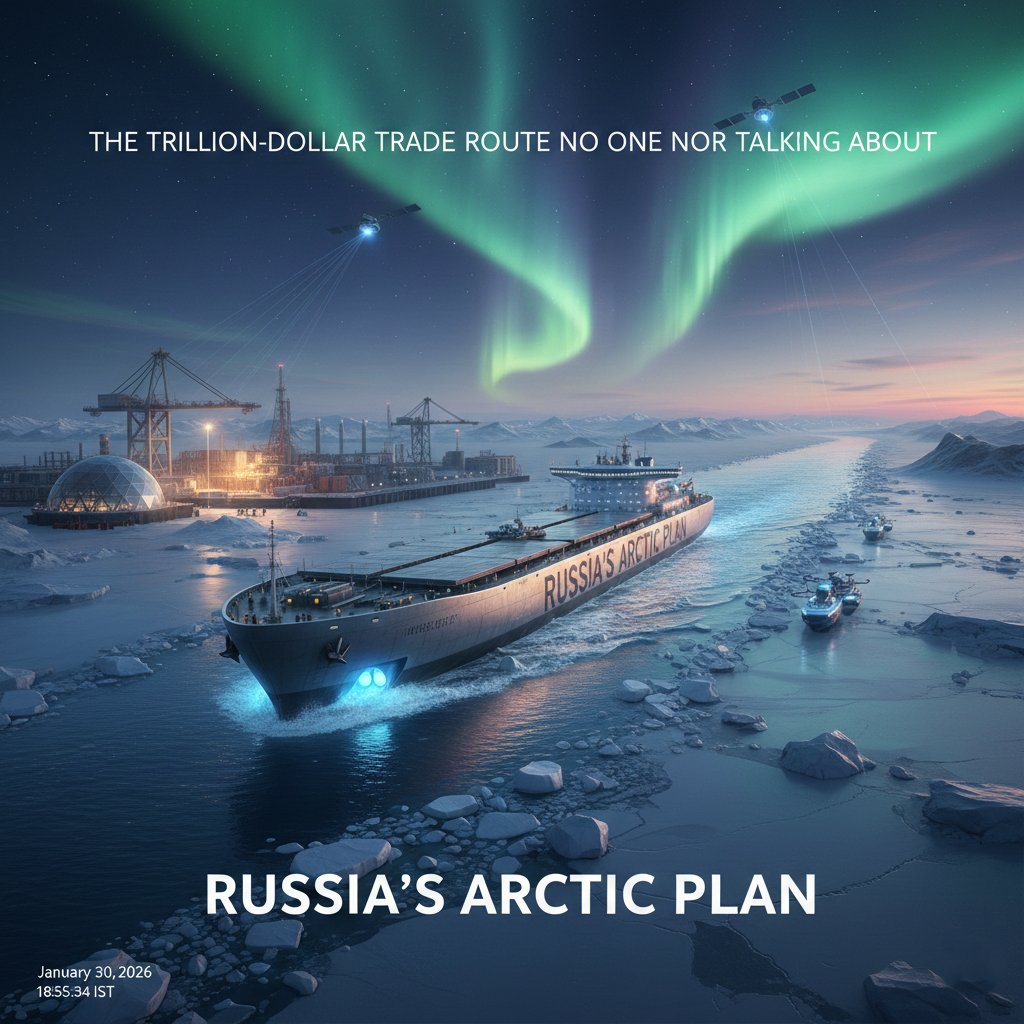
For hundreds of years, the Arctic was a wall of ice. It was a place where explorers got lost. However, the world is changing fast. The ice is melting. Consequently, a new path for ships is opening up. This path is called the Northern Sea Route (NSR). Russia’s Arctic Plan: The Trillion-Dollar Trade Route No One Is Talking About is now the most important project for the Russian government.
While most news stories talk about the Suez Canal, Russia is busy building a new future in the North. This isn’t just a small road on the water. Rather, it is a plan to change how every country in the world buys and sells goods. Because the ice is disappearing, Russia is building massive ports and cities in the coldest places on Earth. This guide will show you how this plan works and why it matters to you.
Why the Arctic is Russia’s New Gold Mine
Russia is a huge country. Much of its land is in the frozen North. Consequently, they see the Arctic as their greatest treasure. Currently, the Arctic gives Russia about 20% of all its money. Furthermore, most of their gas and oil comes from this region.
The Master Plan for 2035
Russia has a very clear map for the future. They call it the “Great Arctic Way.” Their goal is to move 270 million tonnes of cargo through the North every year by 2035. To do this, they are spending billions of dollars.
Big Business: They are opening new mines for coal, gold, and diamonds.
Energy Power: They are building huge factories to freeze gas (LNG) and ship it to Asia.
New Jobs: Thousands of workers are moving to the North to build these projects.
Consequently, Russia is betting its whole economy on the ice. They believe that as the world gets warmer, the Arctic will become the most valuable place on the planet. Furthermore, because they own most of the Arctic coast, they want to be the ones who control the traffic.
The Shortcut: Saving Weeks of Time
Why would a shipping company want to go through the Arctic? The answer is simple: it is much faster. In contrast to the old route through the Suez Canal, the Northern Sea Route is a massive shortcut.
The Math of Shipping
If a ship travels from Shanghai to Hamburg, the distance matters.
Suez Canal Route: This path is about 21,000 kilometers long. It takes about 40 days.
Northern Sea Route: This path is only about 12,800 kilometers. It takes about 20 to 25 days.
Consequently, a ship can save 15 days of travel. Furthermore, saving time means saving money. A large ship can save millions of dollars in fuel on just one trip. Consequently, more companies are looking at the North as a way to stay competitive. In contrast to the Red Sea, there are no pirates in the Arctic. Therefore, it is also a safer path for many businesses.
Nuclear Icebreakers: Russia’s Secret Weapon
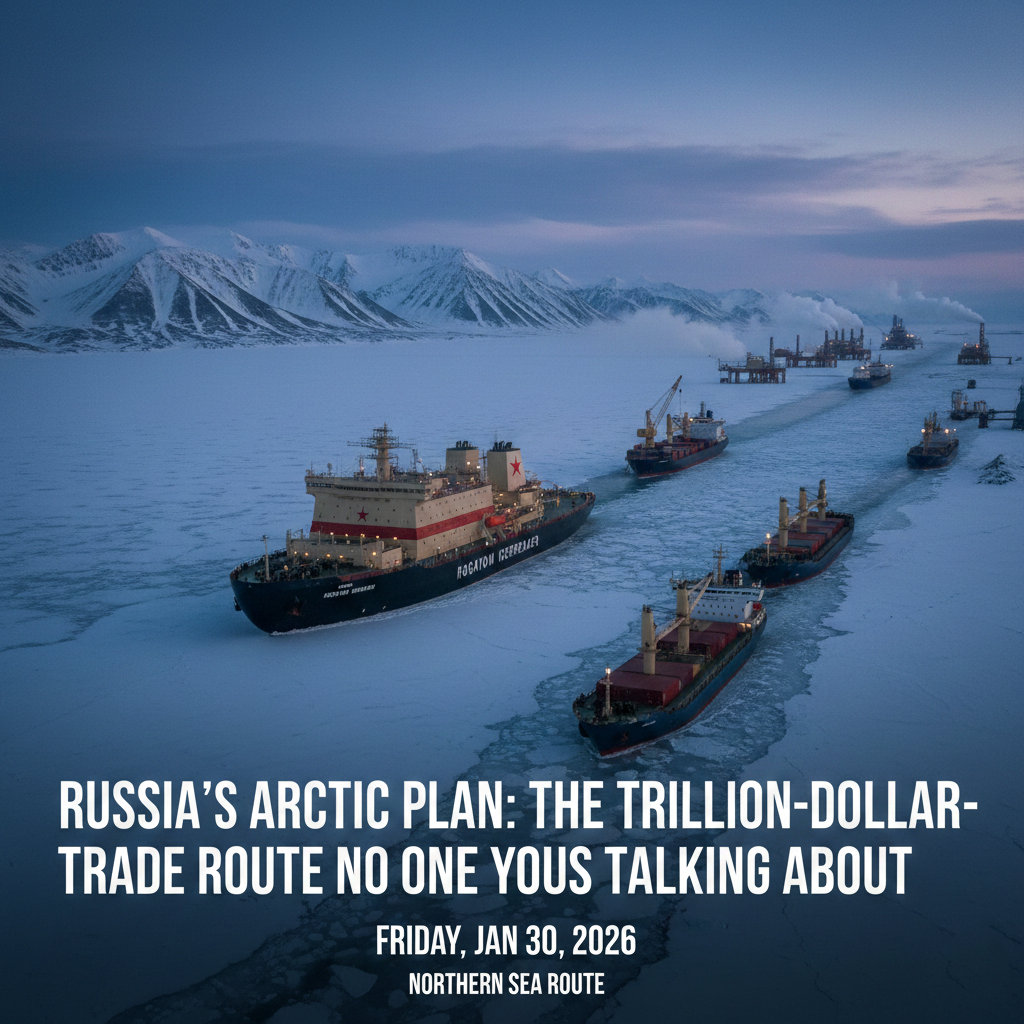
You cannot drive a normal boat through the Arctic. The ice is too thick. Therefore, Russia has built a fleet of giant ships called icebreakers. These ships are the “key” to the whole plan. Furthermore, Russia is the only country in the world that has nuclear-powered icebreakers.
How They Work
These ships don’t use normal fuel. Instead, they have small nuclear reactors inside. Consequently, they can stay at sea for years without stopping.
The Arktika Class: These are the largest icebreakers ever built. They can smash through ice that is 3 meters thick.
Dual Draft: These ships can work in the deep ocean and in shallow rivers. Consequently, they can help ships get to every port in Russia.
The “Lider” Ship: Russia is building even bigger ships that can clear a path for the world’s largest cargo vessels.
Furthermore, Russia has seven of these nuclear giants right now. In contrast, the United States has zero. Consequently, Russia has a massive head start. If you want to use the Arctic route, you usually have to pay Russia to lead you through the ice.
The “Polar Silk Road”: A Team with China
Russia has the ice, but they need money to build the ports. Consequently, they have asked China for help. Together, they are building what they call the “Polar Silk Road.” This is a big part of Russia’s Arctic Plan: The Trillion-Dollar Trade Route No One Is Talking About.
Why China is Helping
China is the world’s biggest buyer of energy. Furthermore, they sell products to everyone.
Safe Energy: China wants a way to get gas that the U.S. Navy cannot block. The Arctic is perfect for this.
New Investment: Chinese banks are putting billions of dollars into Russian gas projects like Yamal LNG.
Better Trade: Consequently, China gets its goods to Europe faster.
Furthermore, this partnership makes both countries very strong. They are building a trade path that does not depend on the West. Consequently, this is changing the balance of power in the world.
Trillions in Wealth Under the Snow
The Arctic isn’t just a road; it’s a warehouse. Experts say there are trillions of dollars in resources hidden under the ice. Furthermore, as the ice melts, it becomes easier to reach them.
What is Down There?
| Resource | Why it Matters |
| Natural Gas | Russia has 30% of the world’s hidden gas in the Arctic. |
| Nickel and Cobalt | We need these for electric car batteries. |
| Platinum | Used in high-tech electronics and cars. |
| Oil | Billions of barrels are waiting under the sea floor. |
Consequently, Russia is building “floating factories” to get these resources out. Furthermore, the Northern Sea Route is the conveyor belt that brings these riches to the world. Without the NSR, these treasures would stay stuck in the cold. Consequently, the route is the most important part of the whole operation.
Building Cities in the Permafrost
To make the plan work, Russia has to build in the middle of nowhere. This is a huge engineering challenge. The ground in the Arctic is usually frozen solid, which is called permafrost. Furthermore, if you build a house on permafrost and it melts, the house will fall.
The New Arctic Cities
Sabetta: This was once a tiny village. Now, it is a high-tech city with a massive port and airport.
Murmansk: This is the largest city in the Arctic. It is the main base for the icebreakers.
Dudinka: A key port for shipping nickel and other metals to the world.
Consequently, Russia is using special technology to keep the ground frozen under their buildings. Furthermore, they are building new schools and hospitals to get people to move North. They want millions of people to live and work in the Arctic by 2040.
The Environmental Warning: A Melting World
There is a dark side to Russia’s Arctic Plan: The Trillion-Dollar Trade Route No One Is Talking About. The plan only works because the Earth is getting hotter. Furthermore, the Arctic is warming four times faster than the rest of the world.
The Problems for Nature
Black Soot: When big ships burn fuel in the Arctic, they leave black soot on the white snow. Consequently, the snow absorbs more heat and melts faster.
Methane Leak: As the ground thaws, it releases methane gas. This gas makes global warming even worse.
Animal Habitat: Polar bears and seals are losing their homes as the ice disappears.
Furthermore, a big oil spill in the Arctic would be a disaster. In contrast to the warm ocean, oil does not break down in the cold. Consequently, it could stay in the water for decades, killing fish and birds.
Geopolitics: The “Ice Curtain” Returns
The Arctic used to be a peaceful place. However, it is now becoming a place for soldiers. Consequently, people are calling it the “New Cold War.” Russia has fixed up over 50 old military bases in the North. Furthermore, they have put missiles and fighter jets there to guard the trade route.
NATO and the North
The West is very worried about Russia’s power. Consequently, NATO is doing more exercises in the cold.
NATO Expansion: Countries like Finland and Sweden have joined NATO. Now, almost all Arctic countries are against Russia.
The U.S. Response: The United States is finally starting to build new icebreakers. Furthermore, they are sending more ships to watch what Russia is doing.
The Battle for Rules: Russia says they own the NSR. In contrast, the U.S. says it should be open to everyone.
Consequently, the North is becoming a crowded place. It is no longer just for scientists. Instead, it is a place where big countries are showing their strength.
How Global Businesses are Adapting
If you run a shipping company, the Arctic is very exciting. But it is also very difficult. Furthermore, you need special training to sail there. Consequently, a new industry is growing to help ships navigate the ice.
What You Need to Sail the NSR
Ice-Class Ships: Your ship needs a thick hull to survive hitting ice.
Special Insurance: Most insurance companies charge a lot of money for Arctic trips.
Russian Pilots: Russia requires you to have a Russian expert on your ship to help with the path.
Furthermore, businesses are using AI and satellites to find the best paths through the ice. Consequently, the route is becoming more predictable. In contrast to 20 years ago, we now have a much better idea of where the ice will be.
The Technology Battle: Can Russia Build It?
Because of the war in Ukraine, many Western companies left Russia. Consequently, Russia lost access to high-tech tools. Furthermore, they used to buy their big turbines and drills from Europe.
The Push for Independence
Russia is now trying to build everything itself. This is a major part of Russia’s Arctic Plan: The Trillion-Dollar Trade Route No One Is Talking About.
Domestic Tech: They are building their own gas factories and underwater robots.
Chinese Parts: They are buying more electronics and parts from China.
New Satellites: They are launching a new group of satellites called Arktika-M to watch the ice 24/7.
Consequently, the next few years will be a test. If Russia can build its own tech, the plan will succeed. In contrast, if they fail, the route might stay empty and quiet.
The Human Impact: People of the North
We often talk about money and ships. But we must not forget the people. Furthermore, the Arctic is home to many indigenous groups. These people have lived there for thousands of years.
Life is Changing
For the Nenets people, the tundra is their home. They move their reindeer across the land every year. Consequently, the new pipelines and roads are blocking their paths.
New Opportunities: Some local people are getting jobs at the new ports.
Culture Loss: As more outsiders move in, the old languages and ways of life are in danger.
Pollution: Local water and fish are being affected by the big factories.
Furthermore, the Russian government is trying to balance this. They provide some money to local groups. Consequently, there is a lot of debate about whether the trade route is good or bad for the people who actually live there.
The 2026 Outlook: What Happens Next?
As we sit in early 2026, the Northern Sea Route is no longer a myth. Furthermore, it is a growing reality. We are seeing more ships every summer. Consequently, the world is starting to realize that the “Trillion-Dollar Trade Route” is real.
Key Milestones to Watch
Year-Round Shipping: Watch for the first time a cargo ship makes it through the East in the middle of winter.
New Hubs: Keep an eye on the port of Pevek. It is becoming a major center for the region.
Sino-Russian Deals: Look for more contracts between Russian gas companies and Chinese buyers.
Furthermore, the weather will play a huge role. If the ice stays thick for a few years, the plan might slow down. Consequently, Russia is watching the thermometer just as much as the stock market.
Conclusion: A New Map for a New World
Russia’s Arctic Plan: The Trillion-Dollar Trade Route No One Is Talking About is a massive change for our planet. Furthermore, it shows that even the coldest places can become the hottest topics in business. Russia has a vision for a world where the North Pole is the center of trade.
Consequently, we must prepare for a future where ships pass through the ice every day. This will change how we get our energy and how we ship our goods. It will also change the balance of power between the East and the West.
Furthermore, the Arctic is a reminder of how our environment and our economy are linked. The melting ice is a warning, but for some, it is an opportunity. Consequently, the story of the Northern Sea Route is the story of our changing world.
Key Facts Summary
Distance: Saves 15 days compared to the Suez Canal.
Value: Accesses trillions in oil, gas, and critical metals.
Control: Russia uses nuclear icebreakers to own the route.
Alliance: China is the main partner providing money and demand.
About the Author