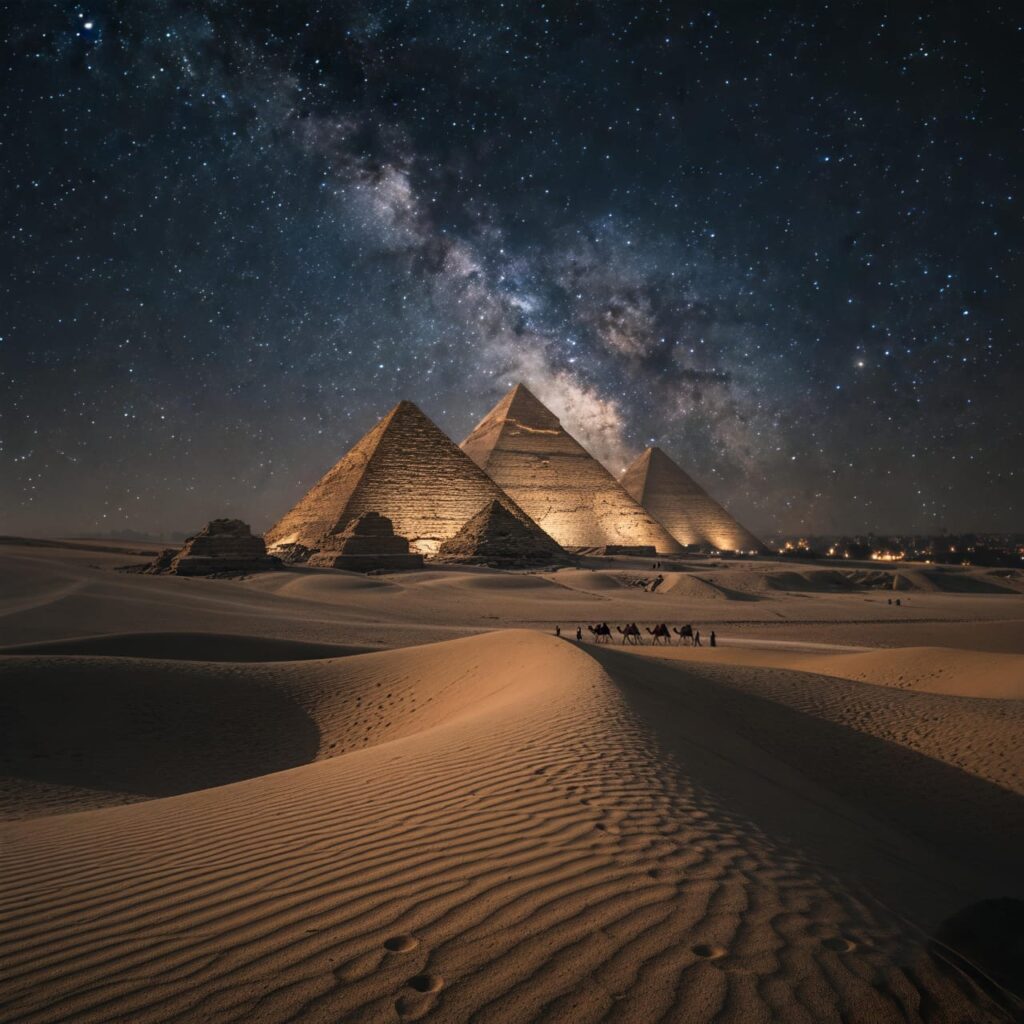
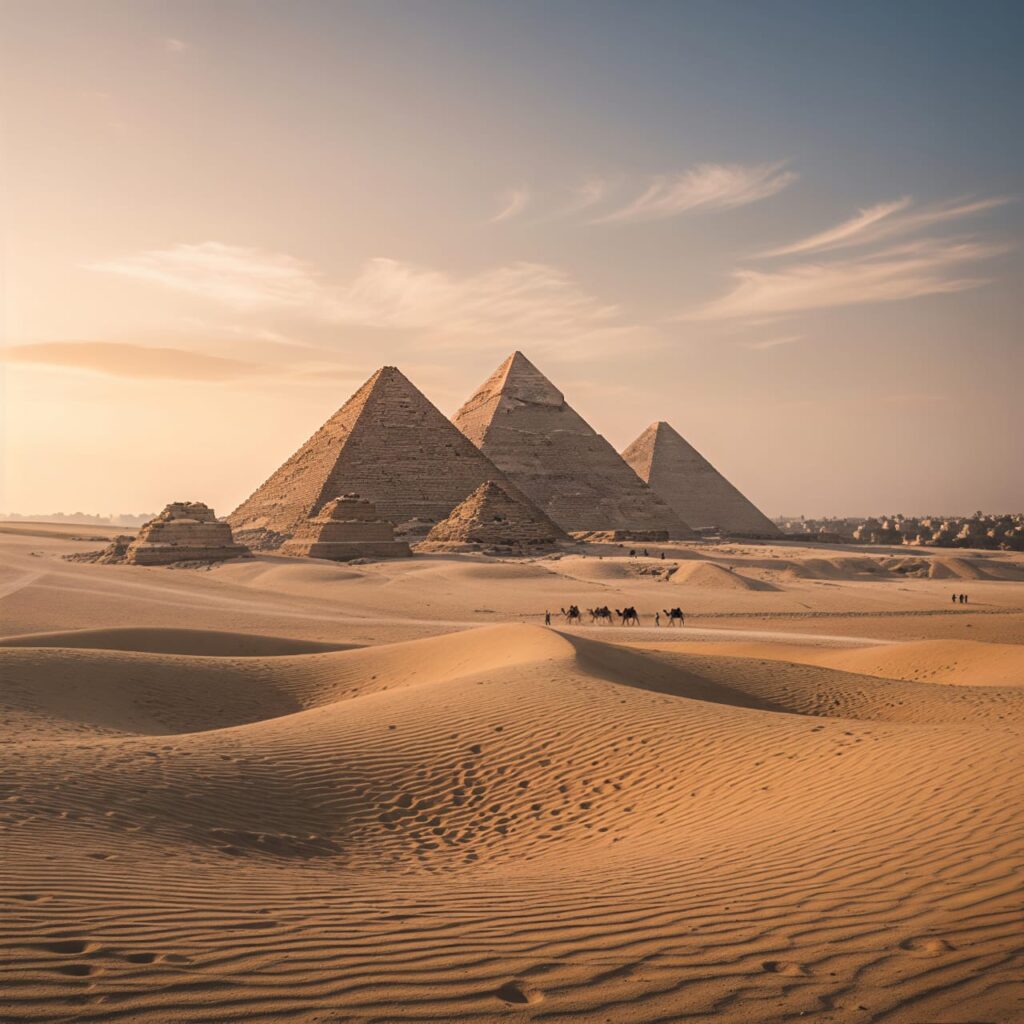
Standing before the Giza Pyramids, one does not merely see a monument; one witnesses a defiant shrug against the passage of time. For over 4,500 years, these structures have served as the ultimate symbol of human ambition. However, as we enter 2026, the story of the Giza Pyramids is being rewritten by cosmic rays and ground-penetrating radar. Consequently, what we thought we knew about these limestone giants is evolving into a narrative far more complex than any textbook could hold.
The 2025 Breakthrough: “Air-Filled Voids” and Hidden Doors
While many believe the Giza Pyramids have been fully explored, recent technology proves otherwise. In late 2025, researchers from Cairo and Munich identified mysterious “air-filled voids” behind the granite façade of the Pyramid of Menkaure.
Furthermore, these gaps were found using non-invasive electrical resistivity tomography. This suggests that the smallest of the three Giza Pyramids might possess a lost entrance that has remained sealed since the Fourth Dynasty. Because of these findings, archaeologists are now reconsidering the internal layout of the entire plateau. In contrast to the idea that these are solid stone blocks, we now see the Giza Pyramids as intricate puzzles with chambers yet to be felt by human hands.
Engineering the Impossible: How the Giza Pyramids Were Truly Built
The most common question regarding the Giza Pyramids is simply: How? While popular culture loves to credit extraterrestrials, the reality is a masterpiece of logistics and social engineering.
The Hydraulic Lift Theory
Interestingly, a new study published in 2025 suggests that the Egyptians may have used a sophisticated hydraulic system. By diverting water from a now-extinct branch of the Nile, they could have created “water shafts” within the Giza Pyramids.
The Process: Water pressure would raise a heavy float.
The Result: Massive stones could be “elevated” like a modern elevator.
The Evidence: Nearby structures like the Gisr el-Mudir appear to function as ancient check dams.
Consequently, this hydraulic mastery allowed the builders to move stones weighing 2 to 15 tons with surgical precision. Furthermore, it highlights that the architects of the Giza Pyramids were not just masons; they were the world’s first fluid dynamic engineers.
Life in the Shadow: The Truth About the Pyramid Builders
For centuries, a persistent myth claimed that slaves built the Giza Pyramids. However, the discovery of the Heit al-Ghurab (The Workers’ Village) has utterly shattered this notion.
The Lifestyle of a Builder
Evidence from the village reveals that these workers were highly respected artisans. Furthermore, they enjoyed a diet that most ancient people would envy.
High-Protein Diet: Excavations found thousands of cattle and sheep bones, indicating the workers ate meat daily.
Medical Care: Skeletons found near the Giza Pyramids show healed fractures and even evidence of brain surgery.
Civic Duty: Participation in the construction was likely a form of tax payment or national service, performed with immense pride.
In contrast to the “slave labor” narrative, the Giza Pyramids were built by a well-fed, medically-cared-for, and spiritually motivated workforce. Consequently, they were buried in honorable tombs within the shadow of the very monuments they created.

Navigating the Giza Plateau: An Expert’s 2026 Guide
Visiting the Giza Pyramids in 2026 is a vastly different experience than it was a decade ago. With the opening of new museum wings and improved infrastructure, your strategy matters more than ever.
When and How to Go
The Morning Rush: Arrive at the Giza Plateau at 7:30 AM. Consequently, you will beat the heat and the crowds that arrive via the Grand Egyptian Museum (GEM) shuttle.
The South Entrance: Most tourists use the north gate. In contrast, the Sphinx entrance (eastern gate) provides a much more dramatic “reveal” of the Giza Pyramids as you walk upward.
Tickets for the Great Pyramid: Only a limited number of people can enter Khufu’s pyramid each day. Furthermore, these tickets often sell out by 9:00 AM.
Practical Essentials for Your Bag
| Item | Why You Need It |
| Linen Clothing | The limestone reflects heat; natural fibers are essential. |
| External Battery | You will take hundreds of photos of the Giza Pyramids. |
| Small Change (EGP) | For tipping the “guardians” who might show you unique photo angles. |
| Sturdy Boots | The sand around the Giza Pyramids hides sharp limestone fragments. |
The Three Giants: A Deep Dive into the Structures
Every visitor knows there are three main Giza Pyramids, but few understand the distinct personality of each structure.
1. The Pyramid of Khufu (The Great Pyramid)
The sheer scale of this monument is hard to process. It consists of roughly 2.3 million stone blocks. Furthermore, the internal “Grand Gallery” is a soaring 8.6-meter-high passageway that defies ancient structural norms. If you choose to go inside, be prepared for a steep, humid climb. However, standing in the King’s Chamber—a room made of massive red granite blocks—is a profound experience.
2. The Pyramid of Khafre
Khafre’s pyramid is easily identified by the “cap” of original white casing stones at its peak. Consequently, it gives the best impression of what the Giza Pyramids looked like when they were first completed. Furthermore, it is the primary guardian of the Sphinx, connected by a long, majestic causeway.
3. The Pyramid of Menkaure
While smaller, Menkaure’s pyramid is arguably the most beautiful. Its lower courses were encased in costly red granite from Aswan. In contrast to the larger Giza Pyramids, Menkaure’s complex feels more intimate and accessible. Notably, the 2025 discovery of air-filled voids occurred right here on its eastern face.
The Sphinx: The Forgotten Face of the Plateau
The Great Sphinx is often treated as a side-show to the Giza Pyramids, but it is a central piece of the spiritual puzzle. Carved directly from the bedrock, it represents the Pharaoh as a solar deity.
Furthermore, recent geological analysis suggests the Sphinx may have been repaired several times even in ancient times. Consequently, this tells us that the Giza Pyramids were living monuments, constantly maintained and revered by successive generations. When you stand between its paws, you are standing in a place where kings once came to dream of their own immortality.
Spirituality and the “Resurrection Machine”
Why did the Egyptians dedicate so much energy to the Giza Pyramids? To them, these were not just tombs; they were “Resurrection Machines.”
The pyramid shape itself represents the benben, the first mound of earth to rise from the chaos of the primeval waters. Furthermore, the alignment of the Giza Pyramids with the stars (specifically the Orion constellation and the star Sirius) suggests a desire to synchronize the Pharaoh’s soul with the clockwork of the universe. Consequently, every stone in the Giza Pyramids was placed with a cosmic purpose in mind.
Modern Myths and Ethical Exploration
As a traveler, you have a responsibility to the Giza Pyramids. The site is fragile, and the local community depends on your respect.
Avoid These Common Mistakes:
Climbing the Stones: It is strictly illegal and dangerous. Furthermore, it damages the ancient limestone of the Giza Pyramids.
Unlicensed Guides: Always check for an official Ministry of Tourism badge. Consequently, you will get accurate historical information rather than “made-up” legends.
Littering: The desert wind carries plastic easily. Please keep the area around the Giza Pyramids pristine for future generations.
In contrast to the “anything goes” attitude of past decades, modern exploration of the Giza Pyramids is focused on sustainability. By following the rules, you ensure that the “Great Voids” and hidden chambers can be studied by scientists for years to come.
The Future of Giza: 2026 and Beyond
The opening of the Grand Egyptian Museum (GEM) has finally provided a world-class home for the treasures found within and around the Giza Pyramids. Furthermore, the new pedestrian walkways and electric bus systems have made the plateau more accessible than ever before.
Consequently, we are entering a “Golden Age” of Egyptology. With AI-assisted translations of ancient papyri and muon scans of the Giza Pyramids, we are closer than ever to answering the questions that have baffled humanity for millennia.
Your Final Checklist for the Giza Pyramids
Book the GEM Tour: Do this 48 hours in advance to see the Khufu Solar Boat.
Check the Weather: If a “Khamsin” (dust storm) is predicted, postpone your visit to the Giza Pyramids by one day.
Charge Your Camera: The “9-Pyramid” viewpoint requires a long lens or a good zoom.
Embrace the Chaos: Giza is loud, vibrant, and busy. Consequently, the best way to enjoy the Giza Pyramids is to go with the flow of the desert.
The Giza Pyramids are not just relics; they are teachers. They teach us about the power of belief, the endurance of stone, and the curiosity of the human mind. As you stand there, dwarfed by the scale of history, you aren’t just looking at the past—you are looking at the height of what humanity can achieve when we look toward the stars.
About the Author