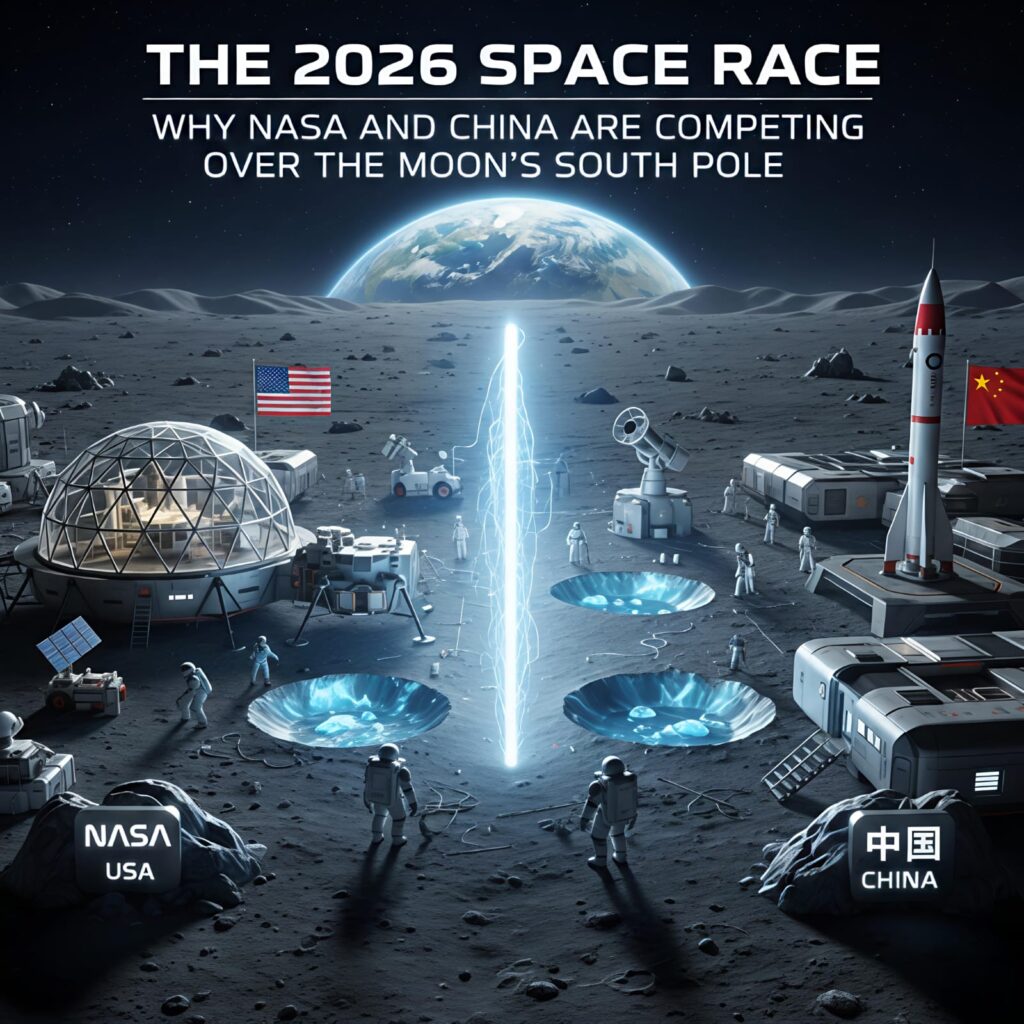
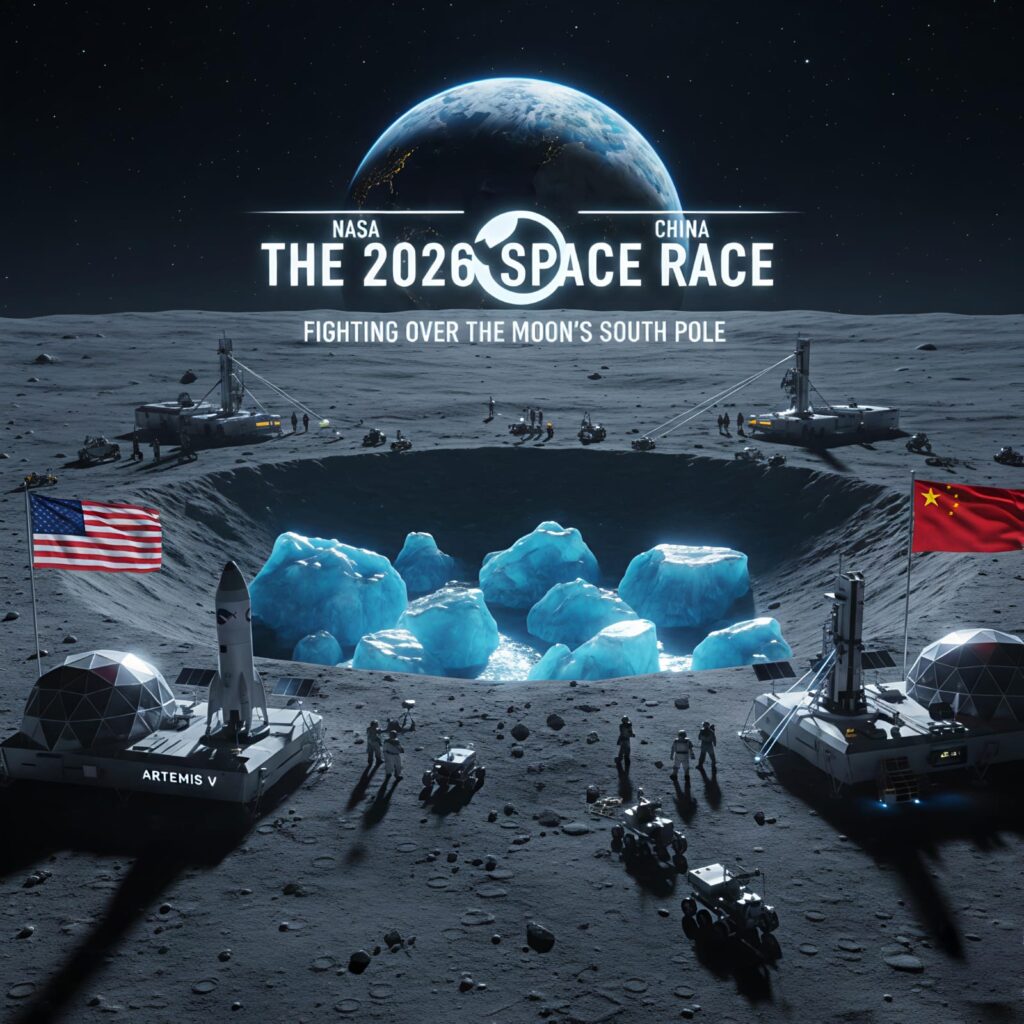
The year 2026 stands as the most significant year for space exploration since 1969. Furthermore, it marks the moment when the “New Space Race” shifts from theoretical planning into high-stakes physical confrontation. Consequently, the eyes of every major superpower are fixed on a rugged, cratered region at the bottom of our celestial neighbor. This article explores the intricate details of the 2026 Space Race and explains exactly why NASA and China are fighting over the Moon South Pole.
The Strategic Goldmine: Why the South Pole?
To the casual observer, the Moon looks like a uniform grey rock. However, the Moon South Pole is entirely different from the equatorial regions visited by the Apollo astronauts. In contrast to those flat, dusty plains, the South Pole is a landscape of extremes.
The Power of Water Ice
The primary reason for the 2026 Space Race is the presence of water ice. This is not just about having something to drink. Instead, water is the “oil” of the solar system.
Fuel Production: Through electrolysis, water ($H_2O$) is split into hydrogen and oxygen. Consequently, this creates high-energy rocket propellant.
Radiation Shielding: Water is an excellent shield against cosmic rays. Therefore, lunar bases covered in ice layers will be safer for humans.
Oxygen Supply: By extracting oxygen from ice, colonies can become self-sustaining.
Furthermore, the Moon South Pole contains “Peaks of Eternal Light.” These are high-altitude ridges that receive sunlight for nearly 90% of the lunar year. Because the Moon’s axis is tilted only 1.5 degrees, these peaks never fall into total darkness. Consequently, they are the only places in the solar system where solar power can be generated almost continuously.
NASA’s Artemis III: The 2026 Milestone
NASA is currently executing the most complex engineering feat in human history. The Artemis Program is the backbone of the American entry into the 2026 Space Race. Furthermore, NASA is not going alone. They have recruited a coalition of over 40 nations through the Artemis Accords.
The Logistics of the Mission
By 2026, NASA aims to have the Gateway—a small space station orbiting the Moon—partially operational. Furthermore, the Artemis III mission is slated to land the first humans near the Moon South Pole.
The SLS Rocket: This is the most powerful rocket ever built by NASA. Consequently, it provides the massive thrust needed to send the Orion capsule toward the Moon.
The SpaceX Starship HLS: NASA has partnered with Elon Musk’s SpaceX to create a Human Landing System (HLS). In contrast to the tiny Apollo landers, the Starship is a skyscraper-sized vessel capable of carrying tons of cargo.
The Axiom Suits: New, flexible spacesuits will allow astronauts to walk into the freezing, dark craters to collect ice samples.
Furthermore, the 2026 timeline is tight. If SpaceX faces delays in their orbital refueling tests, the US might see its lead in the 2026 Space Race slip. Consequently, the pressure on private contractors is at an all-time high.
China’s ILRS: The Long March to Lunar Dominance
China is no longer a “follower” in space. Instead, they have become a formidable peer competitor. The China National Space Administration (CNSA) is developing the International Lunar Research Station (ILRS). This is a direct rival to NASA’s Artemis.
The Chang’e 7 Expedition (2026)
In 2026, China will launch Chang’e 7. This is not a simple lander. Furthermore, it is a multi-part mission designed to scout the best spots for a permanent base at the Moon South Pole.
The Hopper: A small, rocket-powered robot that will “jump” into shadowed craters to detect water.
The Relay Satellite: Since the South Pole is difficult for radio waves to reach, China is placing advanced satellites in “Halo Orbits.”
The Precision Lander: China has demonstrated incredible landing accuracy with Chang’e 4 and 5. Consequently, they are confident they can land closer to the ice deposits than anyone else.
In contrast to NASA’s democratic and often fluctuating budget process, China’s space program enjoys consistent, long-term funding from the state. Therefore, they are often able to hit their deadlines with surgical precision. This consistency is a major factor in the 2026 Space Race.
The “Safety Zone” Conflict: A Legal Battleground
Why use the word “fighting”? In contrast to a traditional war, this is a battle of geopolitical positioning and international law.
The 1967 Outer Space Treaty
This treaty states that “Outer space, including the Moon and other celestial bodies, is not subject to national appropriation by claim of sovereignty.” However, the treaty does not mention mining.
The Artemis Accords vs. The ILRS
NASA’s Artemis Accords introduce the concept of “Safety Zones.” These are areas around a base where other nations are not allowed to interfere.
The US View: These zones are necessary to prevent accidents and “dust blasting” from landing rockets.
The Chinese View: China argues that these zones are a “de facto” land grab. They claim that by declaring a 10km safety zone around a prime water source, the US is effectively claiming that land.
Consequently, the 2026 Space Race is a race to see who can “occupy” the best spots first. Furthermore, if two missions try to land at the same crater rim, the risk of a diplomatic crisis is massive.
Economic Incentives: The Cislunar Economy
The 2026 Space Race is fueled by more than just science. Furthermore, there is a trillion-dollar economy at stake. Experts call this the Cislunar Economy—the business of space between Earth and the Moon.
Helium-3: The Future of Energy
The Moon’s surface is rich in Helium-3, an isotope that is rare on Earth but abundant in lunar regolith. Furthermore, Helium-3 could be the perfect fuel for Nuclear Fusion reactors. Consequently, the nation that mines the Moon first could power the Earth for the next thousand years.
Rare Earth Metals
The Moon contains significant deposits of titanium, aluminum, and rare earth metals. In contrast to Earth, where mining is environmentally destructive and regulated, the Moon offers a “limitless” supply of industrial materials.
The Gateway to Mars
Launching a mission to Mars from Earth requires an incredible amount of fuel just to escape Earth’s gravity. However, launching from the Moon South Pole is much easier. Therefore, the Moon is the “Staging Ground” for the rest of the solar system.
Living on the Edge: The Technology of 2026
Survival at the Moon South Pole requires technology that didn’t exist five years ago. Consequently, the 2026 Space Race is driving a massive wave of innovation.
3D Printing Bases
Shipping bricks to the Moon is impossible. Instead, NASA and China are developing Regolith Sintering. This involves using lasers or microwaves to melt lunar dust into solid structures. Furthermore, China’s 2026 missions include experiments for “lunar brick” manufacturing.
Nuclear Fission Power
Solar power fails during the 14-day lunar night (though less so at the poles). Consequently, both nations are building Small Modular Reactors (SMRs). These are compact nuclear power plants the size of a trash can. They provide constant, reliable electricity to keep life-support systems running.
Autonomous Mining
Human miners are expensive and fragile. Therefore, the 2026 Space Race will see a fleet of autonomous robots. These machines will crawl into the shadows, scrape the ice, and process it into fuel without any human intervention.
The Risks: What Could Go Wrong?
The 2026 Space Race is fraught with danger. Furthermore, a single failure could set human exploration back by decades.
Space Debris: As more rockets launch, the risk of “Kessler Syndrome” in lunar orbit increases.
Biological Contamination: If we find “life” or organic molecules on the Moon, landing human missions could contaminate the site before we can study it.
Political Fallout: If a Chinese rover accidentally crashes into a NASA lander, the resulting tension could spill over into terrestrial politics.
Consequently, the world needs a “Lunar Traffic Control” system. However, in the heat of the 2026 Space Race, neither side seems willing to share data openly.
Expert Strategy: How to Follow the 2026 Space Race
As a Senior SEO Content Strategist, I have analyzed the “keywords” of this conflict. To truly understand who is winning, you must look beyond the press releases.
1. Watch the Launch Windows
Spacecraft can’t launch any time they want. Furthermore, they must wait for specific “windows” when the Moon is in the right position. Consequently, if a mission misses its window in 2026, it may have to wait months or years to try again.
2. Monitor the “Starship” Progress
NASA’s entire strategy depends on SpaceX. In contrast, China uses traditional, state-built rockets like the Long March 5 and the upcoming Long March 10. If SpaceX hits a snag, China will take the lead by default.
3. Track the Alliances
Watch who signs the Artemis Accords in 2025 and 2026. Furthermore, watch which nations join China’s ILRS. The 2026 Space Race is essentially a “Lego set” of alliances. The side with the most partners shares the most cos
The Human Element: Why It Matters to You
You might ask, “Why should I care about a fight over a cold crater?” The answer is simple: Inspiration and Economy.
The 2026 Space Race will create millions of jobs in STEM, engineering, and data science. Furthermore, the technologies developed for the Moon South Pole—like advanced water purification and compact nuclear power—will eventually be used to solve climate change and water scarcity on Earth.
Consequently, the “fight” is actually a catalyst for human progress. In contrast to the stagnant decades following the 1970s, we are finally moving forwar
Conclusion: The Final Frontier of 2026
In conclusion, the 2026 Space Race represents the ultimate test of human ingenuity. NASA and China are fighting over the Moon South Pole because it is the “High Ground” of the 21st century. It offers water, power, and a path to the rest of the stars.
Furthermore, this competition is not just about who gets there first. Instead, it is about who can stay there. Establishing a permanent presence at the Moon South Pole will redefine what it means to be a “multi-planetary species.”
The year 2026 will be remembered as the year we stopped visiting the Moon and started living on it. Consequently, the decisions made by NASA and China today will echo for generations to come.
Summary Checklist of the 2026 Space Race:
The Goal: Dominate the Moon South Pole for water ice and solar power.
The NASA Strategy: Use the Artemis Program and private partners like SpaceX.
The China Strategy: Use the ILRS and consistent state-funded robotic missions like Chang’e 7.
The Conflict: Disputes over “Safety Zones” and mining rights under international law.
The Outcome: The winner controls the “gas station” to Mars and the future of lunar energy.
About the Author