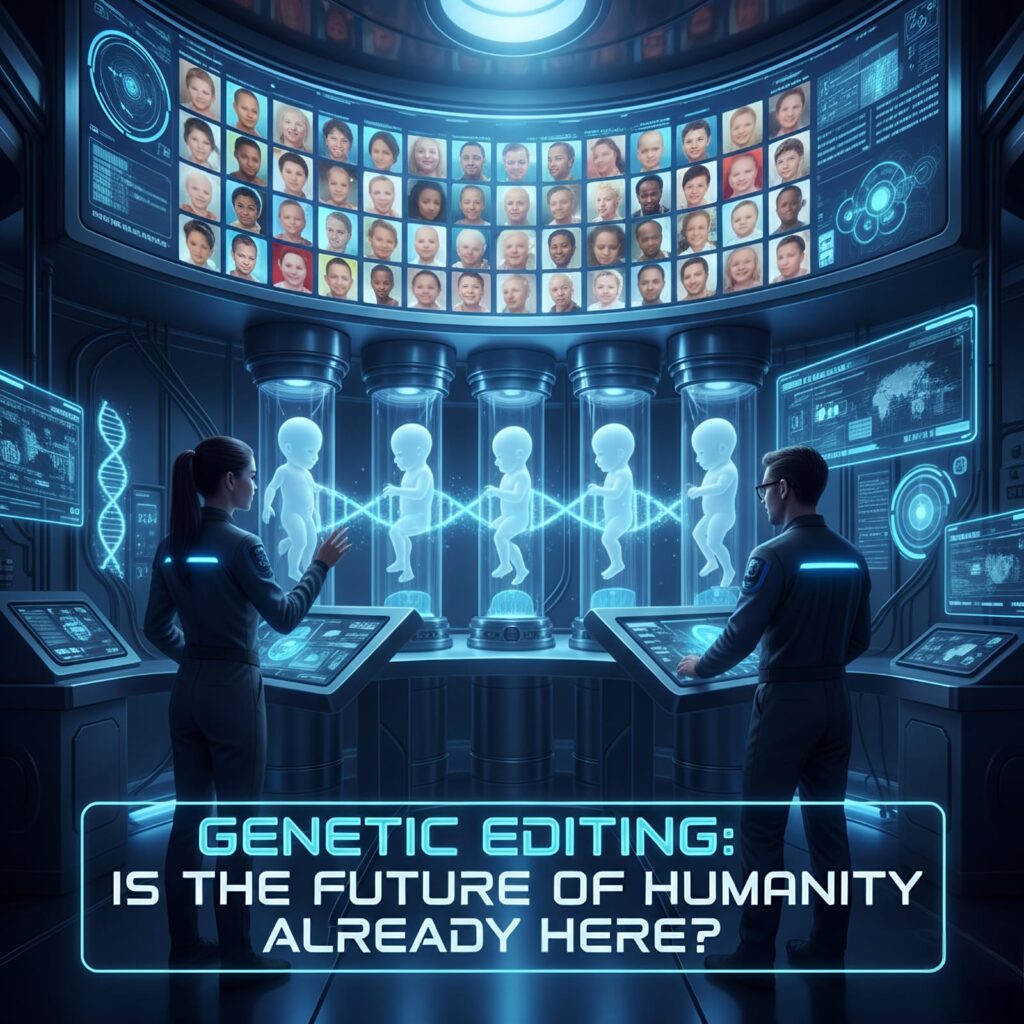
The concept of Genetic Editing often feels like a plot point pulled directly from a high-budget sci-fi movie. We imagine gleaming laboratories where parents pick out eye colors or athletic prowess from a digital menu. However, recent whispers in the scientific community suggest that the future we once feared—or anticipated—might already be knocking on our door. Consequently, we must ask ourselves: is the era of “Designer Babies” technology secretly already here?
The Invisible Evolution of Genetic Editing
For decades, scientists have toyed with the building blocks of life. Nevertheless, the public largely viewed these experiments as distant possibilities. Everything changed with the advent of CRISPR-Cas9, a molecular tool that acts like a pair of high-precision scissors for DNA. While most researchers focus on curing debilitating diseases, the door to more controversial applications has swung wide open.
Furthermore, the transition from therapeutic healing to “enhancement” is a slippery slope. Many experts argue that the technology required to create “Designer Babies” does not require a massive breakthrough; instead, it simply requires the courage—or the recklessness—to use what we already have.
Why the Term “Secretly” Matters
When we talk about “secret” technology, we aren’t necessarily referring to underground bunkers. Instead, we are looking at the “gray zones” of international law. For example, while many Western countries strictly regulate Genetic Editing on human embryos, other nations maintain much looser oversight. In contrast to public consensus, private clinics might already be pushing the boundaries of what is ethically permissible.
Furthermore, the rise of “biohacking” communities suggests that the tools for Genetic Editing are no longer confined to billion-dollar institutions. Consequently, the possibility of an off-the-grid “designer” experiment is higher than most governments care to admit.
The He Jiankui Incident: A Warning Shot
In 2018, the world gasped when Chinese scientist He Jiankui announced the birth of the first gene-edited infants. By using Genetic Editing to make the twins resistant to HIV, he effectively bypassed every international ethical standard. Consequently, he proved that the technology for “Designer Babies” is not just theoretical; it is functional and available.
The Goal: Immunity to specific viruses.
The Method: Deleting the CCR5 gene during the embryonic stage.
The Result: Two healthy girls, Lulu and Nana, but a world left in ethical turmoil.
This event served as a wake-up call. If one scientist could achieve this in a standard lab years ago, what are well-funded, private entities doing behind closed doors today? Furthermore, the rapid advancement of Genetic Editing suggests that the “Pandora’s Box” is not just cracked; it is wide open.
How “Designer Babies” Technology Works Today
To understand if this technology is already among us, we must look at the current state of reproductive science. Most parents today already use a form of “selection” that borders on the early stages of Genetic Editing.
Preimplantation Genetic Diagnosis (PGD)
Currently, couples undergoing IVF can screen embryos for genetic disorders. However, this process has evolved significantly. Parents can now screen for:
Biological Sex: Choosing a boy or a girl with 100% certainty.
Hair and Eye Color: Identifying specific aesthetic traits through polygenic risk scores.
Polygenic Scores: Predicting the likelihood of high IQ, athletic ability, or even personality traits like extroversion.
The Rise of “Prime Editing” and “Base Editing”
While CRISPR was the first big name, Prime Editing is the new gold standard. It allows for even more precise changes to the DNA sequence without breaking the double helix strands. Therefore, the risk of “off-target” mutations—the primary concern of critics—is plummeting. As the precision of Genetic Editing increases, the feasibility of “Designer Babies” becomes a mathematical certainty rather than a scientific dream.
The Economics of Genetic Superiority
The most significant indicator that “Designer Babies” technology is already here is the flow of capital. Silicon Valley billionaires are notoriously obsessed with longevity and “optimization.” Consequently, venture capital is pouring into startups that specialize in Genetic Editing.
In contrast to public healthcare, these private firms operate with a “pay-to-play” model. If a wealthy family wants to ensure their offspring has a genetic advantage in cognitive processing, there is likely a boutique clinic somewhere in the world willing to facilitate that request. Furthermore, the lack of a global registry for gene-edited humans means we might already be living alongside individuals who have been “enhanced” without our knowledge.
The Hidden Market for Elite Traits
Height: Studies have already identified the clusters of genes responsible for stature.
Muscle Density: The MSTN gene can be edited to produce extraordinary strength and speed.
Sleep Efficiency: Some people possess a rare gene (DEC2) that allows them to thrive on only four hours of sleep.
By targeting these specific markers, Genetic Editing moves from the realm of medicine into the realm of luxury consumer goods. Consequently, the divide between the “haves” and “have-nots” could soon become biological.
Ethical Red Lines: Are We Playing God?
The primary argument against “Designer Babies” is the fear of creating a “genetic underclass.” If only the wealthy can afford Genetic Editing, then social inequality becomes baked into our very DNA. Furthermore, we do not yet know the long-term effects of altering the human germline.
Consequently, the scientific community remains deeply divided. Some argue that it is our moral imperative to use Genetic Editing to eliminate suffering and inherited diseases. In contrast, others believe that tinkering with our DNA will lead to unforeseen ecological and social disasters. Nevertheless, the speed of innovation continues to outpace the speed of legislation.
Global Hotspots for Genetic Innovation
While the United States and Europe debate the ethics, other regions are sprinting ahead. Countries with less stringent regulatory frameworks are becoming hubs for “Genetic Tourism.”
Island Nations: Several small nations offer “medical freedom” zones where Genetic Editing is lightly regulated or entirely overlooked.
Developing Tech Hubs: Areas with high-tech infrastructure but low legal oversight are perfect for “Designer Babies” research.
Private Seasteading: Some tech moguls have even proposed floating laboratories in international waters to escape government jurisdiction entirely.
Furthermore, the competitive nature of global politics plays a role. If one nation begins producing “enhanced” citizens with higher IQs or better health, other nations will feel pressured to follow suit to maintain their competitive edge. Consequently, we are entering a “Genetic Arms Race.”
The Role of AI in Accelerating Genetic Editing
Artificial Intelligence has acted as a massive catalyst for Genetic Editing. Previously, mapping the effects of a single gene change was a laborious process that took years. Now, AI algorithms can simulate millions of genetic variations in seconds. Consequently, the “guessing game” of creating “Designer Babies” is over.
AI can predict exactly how a specific edit will manifest in a human being. This synergy between Silicon (AI) and Carbon (DNA) is why many experts believe the technology has secretly matured. We are no longer throwing darts in the dark; we are using laser-guided systems to rewrite the human code. Furthermore, AI helps in identifying “junk DNA” that might actually hold the key to advanced human traits.
The Social Stigma and the “Hidden” Generation
If “Designer Babies” are already among us, they likely live lives of quiet privilege. Parents who have utilized Genetic Editing would have every reason to keep it a secret. Public backlash, legal repercussions, and social stigma would be immense.
Consequently, we might have a “hidden” generation of children who are slightly faster, slightly smarter, and significantly more resistant to disease. In contrast to the natural-born population, these individuals would have an unfair advantage in every aspect of life, from academics to athletics. This creates a ghost in the machine of our meritocracy.
The Biological Risks: A Pandora’s Box
The human genome is not a simple list of instructions; it is an incredibly complex ecosystem. Consequently, when we perform Genetic Editing to enhance one trait, we may inadvertently damage another. This is known as pleiotropy. For example, a gene that enhances memory might also increase the risk of chronic pain.
Furthermore, the “off-target” effects of Genetic Editing remain a significant concern. Even with Prime Editing, there is a risk that the “molecular scissors” will cut the wrong part of the genome. In a laboratory setting, this is a failed experiment. In the context of “Designer Babies”, this is a human life with a permanent, potentially lethal genetic error.
The Philosophy of Perfection
Why are we so obsessed with Genetic Editing? Consequently, we must look at our cultural obsession with perfection. From social media filters to cosmetic surgery, we are constantly trying to “upgrade” ourselves. “Designer Babies” represent the final frontier of this trend.
However, many philosophers argue that human value lies in our flaws and our diversity. If we use Genetic Editing to create a homogenized version of “perfect” humans, we risk losing the very things that make us resilient as a species. Furthermore, a world where every child is “designed” is a world where the element of surprise—the cornerstone of human experience—is extinguished.
The “Gene-Rich” vs. the “Gene-Poor”
Sociologist Lee Silver coined the term “Remodern” to describe a future where humans diverge into two species based on Genetic Editing. The “Gene-Rich” would be the descendants of “Designer Babies”, possessing superior health, intelligence, and longevity. In contrast, the “Gene-Poor” would be those born through natural means, relegated to the lower tiers of society.
This is not just a social theory; it is a potential biological reality. If Genetic Editing becomes a standard practice for the elite, the gap between social classes will become permanent. Consequently, we must ask if our current legal frameworks are strong enough to prevent this “biological feudalism.”
Case Study: The “Super-Athlete” Gene
Consider the ACTN3 gene, often called the “sprinter gene.” Research shows that almost every Olympic-level power athlete has a specific version of this gene. Consequently, if parents can use Genetic Editing to ensure their child has the ACTN3 variant, they are essentially pre-programming an athletic career.
Furthermore, if this practice becomes widespread, “natural” athletes will no longer be able to compete. This raises a massive ethical question for the world of sports: will we need separate Olympic Games for “Designer Babies”? Consequently, the very definition of “achievement” is currently under threat by Genetic Editing.
Religious and Cultural Perspectives
In contrast to the secular scientific debate, religious groups offer a different lens on Genetic Editing. Many believe that life is a gift, not a product to be manufactured. Consequently, the idea of “Designer Babies” is seen as a violation of the sacred nature of human life.
Furthermore, different cultures have different definitions of what a “desirable” trait is. While Western cultures might prioritize individual intelligence, other cultures might prioritize communal traits or physical resilience. Consequently, Genetic Editing could lead to a global cultural conflict over the “ideal” human template.
Practical Advice: How to Engage with the Biotech Revolution
Since Genetic Editing is likely here to stay, how can the average person stay informed and involved?
Educate Yourself on the Basics: Understand the difference between “somatic” and “germline” cells.
Support Ethical Research: Many companies use Genetic Editing for purely medical reasons, such as curing blindness. Support these over “enhancement” firms.
Engage in Local Policy: Write to your representatives about the need for strict oversight of Genetic Editing clinics.
Promote Genetic Diversity: Advocate for a society that values all types of human biological expressions, not just those deemed “optimal.”
The Inevitability of the Technology
Despite the protests, many scientists believe that Genetic Editing is an inevitable part of our evolution. Just as we moved from hunting and gathering to agriculture, we are now moving from natural selection to “intentional selection.” Consequently, the era of “Designer Babies” may simply be the next stage in the history of life on Earth.
Furthermore, the technology is becoming more accessible every day. “DIY” CRISPR kits are available online for a few hundred dollars. While these are meant for bacteria, the barrier to entry for Genetic Editing is falling rapidly. Consequently, the “secret” labs of the future might not be in skyscrapers, but in suburban garages.
Conclusion: A Call for Global Wisdom
In summary, the evidence suggests that Genetic Editing has already crossed the threshold into the realm of “Designer Babies”. While we may not see advertisements for “super-children” on billboards yet, the technical capability, the economic incentive, and the historical precedents are all in place.
The technology is likely being refined in private labs and less-regulated jurisdictions as we speak. Consequently, the “secret” isn’t that the technology exists; the secret is how widespread it has already become. We are standing at the dawn of a new era of human evolution—one that we are writing ourselves.
Furthermore, the conversation around Genetic Editing is no longer a debate about the future. It is a debate about the present. As we look at the rapid integration of biotech into our lives, it becomes clear that the first “designer” generation may already be among us, growing up in a world that is only just beginning to understand their existence. We must act now to ensure that this power is used to uplift humanity as a whole, rather than divide it further.
About the Author