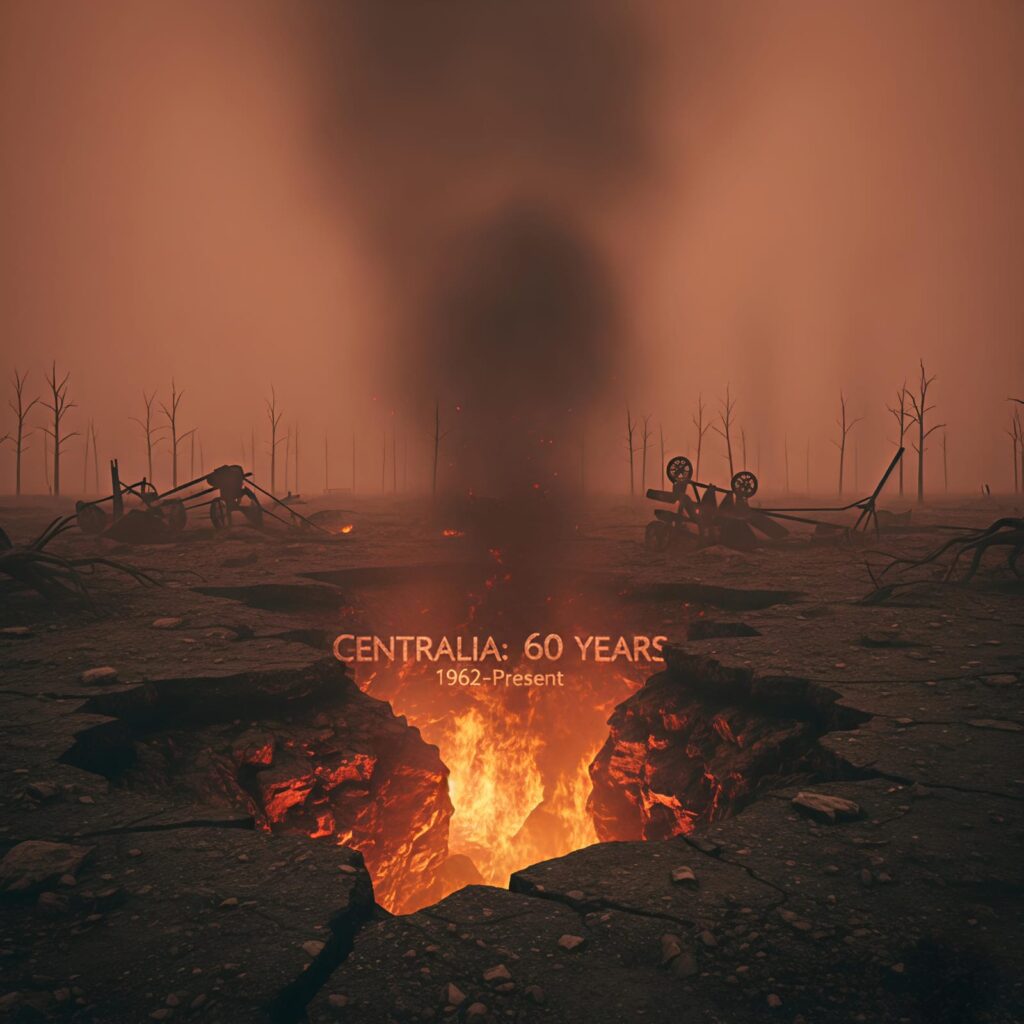
Imagine a place where the earth breathes fire and the streets lead to nowhere. Specifically, you are visualizing Centralia, Pennsylvania: The real silent hill town that has been burning for 60 years. Currently, this location stands as a haunting grid of abandoned sidewalks and scorched earth in Columbia County. However, it was not always a desolate wasteland. Previously, it boasted a vibrant community of over 1,000 residents who lived, worked, and played atop the Appalachian coal veins. Unfortunately, a subterranean inferno now consumes the ground beneath their former porches. Consequently, this disaster created one of America’s most eerie and fascinating landmarks. Furthermore, it serves as a grim reminder of how human error can permanently alter the natural world.
The Spark That Ignited a 60-Year Nightmare
To understand this tragedy, we must examine the events of May 1962. At that time, the Centralia Borough Council faced a mundane problem with an overflowing landfill. Therefore, they hired five volunteer firefighters to clean up the dump site near the Odd Fellows Cemetery. Routinely, these firefighters set the trash ablaze to reduce its volume before Memorial Day celebrations. Subsequently, they doused the visible flames with water and went home.
However, they missed a critical, hidden detail. Unbeknownst to them, the landfill sat inside an old strip-mine pit that lacked a fireproof clay seal. As a result, embers slipped through a hole in the pit floor. Instantly, these embers entered the labyrinth of abandoned coal mines. Consequently, the fire ignited the massive anthracite coal seam. Unlike other fuels, anthracite coal contains high carbon and burns with incredible intensity and durability. Thus, the fire took root deep underground where no hose could reach it. Eventually, it began to spread beneath the town’s streets, schools, and houses.
The Decades of Denial and Danger
Initially, the residents of Centralia did not realize the scale of the threat. Instead, they only noticed foul odors in their backyards. But soon, the situation worsened dramatically. Alarmingly, carbon monoxide detectors began to scream in residential basements. Despite these warning signs, government officials delayed effective action for decades. For years, they debated the costs of trenching versus flushing the mines with sand. Meanwhile, the fire expanded relentlessly through the oxygen-rich tunnels.
Consequently, the families in Centralia, Pennsylvania: The real silent hill town that has been burning for 60 years lived atop a ticking time bomb. Furthermore, the ground itself became unstable as the coal turned to ash and collapsed. Indeed, the danger became undeniable on Valentine’s Day, 1981, when a young boy nearly lost his life.
The Day the Earth Swallowed Todd Domboski
On that day, 12-year-old Todd Domboski walked into his grandmother’s yard to investigate a wisp of smoke. Suddenly, a sinkhole opened beneath his feet. Terrifyingly, the boy plunged into the earth. Luckily, he grabbed a tree root and screamed for his life. Swiftly, his cousin pulled him from the toxic, steam-filled hole. Because of this near-tragedy, the U.S. Congress finally paid attention. Ultimately, they allocated $42 million to relocate the town’s residents. Consequently, most families took the buyout and fled the burning mountain.
Centralia vs. Silent Hill: Fact and Fiction
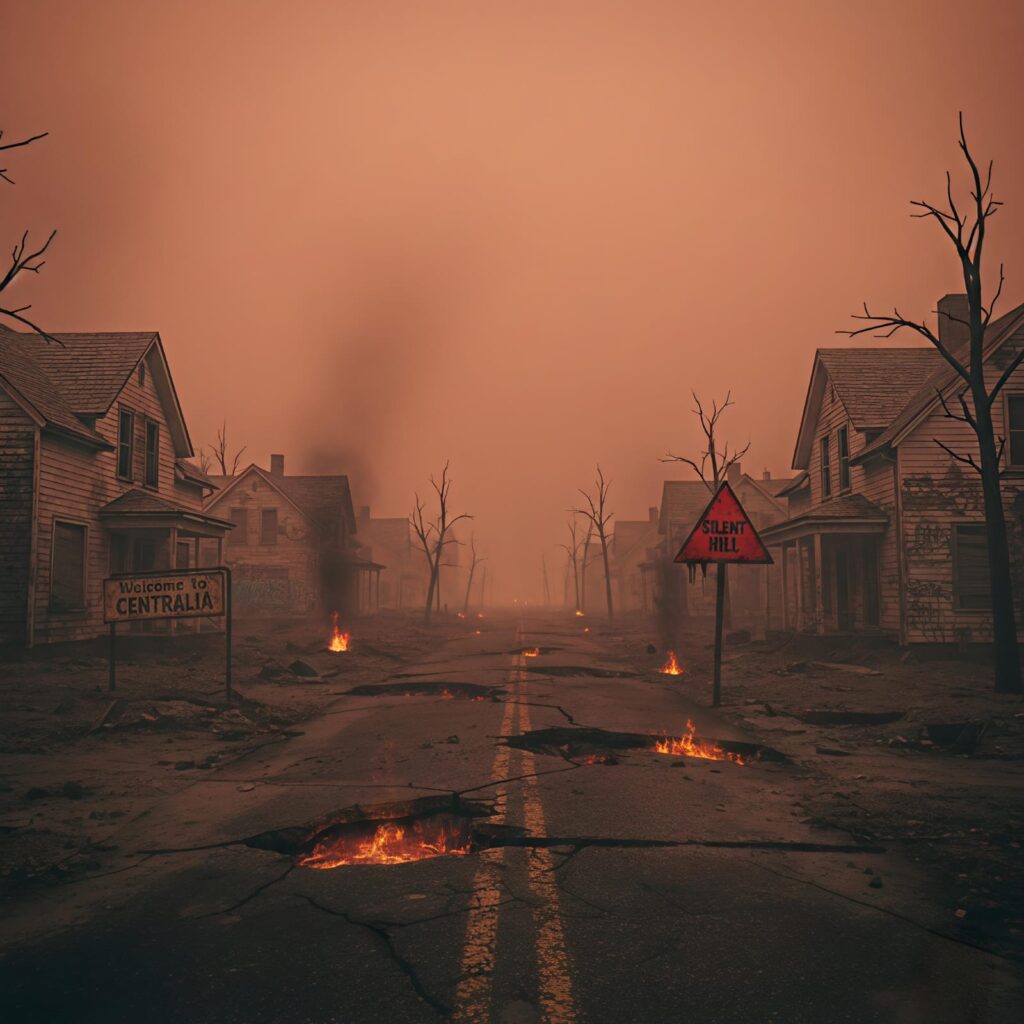
Frequently, pop culture enthusiasts link this town to the horror franchise Silent Hill. In fact, the 2006 film’s director, Christophe Gans, explicitly cited Centralia as his visual inspiration. However, we must distinguish Hollywood myth from historical reality.
First, the movie depicts ash falling like snow from a gray sky. In contrast, real-life Centralia experiences steam and sulfurous smoke, but rarely falling ash.
Second, the film features supernatural monsters and cults. Conversely, the real dangers in Centralia, Pennsylvania: The real silent hill town that has been burning for 60 years include silent gases and shifting ground.
Third, the movie suggests the town is cursed. Similarly, some residents believed the fire was a punishment. Nevertheless, the cause was purely mechanical and human-led.
Finally, the movie shows a town trapped in time. Similarly, Centralia feels frozen, yet it is slowly being reclaimed by the forest.
The Legend and Loss of the Graffiti Highway
For decades, visitors flocked to a closed section of Route 61. Originally, the subterranean heat damaged this road, causing the asphalt to buckle and crack. Therefore, the state closed it in 1993 and diverted traffic. Subsequently, artists and tourists covered the pavement in vibrant spray paint. Thus, it earned the name “Graffiti Highway.”
However, you cannot visit this landmark today. Recently, in April 2020, the land’s private owners decided to cover the road. Citing liability concerns and illegal gatherings, they dumped thousands of tons of dirt over the artwork. Now, mounds of earth bury the famous highway. Consequently, Centralia, Pennsylvania: The real silent hill town that has been burning for 60 years has lost its most colorful attraction to the dirt. Nevertheless, the legend of the highway lives on in thousands of photographs.
A Deep Dive into the Anthracite Inferno
To appreciate why this fire persists, we must look at the geology of the region. Specifically, the anthracite coal in Pennsylvania is some of the hardest and most energy-dense coal on Earth. Because the mines are so deep and complex, they provide a constant supply of oxygen. Therefore, the fire behaves like a giant underground furnace. Moreover, the heat stays trapped within the rock layers. As a result, the fire does not need a massive flame to survive. Instead, it smolders at temperatures exceeding 1,000 degrees Fahrenheit.
Furthermore, the fire moves in unpredictable patterns. Sometimes, it follows a coal seam for miles. Other times, it stays stagnant in one area for years. Consequently, firefighters cannot simply “put it out.” Indeed, experts estimate that it would take billions of dollars to excavate the entire mountain. Thus, the government decided it was cheaper to move the people than to stop the fire.
The Ghost Town That Still Breathes
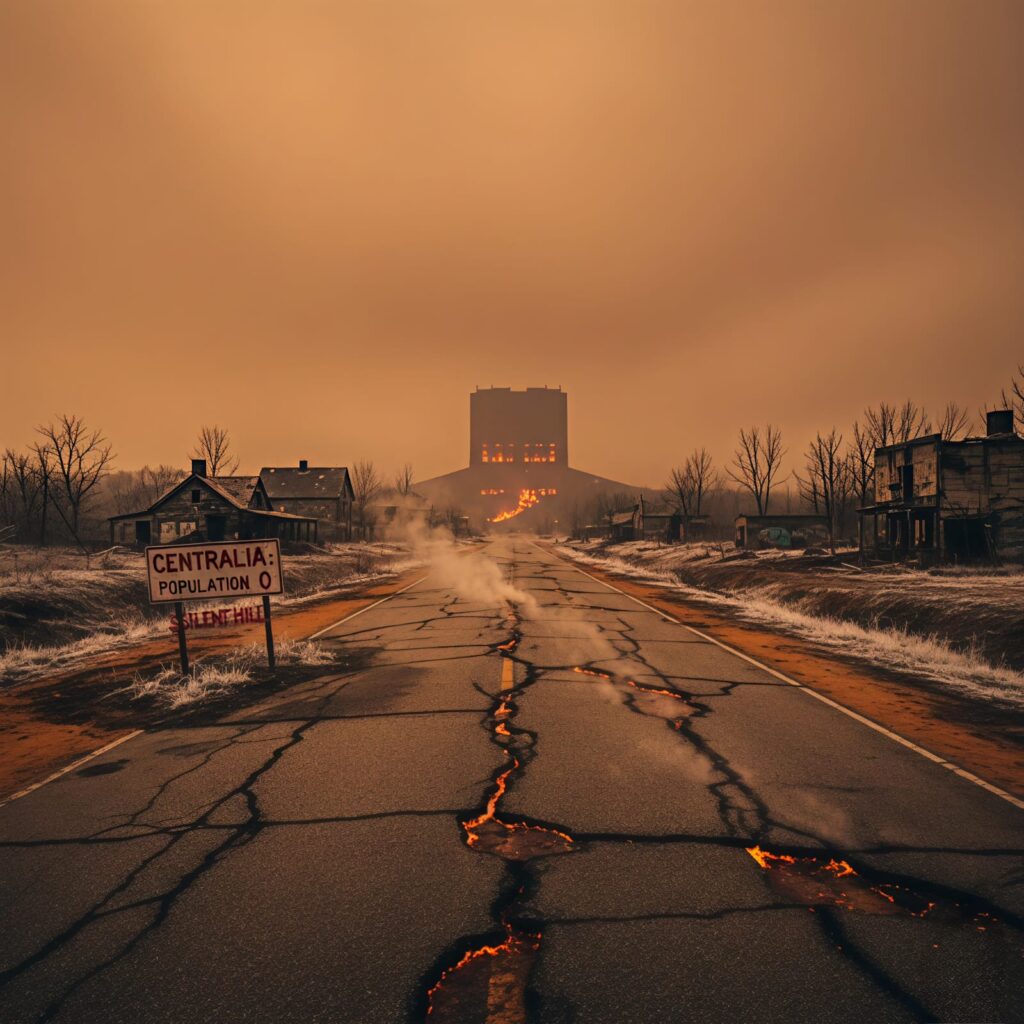
Today, walking through Centralia is a surreal experience. Usually, you expect a ghost town to have ruins. However, in Centralia, the houses are almost entirely gone. Instead, you see “ghost streets.” Specifically, these are paved roads with curbs and stop signs that lead to empty, grassy lots. Furthermore, you might see stone steps that once led to a front door. Now, they lead only to overgrown weeds and silence.
Occasionally, you will see the physical evidence of the fire. On cold days, steam vents from the hillsides. Moreover, the smell of sulfur—resembling rotten eggs—clings to the air in certain zones. Clearly, the town is still “breathing.” However, it is a poisonous breath. Therefore, visitors should never linger near active smoke vents.
The Last Holdouts: Resistance in the Burn Zone
Surprisingly, a few residents still call Centralia home. Despite the mandatory relocation and the state’s attempts to seize properties, a small group fought to stay. Eventually, they reached a legal settlement in 2013. According to the agreement, they can live out their lives in their homes. However, once they pass away, the state will take ownership and demolish the structures.
Consequently, these residents are the final guardians of the town. Moreover, they maintain their properties with pride. Indeed, you will see neatly mowed lawns next to smoking fissures. Because they have lived here for decades, they do not fear the fire. Instead, they fear the loss of their community’s history. Therefore, visitors should treat these residents with the utmost respect and privacy.
Exploring the Remaining Landmarks
While much of the town is gone, a few key sites remain for those visiting Centralia, Pennsylvania: The real silent hill town that has been burning for 60 years.
1. The Ukrainian Catholic Church
Perched on a hill overlooking the town, the Assumption of the Blessed Virgin Mary Church remains untouched. Remarkably, the coal seams beneath the church are separated by solid rock that the fire cannot penetrate. Consequently, it stands as a beacon of hope. Moreover, people still travel from surrounding towns to attend services here.
2. The Three Cemeteries
Centralia has more dead residents than living ones. Specifically, three cemeteries sit within the borough limits. Oftentimes, these are the only places where you can see the names of the families who built this town. Furthermore, the cemeteries are well-maintained. Indeed, they offer the best vantage points for seeing the smoke on cold mornings.
3. The Municipal Building
Standing as one of the last original structures, the municipal building houses a lonely fire truck. Although the town has no official government, this building serves as a symbol of what once was. Moreover, it marks the center of what was once a bustling downtown district.
The Environmental Impact of a Century-Long Burn
Beyond the human tragedy, we must consider the environmental toll. Primarily, the fire releases massive amounts of carbon dioxide and methane into the atmosphere. Furthermore, the subterranean heat kills the root systems of the trees above. As a result, “kill zones” exist where only bleached, dead trees remain. Moreover, the sulfur runoff can contaminate local water tables.
Consequently, the landscape of Centralia, Pennsylvania: The real silent hill town that has been burning for 60 years is a scarred one. Nevertheless, nature is slowly trying to adapt. Often, you will see hearty shrubs growing in the cracks of the abandoned streets. In fact, the forest is swallowing the town faster than the fire is. Thus, in another 50 years, the street grid may disappear entirely under a canopy of green.
Visiting Centralia in 2026: What You Need to Know
If you decide to visit this haunting location, you must prepare correctly. First, check the weather. Because the steam is only visible when the air is cold, winter and early spring are the best times to go. Second, wear sturdy boots. Since the ground can be unstable, you need good ankle support. Third, bring a map. Although the town is small, the lack of landmarks can make it disorienting.
Furthermore, follow these ethical guidelines:
Never trespass on the remaining residential properties.
Avoid entering the smoke plumes, as they contain high levels of carbon monoxide.
Do not spray paint the trees or the remaining stone structures.
Always carry out your trash to keep the site clean.
The Science of Extinguishing a Coal Fire
Many people ask why we cannot simply put out the fire. Theoretically, we could. However, the practical challenges are immense. For instance, you would have to dig up hundreds of acres of earth to a depth of several hundred feet. Subsequently, you would have to quench the glowing coal and move it to a safe location. Furthermore, the cost would likely exceed $1 billion. Given that the town is already empty, the government sees no economic reason to spend that money.
Alternatively, some suggest flooding the mines with water. Unfortunately, this would likely create massive steam explosions. Moreover, the water would turn into acidic runoff, destroying the regional ecosystem. Therefore, the current strategy is “monitored neglect.” Essentially, the state lets the fire burn while ensuring it does not spread to nearby towns like Ashland or Mount Carmel.
A Legacy of Resilience and Loss
In summary, the story of Centralia, Pennsylvania: The real silent hill town that has been burning for 60 years is a complex tapestry of industrial pride and environmental disaster. Clearly, it shows how fragile our communities are when faced with the forces of nature. Yet, it also shows the resilience of the human spirit. Indeed, the families who lived here still hold reunions. Furthermore, they keep the memory of their town alive through stories and photographs.
Today, the town is a pilgrimage site for urban explorers and historians. Moreover, it serves as a laboratory for geologists studying mine fires. Ultimately, Centralia is a place where the past is literally burning beneath the present. Whether you view it as a horror story or a historical tragedy, you cannot deny its power.
The 250-Year Forecast
Looking forward, what is the fate of this burning town? Geologists estimate that there is enough coal to fuel the fire for at least another two centuries. Consequently, future generations will likely continue to visit this smoking landscape. Eventually, the fire will hit a natural barrier or run out of fuel. Until then, the smoke will continue to rise.
Moreover, as the remaining houses are eventually demolished, the town will transition into a state forest. Thus, the only evidence of Centralia will be the names on the gravestones and the heat in the ground. In conclusion, Centralia, Pennsylvania: The real silent hill town that has been burning for 60 years remains a unique, somber chapter in American history. It is a town that was, a fire that is, and a legend that will always be.
Key Statistics Table
| Feature | Data Point |
| Year Fire Started | 1962 |
| Original Population | 1,100+ |
| Current Population | < 5 |
| Estimated End of Fire | Year 2270+ |
| Key Landmark | Ukrainian Catholic Church |
| Primary Danger | Sinkholes & Toxic Gas |
| Major Media Link | Silent Hill Inspiration |
The Cultural Impact of Centralia
Interestingly, the town’s influence extends beyond film. For example, many novelists have used Centralia as a setting for post-apocalyptic stories. Additionally, photographers find the “dead zone” aesthetics perfect for capturing the concept of the Anthropocene. Because the town represents a failed struggle between man and nature, it resonates with modern environmental movements. Consequently, the town has become a symbol of what happens when we ignore the hidden costs of our energy needs.
Furthermore, the “Silent Hill” nickname has brought an influx of younger tourists who might otherwise never learn about Pennsylvania’s coal history. While some locals dislike the horror association, others appreciate that the town is not being forgotten. Indeed, without the movie’s fame, Centralia might have faded into total obscurity. Instead, it remains a top destination for those seeking the weird and the wonderful.
Final Thoughts for the Modern Explorer
If you stand in the center of Centralia today and close your eyes, you can almost hear the ghosts of the past. You can imagine the sounds of children playing and the clinking of miners’ lunch pails. Then, you open your eyes to see the smoke and the empty lots. It is a profound experience that stays with you. Truly, Centralia, Pennsylvania: The real silent hill town that has been burning for 60 years is a place like no other on Earth. It reminds us that the ground we walk upon is not always as solid as it seems.
Therefore, if you have the chance, go and see it before it disappears entirely into the woods. But, remember to walk softly. Because beneath your feet, a giant is sleeping—and he is breathing fire.
About the Author