
Imagine waking up on a Tuesday morning in October 2027. You walk to your local cafe to buy a sandwich and a coffee. You tap your phone on the reader as you always do. Suddenly, a red light flashes on the screen. A message appears on your phone: “Weekly meat quota reached. Transaction denied.” You check your bank app and see you have $5,000 in your account. However, the money simply will not work for that specific purchase. This is the reality of the “Cashless” Trap. As we approach 2027, the world is moving toward Central Bank Digital Currencies (CBDCs). Consequently, the way you think about your savings is about to change forever.
The Silent Shift: Defining the “Cashless” Trap
Initially, the move away from paper money felt like a gift. We all loved the speed of digital apps and tap-to-pay cards. Furthermore, the convenience made life easier for everyone. But beneath the surface, a new system was being built. This system is what experts now call the “Cashless” Trap. Specifically, it is a world where physical cash no longer exists to provide an exit. Therefore, every single cent you own must live inside a digital ledger controlled by the government.
Why Your Bank App is Not a CBDC
Many people think they already live in a cashless world. You might see numbers on a screen, but those are just promises from your commercial bank. In contrast, a CBDC is a direct digital version of the national currency. Specifically, it is a liability of the central bank itself. This means the government does not just watch your money; they actually “issue” and “program” it. Consequently, the “Cashless” Trap creates a direct link between your wallet and the people who write the laws.
The 2027 Countdown: Why the Trap Snaps Shut Soon
Why are analysts pointing to 2027 as the critical year? Currently, in 2026, the technical “pipes” are being laid across the globe. Specifically, the European Central Bank (ECB) has finished its prep work. They expect a massive pilot program to start in mid-2027. Moreover, the United Kingdom is fast-tracking its “Digital Pound” project. In addition, countries like Brazil and Russia are planning full-scale launches within this same window. Therefore, 2027 represents the “point of no return” for global savings.
The End of the Pilot Phase
For the last few years, CBDCs were just a “maybe.” However, the transition from research to reality is happening right now. Specifically, governments are passing laws that give digital coins the same status as paper cash. Once these laws are in place, they can start to “sunset” physical bills. Consequently, by 2027, you might find that your favorite shops no longer accept the paper money in your wallet. This is how the “Cashless” Trap begins to close.
Programmable Money: How Your Savings Become “Instructional”
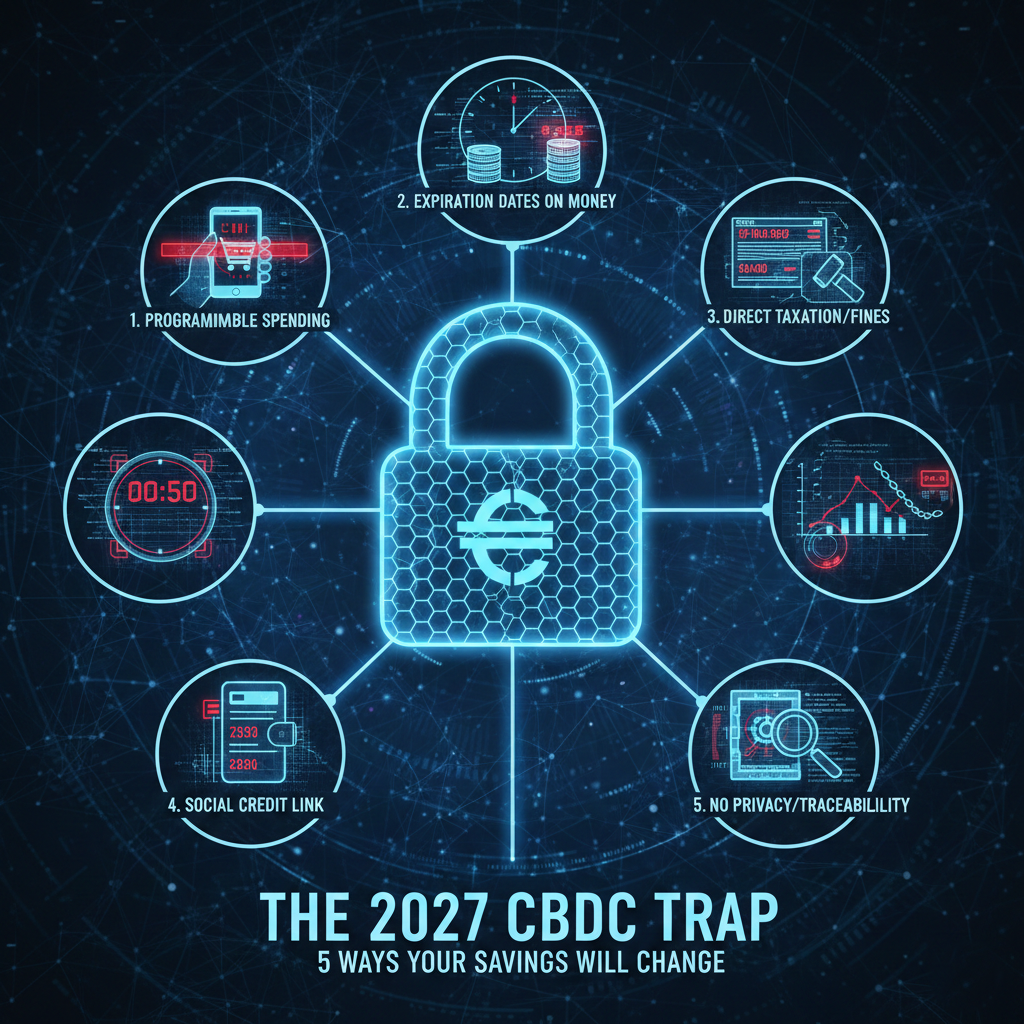
The most dangerous part of the “Cashless” Trap is a feature called “programmability.” Specifically, this allows the central bank to put “If/Then” logic inside your money. Consequently, your savings are no longer a neutral tool for trade. Instead, they become a set of instructions that you must follow.
Expiry Dates on Your Hard-Earned Wealth
Imagine if the government decided the economy was “too slow.” In the old world, they would lower interest rates to encourage you to spend. In the “Cashless” Trap, they can simply put an expiry date on your funds. For example, they could program $500 of your savings to disappear if you do not spend it by Friday. Furthermore, you cannot withdraw that money as cash to save it for later. Therefore, your wealth becomes a ticking clock that the government controls.
Merchant Restrictions and Social Goals
Moreover, the government can control where you spend your money. Specifically, they could block transactions at gun shops, liquor stores, or even “unapproved” bookstores. If the state wants to hit a “climate goal,” they can limit how much gas you buy with your CBDC. Consequently, the “Cashless” Trap turns your savings into a social credit tool. It stops being your money and starts being a permission slip from the state.
The End of the Mattress: Why Savings Can No Longer Hide
In the past, people could protect their savings from bad bank policies by holding physical cash. If the bank was failing, you took your money home. This created a “floor” that kept the system honest. However, the “Cashless” Trap removes that floor entirely.
Negative Interest Rates: The Hidden Drain
Central banks have always wanted to use negative interest rates. Specifically, they want to charge you a fee just for having money in the bank. In a world with cash, this is impossible because people would just withdraw their funds. But in 2027, there is nowhere to go. Consequently, the central bank can charge you 2%, 5%, or even 10% a year to “store” your digital coins. Resultantly, your savings slowly melt away to pay for government debt.
Holding Limits: Capping Your Success
Furthermore, many CBDC plans include “holding limits.” Specifically, the government might only allow you to keep $3,000 in your digital wallet. If you save more than that, the system could automatically convert the extra money into low-interest government bonds. Therefore, the “Cashless” Trap prevents you from building real, liquid wealth. It keeps everyone at a baseline level that the state can easily manage.
Surveillance as a Service: The Social Credit Connection
Privacy is the first thing to die in the “Cashless” Trap. Currently, if you buy a coffee with a $5 bill, nobody knows but you and the barista. But in 2027, every transaction is a data point on a government server. Specifically, this creates a “financial twin” of your entire life.
Monitoring Your Every Move
Artificial intelligence will analyze your spending patterns in real-time. If you start buying survival gear or water filters, the system might flag you as a “risk.” Moreover, they can link your wallet to your internet search history. Consequently, your access to your savings becomes tied to your “good behavior” in the eyes of the state. If you post something “wrong” on social media, they could simply toggle your wallet to “Read Only” mode.
The Carbon Footprint Link
Interestingly, many European pilots are already testing “carbon tracking.” Specifically, every purchase you make adds to a digital carbon score. If your score gets too high, the “Cashless” Trap might increase the tax on your next purchase. Alternatively, it could block you from booking a flight or buying a new car. Therefore, your savings are no longer yours to use; they are a tool for a global social experiment.
The Death of Local Banking: Who Survives the Shift?
The “Cashless” Trap does not just hurt individuals. It also destroys the community banks that we rely on. Currently, your local bank uses your deposits to give loans to local small businesses. However, in 2027, people will move their money to the “safe” CBDC account at the central bank.
The Great Disintermediation
Specifically, this process is called “disintermediation.” When the central bank competes for your savings, the local banks lose their funding. Consequently, they cannot provide mortgages or car loans to your neighbors. This leaves only a few giant, state-backed banks in control of the entire economy. Furthermore, these big banks will be much easier for the government to control and regulate. Therefore, the “Cashless” Trap ends local economic freedom.
Why “Safe” Money is a Danger
The central bank will tell you that a CBDC is “safer” than a bank deposit. After all, a central bank cannot go bankrupt. However, this “safety” comes at a high price. Specifically, you trade the risk of a bank failure for the risk of total state control. In the “Cashless” Trap, your money is “safe” from a bank run, but it is not safe from a politician’s keyboard.
Lessons from Abroad: Nigeria and China’s Warnings
To see the future of the “Cashless” Trap, we must look at the countries that have already started. Nigeria launched its “eNaira” a few years ago. Initially, the public refused to use it. Consequently, the government tried to force adoption by limiting cash withdrawals at ATMs. This led to riots and massive economic pain. Specifically, it showed that the government is willing to break the economy to force people into the digital trap.
The China Model
In contrast, China has used its “e-CNY” to build the world’s most advanced social credit system. Specifically, they can “expire” money for citizens who have low scores. They can also prevent people from using their savings on high-speed trains or luxury goods. Furthermore, the system tracks who you give money to. If you give money to a “dissident,” you become a target as well. Therefore, the “Cashless” Trap is the ultimate tool for a high-tech dictatorship.
The Exit Strategy: How to Escape the “Cashless” Trap
The 2027 deadline is close, but it is not here yet. Specifically, you have a small window to move your savings into assets that the government cannot “program” or “expire.”
1. Diversifying into Physical Hard Assets
The most effective way to beat the “Cashless” Trap is to own things you can touch.
Gold and Silver: These have been money for 5,000 years. Specifically, they have no “Off” switch. If the digital grid goes down or your wallet is frozen, a gold coin still has value.
Productive Land: If you own a farm or a garden, you have a source of food that does not require a digital transaction. Consequently, land is the ultimate form of savings.
Essential Supplies: In a cashless world, having a 6-month supply of food and medicine is like having a private bank account. Therefore, start building your physical reserves now.
2. Decentralized Finance (DeFi) and Cold Storage
Fortunately, technology has also given us an “exit door.” Bitcoin was designed specifically to fight the “Cashless” Trap. Unlike a CBDC, Bitcoin is “permissionless.” Specifically, no government can stop you from sending it, and no central bank can print more of it.
However, you must be careful. If you keep your Bitcoin on a big exchange like Coinbase, the government can still freeze it in 2027. Therefore, you must use “Cold Storage.” This means your savings live on a private device that is not connected to the internet. Consequently, you become your own bank, and the trap cannot snap shut on you.
3. The Power of Peer-to-Peer Networks
In addition, you should build a “parallel economy” today. Specifically, find local farmers, mechanics, and doctors who are willing to take cash or gold. By building these relationships now, you create a safety net for 2027. If the official “Cashless” Trap becomes too restrictive, you will have a community that still knows how to trade freely.
The Psychology of Compliance: How They Sell the Trap
To make the 2027 rollout work, the government will use powerful “Nudge” tactics. Specifically, they will try to make the “Cashless” Trap look like a “benefit” for you.
The “Security” Narrative
They will tell you that cash is used by terrorists and drug dealers. Specifically, they will say that a CBDC is the only way to stop identity theft and fraud. Consequently, many people will happily trade their privacy for a false sense of security. But remember, a system that can stop a criminal can also stop a law-abiding citizen who has a “wrong” opinion.
The “Convenience” Bait
Moreover, they will make the CBDC incredibly easy to use. You might be able to pay for groceries with a simple palm scan. Furthermore, they will offer “cash-back” rewards and “free money” bonuses for using the digital wallet. This is the bait. Therefore, the “Cashless” Trap is designed to feel like a luxury right up until the moment it locks.
Conclusion: Taking Back Your Financial Sovereignty
The move toward a 2027 CBDC rollout is the most significant change to the global financial system in our lifetime. While the government promises convenience and safety, the reality of the “Cashless” Trap is much darker. Specifically, it represents the end of financial privacy and the beginning of programmable control over your life. Your savings are the result of your hard work and your time. Consequently, you have a right to control how they are spent and saved.
As we count down to 2027, the choice is yours. You can wait for the trap to close, or you can start building your exit strategy today. Specifically, move a portion of your wealth into hard assets. Learn how to use decentralized tools. Most importantly, stay informed. The “Cashless” Trap only works if people don’t see it coming. Therefore, by reading this and acting now, you are already ahead of the curve.
Ultimately, your freedom is worth more than a few seconds of convenience at a checkout counter. Stand up for your privacy, protect your savings, and ensure that your future remains in your hands, not on a government ledger.
About the Author