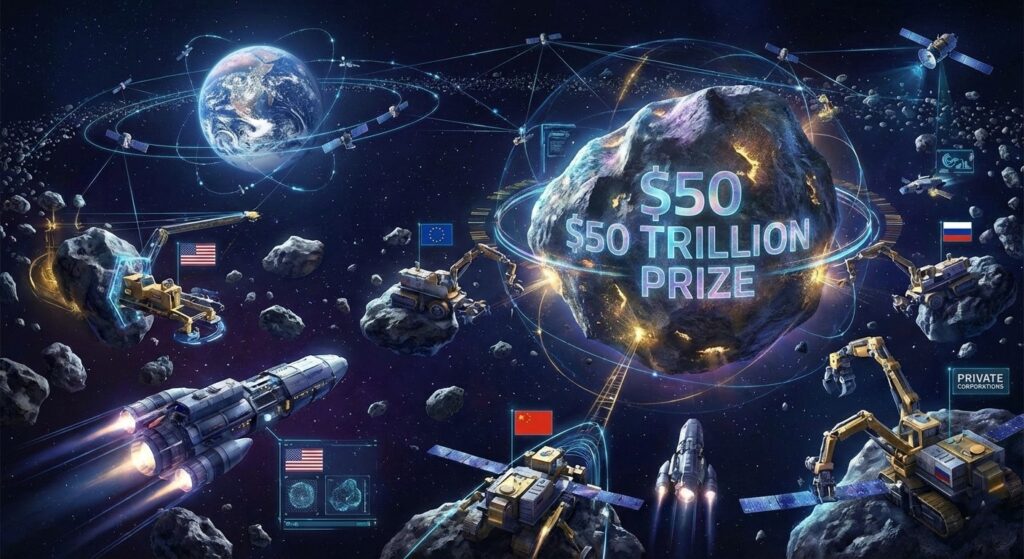
Imagine a massive rock made of pure gold floating in the sky. Consequently, the world as we know it would change forever. Today, this is not just a story from a book. Instead, it is the heart of a new global struggle. In 2026, the Geopolitics: The $50 Trillion “Space Mining” Race has become the most important topic for every world leader. Furthermore, the goal is no longer just to visit space. Now, the goal is to own the wealth found there.
For decades, we thought our resources were stuck on Earth. However, we were wrong. Space is filled with the building blocks of the future. Specifically, these are metals and gases that we need for our phones, cars, and clean energy. Because Earth is running low on these items, the race to find them in the stars is heating up. Therefore, the nation that wins this race will be the richest nation in history.
Why the $50 Trillion Price Tag?
Many people ask why we call it the Geopolitics: The $50 Trillion “Space Mining” Race. The answer lies in the math of the stars. In our solar system, there are millions of asteroids. Some are just piles of dust. Conversely, others are solid chunks of precious metal.
The Value of a Single Asteroid
Consider an asteroid named 16 Psyche. It is located in the belt between Mars and Jupiter. Scientists believe it is made of iron, nickel, and gold. If we brought that wealth to Earth, it would be worth more than $10 quadrillion. Furthermore, even a small 500-meter rock can hold $50 billion worth of platinum. Consequently, the economic impact is staggering.
Platinum: Used in every modern electronic device.
Cobalt: Essential for electric car batteries.
Iridium: Rare on Earth but common in space rocks.
The “Oil” of Space: Water Ice
While gold sounds exciting, water is the real prize. We cannot move heavy fuel from Earth into deep space easily. Instead, we need to find it there. Water ice can be turned into rocket fuel. Therefore, water is the “oil” that powers the Geopolitics: The $50 Trillion “Space Mining” Race. If you control the water, you control the “gas stations” of the solar system.
The Big Players: Who is Leading the Race?
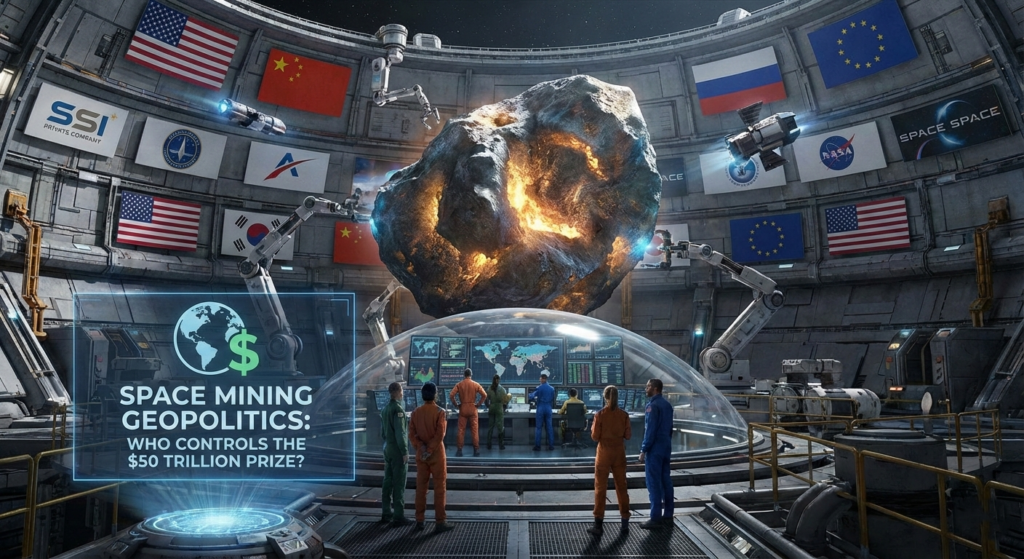
In 2026, the world is split into two main teams. Each team wants to set the rules for the stars. Consequently, this has created a new kind of “Cold War” in orbit.
The Artemis Team (Led by the USA)
The United States is leading a group of over 40 nations. They call their plan the Artemis Accords. Furthermore, they believe that private companies should be allowed to keep what they mine. They want a future where businesses like SpaceX can grow and profit. Consequently, the American strategy is fast and flexible.
The ILRS Team (Led by China and Russia)
On the other side, we see the International Lunar Research Station (ILRS). China and Russia lead this group. They have a different view of the Geopolitics: The $50 Trillion “Space Mining” Race. Specifically, they want the state to lead the way. They are building a massive base at the Moon’s South Pole. Consequently, they hope to control the most important spots on the Moon before anyone else.
How Does Space Mining Actually Work?
You might think mining involves people with shovels. However, that is not true. The Geopolitics: The $50 Trillion “Space Mining” Race is run by robots and AI.
Step 1: Finding the Target
First, companies must find the right rock. They use special telescopes to look at the light bouncing off asteroids. This light tells them what the rock is made of. Furthermore, they use AI to calculate the best path to reach it. Consequently, they don’t waste time on rocks that have no value.
Step 2: The Soft Landing
Landing on an asteroid is very hard. These rocks have almost no gravity. Therefore, a ship cannot just “land” on top of one. Instead, it must “dock” with the rock. Many companies use harpoons or nets. Once attached, the robot can start its work.
Step 3: Cooking the Rock
In space, we don’t use drills like we do on Earth. Instead, we use mirrors. These mirrors focus sunlight into a hot beam. Consequently, the heat turns the ice or metal into a gas. We then catch that gas in a big bag. Furthermore, this process is much cleaner than mining on Earth.
The Legal Problem: Who Owns the Stars?
This is the trickiest part of the Geopolitics: The $50 Trillion “Space Mining” Race. In 1967, the world signed a treaty. It said that no nation can “own” the Moon. However, it did not say anything about companies.
The “Safety Zone” Trick
Because they cannot own the land, nations are using “Safety Zones.” If you build a base, you can tell others to stay away for safety. Consequently, if you build your base on top of a gold mine, you effectively own it. Therefore, the race is really about who can get there and build something first.
New Laws for a New Era
In 2026, countries like Luxembourg and the UAE have passed new laws. These laws say that if a company mines a rock, that company owns the minerals. Furthermore, this has turned these small countries into “tax havens” for space companies. Consequently, the Geopolitics: The $50 Trillion “Space Mining” Race is changing how we think about borders.
The Impact on Earth: Good or Bad?
Why should you care about rocks in space? Because the Geopolitics: The $50 Trillion “Space Mining” Race will change your life on Earth.
Saving the Environment
Mining on Earth is dirty. It destroys forests and poisons water. In contrast, space mining happens on dead rocks. If we can move our mining to space, we can let Earth heal. Furthermore, we can get the materials we need for green energy without hurting our planet. Consequently, space mining might be the only way to save Earth’s environment.
The Risk of Space Junk
However, there is a big risk. When we mine, we create dust and debris. In space, this debris stays in orbit. If there is too much junk, it could destroy our satellites. Therefore, we could lose our GPS, our internet, and our weather tracking. Consequently, the Geopolitics: The $50 Trillion “Space Mining” Race must be done carefully.
Private Titans: The New Kings of Space
In the past, only governments went to space. Today, that has changed. The Geopolitics: The $50 Trillion “Space Mining” Race is being driven by billionaires.
Elon Musk (SpaceX): He provides the “trucks” that carry everything to orbit.
Jeff Bezos (Blue Origin): He wants to move heavy industry off Earth.
AstroForge: A small company that is already testing how to refine metal in space.
Furthermore, these leaders move much faster than any government. Consequently, they are often the ones making the rules. This shift from public to private power is a key part of the Geopolitics: The $50 Trillion “Space Mining” Race.
The Strategic Importance of the Moon’s South Pole
If you look at a map of the Moon in 2026, you will see a lot of activity at the South Pole. Why? Because that is where the water is.
Shadows and Light
The South Pole has deep craters that are always in shadow. These craters hold billions of tons of ice. Furthermore, right next to these craters are mountain tops that are always in the sun. Therefore, you have power (from the sun) and fuel (from the ice) in the same spot. Consequently, this is the most valuable real estate in the solar system.
The First “Moon Village”
The ESA (European Space Agency) wants to build a “Moon Village” here. They hope it will be a place for everyone to work together. In contrast, the US and China are racing to see who can set up their power grid first. Consequently, the Geopolitics: The $50 Trillion “Space Mining” Race is currently a race for the best “parking spots” on the Moon.
How You Can Benefit from the Space Economy
You don’t have to be an astronaut to join the Geopolitics: The $50 Trillion “Space Mining” Race. In 2026, the space economy is creating millions of jobs.
Engineering: We need people to design robots that can work in the cold.
Software: AI is the brain of every space mission.
Law: Space lawyers are needed to write the contracts for asteroid ownership.
Finance: Investors are looking for the next “Space Unicorn” company.
Furthermore, as launch costs go down, more people can participate. Consequently, the “final frontier” is finally opening up to everyone.
The Role of Developing Nations
It is not just the US and China. In 2026, nations like India and the UAE are major players in the Geopolitics: The $50 Trillion “Space Mining” Race.
India’s Rise
India recently landed a craft near the lunar south pole for a fraction of the cost of other nations. Consequently, they have proven that space is no longer just for the super-rich. Furthermore, they are now partnering with Japan to explore the Moon’s caves. Therefore, the “Global South” will have a big say in how space resources are shared.
The UAE and Asteroids
The United Arab Emirates is planning a mission to the asteroid belt. They want to diversify their economy away from oil. Consequently, they are investing heavily in space technology. Furthermore, they are hosting global conferences to discuss the Geopolitics: The $50 Trillion “Space Mining” Race.
The Danger of Conflict: Will We Fight Over Space?
History shows that humans often fight over resources. Will the Geopolitics: The $50 Trillion “Space Mining” Race lead to a war in space?
The Threat of “Dual-Use” Tech
A robot that can grab an asteroid can also grab a satellite. Therefore, every mining tool is also a potential weapon. Consequently, there is a lot of tension between nations. If one country thinks another is stealing their rock, things could get ugly. Furthermore, there is no “Space Police” to stop a fight.
The Need for a New Treaty
Many experts believe we need a new global agreement. Specifically, we need rules that everyone agrees on. If we don’t, the Geopolitics: The $50 Trillion “Space Mining” Race could become a disaster. However, getting everyone to agree is very hard. Consequently, we are currently living in a “Wild West” era of space.
The Future of Work in the Stars
By 2030, we expect to see the first “Space Miners” living in orbit. These won’t be temporary visitors. Instead, they will be the pioneers of a new way of life.
Living Off the Land
To stay in space, we must learn to use what we find. Consequently, we will build houses out of Moon dust and breathe oxygen made from Moon rocks. Furthermore, we will grow food in special greenhouses. Therefore, the Geopolitics: The $50 Trillion “Space Mining” Race is the first step toward a permanent human home in the stars.
A New Generation
Children born in 2026 will grow up in a world where space mining is normal. For them, the Moon will be like another continent. Consequently, their view of the world will be much bigger than ours. Furthermore, they will face challenges we can’t even imagine.
Breaking Down the Costs: Why it is Finally Possible
In the past, it cost $20,000 to send one kilogram of stuff to space. Now, it costs less than $2,000. Consequently, the Geopolitics: The $50 Trillion “Space Mining” Race is finally affordable.
Reusability: Rockets now land themselves and fly again.
Size: New rockets like Starship can carry 100 tons at a time.
Speed: We can launch more often than ever before.
Furthermore, as the cost goes down, the profit goes up. Therefore, more companies are jumping in. Consequently, the pace of change is faster than anyone expected.
The Role of AI in Space Mining
AI is the “secret sauce” of the Geopolitics: The $50 Trillion “Space Mining” Race. Because space is so big, humans cannot control everything from Earth.
Real-Time Decision Making
It takes seconds or minutes for a signal to travel to space. If a robot is about to hit a rock, it cannot wait for a human to tell it what to do. Consequently, the robot must have a “brain” of its own. Furthermore, AI helps find the best places to dig. Therefore, the nation with the best AI will likely win the race.
Self-Repairing Robots
If a robot breaks on an asteroid, you cannot send a repairman. Instead, the robot must fix itself. Consequently, researchers are building robots that can “evolve” and adapt. Furthermore, this tech will eventually help us on Earth, too.
Conclusion: Our Place in the Solar System
The Geopolitics: The $50 Trillion “Space Mining” Race is about more than just money. It is about the future of our species. We are moving from a world of “not enough” to a world of “plenty.” Consequently, the old ways of fighting over land and oil may slowly fade away.
Furthermore, we must remember that space belongs to everyone. As we race to mine the stars, we must also work to keep the peace. Therefore, the leaders of today have a huge responsibility. If they do it right, the Geopolitics: The $50 Trillion “Space Mining” Race will be the start of a golden age. If they do it wrong, we could lose everything.
In 2026, the engines are starting. The robots are ready. The rocks are waiting. Consequently, the only thing left to do is go and get them.
Summary Checklist for 2026
Target: Asteroids like 16 Psyche and the Lunar South Pole.
Primary Prize: Water ice for fuel and Platinum for tech.
Main Conflict: US-led Artemis Accords vs. China-led ILRS.
Major Benefit: Moving dirty industry off Earth to save the environment.
Biggest Risk: Space debris and orbital conflict.
The stars are no longer just for wishing. Now, they are for building. The Geopolitics: The $50 Trillion “Space Mining” Race is here to stay.
About the Author