Undoubtedly, few places on Earth capture the imagination like Petra. Hidden deep within the rugged desert canyons of Jordan, this ancient wonder leaves every visitor speechless. Specifically, the sheer scale of the rock-cut architecture makes it a unique destination. Consequently, millions of travelers dream of walking through its legendary Siq.
If you are planning a trip to this UNESCO World Heritage Site, you need more than just a map. You need insider knowledge. Therefore, this guide provides essential tips, historical context, and practical advice for your journey.
Unlocking the History of the Nabataeans
First, to appreciate Petra, you must understand its builders. Remarkably, the Nabataeans were not just simple desert nomads. In fact, they were master engineers and wealthy traders. Originally, they settled in this area around the 4th century BC. Because they controlled the lucrative incense and spice trade routes between Arabia, Egypt, and the Mediterranean, they amassed incredible wealth.
Subsequently, they used this wealth to carve their capital directly into the pink sandstone cliffs. However, they did not just carve tombs. Additionally, they built a complex water management system to survive the arid climate. Eventually, the Roman Empire annexed the city in 106 AD. Nevertheless, the Nabataean legacy remains etched in stone today.
The Journey Begins: Entering the Siq
Typically, your adventure starts at the Visitor Center. From there, you will walk towards the Bab Al Siq. Soon, you reach the main entrance, known as the Siq. Essentially, this is a narrow gorge, flanked by towering cliffs that rise up to 80 meters high. As you walk, notice the ancient terracotta pipes along the walls. Specifically, these pipes once carried water to the city center.
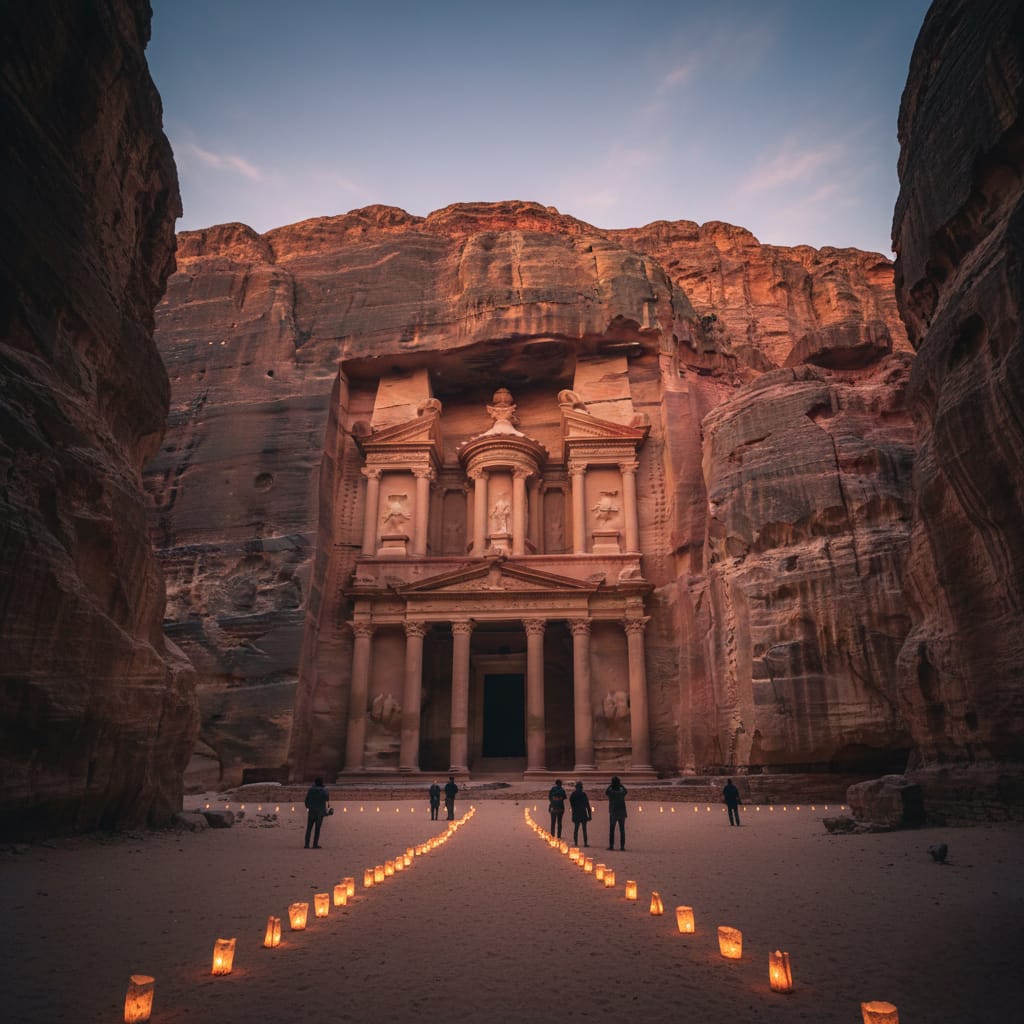
Moreover, the suspense builds with every step. The path winds and twists for about 1.2 kilometers. Suddenly, the gorge narrows significantly. Finally, you catch your first glimpse of the Treasury through a thin crack in the rocks. Undoubtedly, this is the most famous view in all of Jordan.
The Treasury (Al-Khazneh): A Masterpiece in Stone
Upon exiting the Siq, the Treasury reveals itself in full glory. Instantly, you recognize the intricate facade from movies like Indiana Jones and the Last Crusade. Although bedouins locally call it “Al-Khazneh” (The Treasury), it was actually a royal tomb, not a bank.
Furthermore, timing is everything here. If you want to see the sun illuminating the facade, arrive between 9:00 AM and 11:00 AM. Conversely, for photos without crowds, you should arrive right when the gates open at 6:00 AM. Additionally, late afternoon provides a softer, golden light that many photographers prefer.
Beyond the Treasury: Exploring the Main Trail
However, do not stop at the Treasury. Surprisingly, the ancient city stretches for miles beyond this point. After you take your photos, continue down the Street of Facades. Here, you will find rows of smaller tombs carved into the cliffside.
Next, you will encounter the massive Theatre. Amazingly, the Nabataeans carved this entire amphitheater out of solid rock. Specifically, it could seat over 4,000 spectators. From here, the path widens into the Colonnaded Street, which was once the heart of the city’s daily life.
Key Sites to Watch For:
The Royal Tombs: These sit high on the cliff face. Notably, the Urn Tomb is the most impressive.
The Great Temple: A massive complex that archaeologists are still excavating.
Qasr al-Bint: The only freestanding structure that survived the ancient earthquakes.

The Climb to the Monastery (Ad Deir)
For the adventurous traveler, the Monastery is the true highlight. However, reaching it requires effort. Specifically, you must climb approximately 800 stone steps. Therefore, you should wear comfortable hiking shoes and carry plenty of water.
Nevertheless, the climb is worth it. Eventually, you reach the summit, and the Monastery greets you. In comparison to the Treasury, the Monastery is much larger and far less crowded. Moreover, a nearby viewpoint offers stunning panoramas of the Wadi Araba valley. Ideally, you should plan this hike for the afternoon when the facade is bathed in sunlight.
Practical Information: Tickets and Timing
Before you go, you must sort out your logistics. Currently, ticket prices are steep, but they offer great value.
One-Day Ticket: 50 JOD (approx. $70 USD)
Two-Day Ticket: 55 JOD
Three-Day Ticket: 60 JOD
Significantly, the smartest option is the Jordan Pass. If you buy this online before arrival, it covers your visa fee and your entry to Petra. Consequently, you save money and time at the airport.
Petra by Night
Additionally, you might consider the “Petra by Night” show. Starting May 2025, the event runs from Sunday to Thursday. During this event, thousands of candles light up the Siq and the Treasury. However, be aware that the ticket price has recently increased to 30 JOD. While some find it magical, others find it crowded. Thus, manage your expectations accordingly.
Insider Tips for an Authentic Experience
To truly enjoy Petra, follow these simple rules:
Arrive Early: Be at the gate by 6:00 AM. Consequently, you beat the tour buses.
Dress appropriately: Layers are key. Furthermore, the desert is cold in the morning but hot by noon.
Stay Hydrated: The air is very dry. Therefore, keep a water bottle with you.
Negotiate: If you want to ride a donkey or camel, fix the price beforehand.
Respect the Locals: The Bedul Bedouins still live and work here. Always ask before taking their photo.
Final Thoughts
Ultimately, Petra is more than just a photo opportunity. It is a testament to human ingenuity and resilience. Whether you hike to the High Place of Sacrifice or simply marvel at the Treasury, the experience stays with you. So, pack your bags, buy your Jordan Pass, and prepare for an unforgettable adventure.
About the Author