Berlin is a city of ghosts. Walking through its streets, you constantly brush against history that generations have built over, torn down, or reimagined. However, few vanished buildings spark as much debate, nostalgia, and curiosity as The Palace of the Republic (Palast der Republik).
Located on Museum Island in the heart of East Berlin, this structure represented far more than just a government building. In fact, it stood as a bold statement of socialist modernity. For millions of East German citizens, the Palace of the Republic served as a cultural playground. Yet, for others, it loomed as a symbol of an oppressive regime.
Today, the baroque Humboldt Forum occupies the site. Nevertheless, the story of the Palace remains essential for understanding the complex identity of modern Berlin. In this guide, we will peel back the layers of history to explore what life really looked like inside the People’s Palace.
A Vision of Socialist Modernity
To understand the Palace of the Republic, you must first understand the void it filled. Originally, the site held the Berlin City Palace (Stadtschloss), the historic winter residence of Prussian kings. However, the East German government viewed the war-damaged City Palace as a symbol of Prussian militarism. Consequently, in 1950, they demolished it.
For over two decades, the square remained largely empty. Then, in the 1970s, the German Democratic Republic (GDR) sought a new centerpiece for its capital. Officials wanted a building that projected confidence, openness, and prosperity. Therefore, under the leadership of Erich Honecker, the state finalized plans for the Palace of the Republic.
Breaking Ground
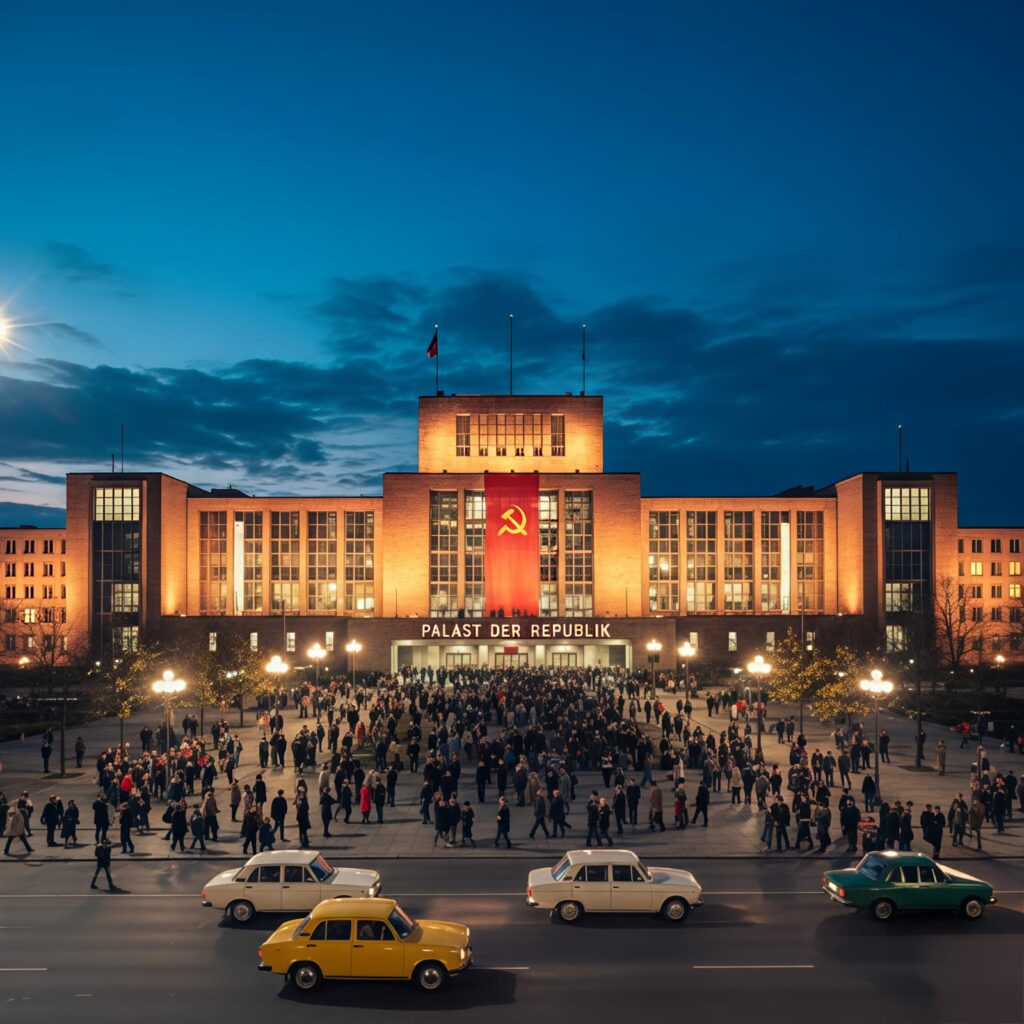
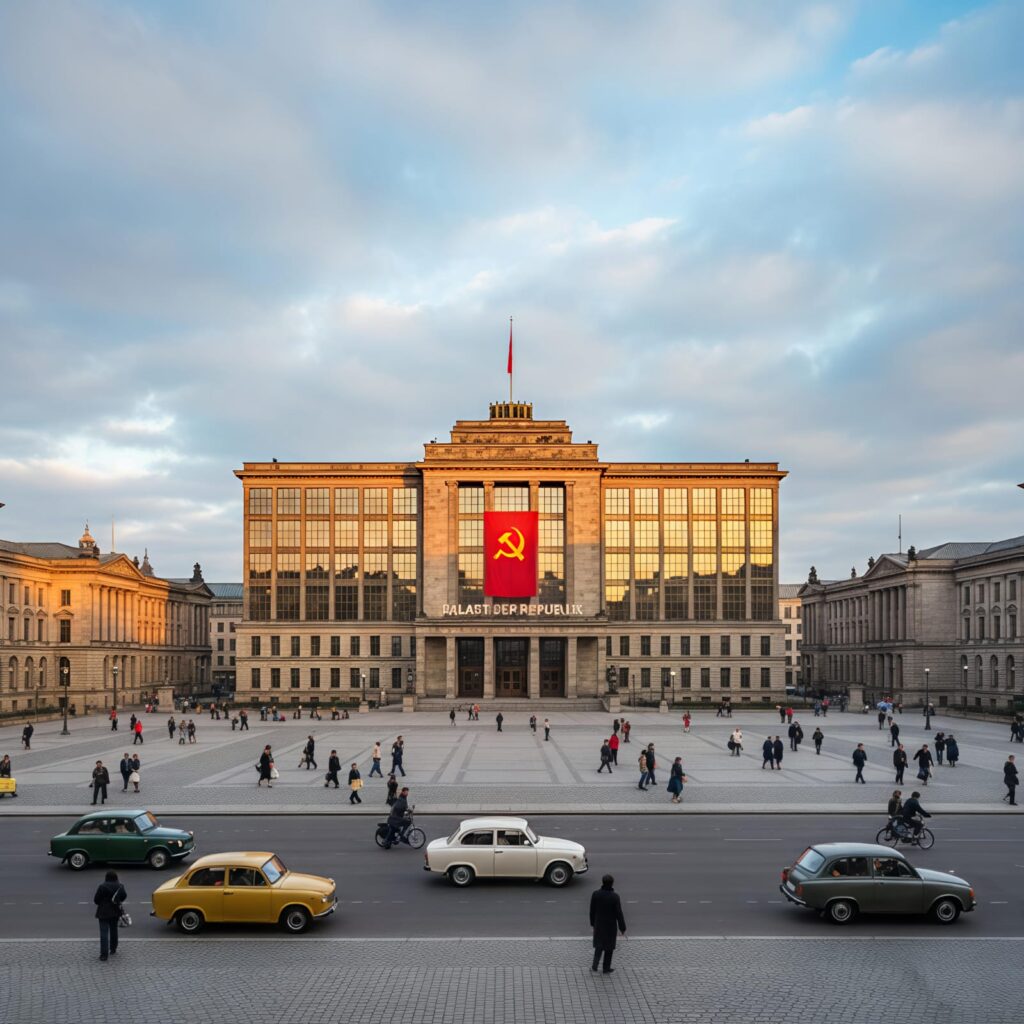
Construction began in 1973. Unlike the grey, concrete tenements often characterizing East German architecture, architects designed this building to dazzle. Heinz Graffunder and his team utilized bronze-mirrored glass and white marble. As a result, the building shimmered against the Berlin sky.
Furthermore, the scale proved massive. The Palace of the Republic measured 180 meters in length and 85 meters in width. When it finally opened on April 23, 1976, it signaled a new era for East Berlin. Specifically, it claimed that the GDR was not just surviving; it was thriving.
Inside “Erich’s Lamp Shop”
Locals in Berlin are famous for their dry, cynical wit. Almost immediately, they gave the Palace of the Republic a nickname: Erichs Lampenladen (Erich’s Lamp Shop).
Why the strange name?
If you stepped inside the main foyer, the answer became obvious instantly. Thousands of glowing glass lights adorned the ceiling. Indeed, over 1,001 globe-shaped lamps illuminated the vast marble halls.
More Than Just Politics
While the nickname poked fun at the decor, the building enjoyed genuine popularity. Unlike Western government buildings, which often stood as closed fortresses, the Palace of the Republic welcomed the public daily.
It operated as a Volkshaus (People’s House). Thus, it combined high politics with mass entertainment. Imagine the US Capitol building, but with a bowling alley and affordable restaurants inside. That describes the unique reality of the Palace of the Republic.
Key features included:
The Great Hall: A massive hexagonal auditorium seated up to 5,000 people. It featured a swing-floor system that could adjust the stage height.
Restaurants and Bars: Visitors could choose from 13 different dining establishments. You could grab a coffee at the Espresso Bar or enjoy a full meal at the Spree Restaurant.
The Bowling Alley: Surprisingly, the basement bowling center ranked as one of the most beloved features.
The Post Office: A fully functioning post office allowed visitors to send postcards featuring the Palace to friends abroad.
The Cultural Heart of East Berlin
For many East Berliners, the Palace of the Republic offered a rare taste of luxury. In a country where shortages occurred frequently, the Palace always kept well-stocked shelves.
The food tasted better here. The coffee packed a stronger punch. Moreover, the administration kept prices artificially low. A family could spend the entire day here without breaking the bank. Consequently, it became a prime destination for weddings, youth dedication ceremonies (Jugendweihe), and first dates.
Entertainment on a Grand Scale
The Great Hall hosted everything from party congresses to rock concerts. Interestingly, the GDR government used the venue to prove its cultural relevance.
Famous Western artists performed here, a rarity in the Eastern Bloc. For example, Carlos Santana played a legendary concert at The Palace of the Republic. Additionally, Harry Belafonte and Udo Jürgens graced the stage.
Furthermore, crews filmed the quintessential East German TV show, Ein Kessel Buntes, right here. This variety show brought color and glamour into the living rooms of millions. Therefore, for the average citizen, the building represented fun and warmth, rather than just political indoctrination.
The Political Facade
Despite the bowling and the milkshakes, we cannot ignore the building’s primary purpose. The Palace of the Republic functioned as the seat of the Volkskammer (People’s Chamber), the parliament of the GDR.
Legislators stamped the laws of the land in this small hall within the Palace. However, in the one-party system of the GDR, the parliament held little real power. The Politburo of the Socialist Unity Party (SED) made the actual decisions. Thus, the Volkskammer largely served as a theatrical stage for unanimous voting.
A Historic Vote
Ironically, the most important vote ever occurring in the Palace of the Republic involved the decision to end the country.
Following the fall of the Berlin Wall in 1989, the political landscape shifted rapidly. On August 23, 1990, the democratically elected Volkskammer met in the Palace. In a historic session, members voted for the accession of the GDR to the Federal Republic of Germany.
Effectively, the Palace of the Republic hosted the funeral of the state that built it.
The Asbestos Nightmare
After German reunification in 1990, the fate of the Palace of the Republic hung in the balance. However, a silent killer forced the issue.
Inspectors discovered asbestos packed the building. During construction in the 1970s, builders had sprayed nearly 5,000 tons of asbestos on the steel structure to protect it from fire.
At the time of construction, officials knew but often ignored the dangers of asbestos in favor of speed and cost. Now, it presented a massive health hazard. Consequently, the government closed the Palace to the public in September 1990.
The Shell Remains
For over a decade, the Palace of the Republic stood as a hollow shell. Specialists stripped the interior down to the steel beams to remove the toxic material.
During this time, the building became a ghostly skeleton on the Berlin skyline. Windows disappeared. Workers removed the famous lamps. Yet, the debate about what to do with the carcass raged on.
The Battle: Demolition vs. Preservation
The question of whether to tear down the Palace of the Republic divided the city.
The Case for Demolition Proponents of demolition argued that the building created an eyesore. They felt it disrupted the historic ensemble of Museum Island. Furthermore, many saw it as a symbol of the dictatorship. They wanted to restore the historic footprint of the city by rebuilding the Prussian City Palace.
The Case for Preservation Conversely, many former East Berliners felt erased. They argued that tearing down the Palace of the Republic constituted an act of “victor’s justice.” To them, it served not just as a government building, but as part of their personal history.
Where did they have their prom? The Palace. Where did they eat ice cream with their grandmother? The Palace.
Activists launched the “Zwischenpalastnutzung” (Intermediate Palace Use) project. They turned the stripped-down steel frame into an art installation. Next, organizers flooded the basement to create a boat ride. Temporary exhibitions also took place. These events proved that the space still possessed life.
Nevertheless, the German Bundestag made the final call. In 2003, members voted to demolish the Palace of the Republic and rebuild the City Palace exterior.
The Slow Death of a Giant
Demolition proved complex. You cannot simply blow up a building that sits next to a historic cathedral and delicate museums.
Therefore, crews dismantled the Palace of the Republic piece by piece. The process began in 2006 and took nearly three years. Enormous hydraulic shears chewed away the steel and concrete.
By late 2008, the site sat empty again. The bronze glass had vanished. The “Lamp Shop” had closed its doors forever.
However, the materials found a second life. Foundries melted down and recycled much of the steel from the Palace of the Republic. Rumor has it that some of the metal ended up in the engine blocks of Volkswagen cars. Additionally, builders used the crushed concrete for road construction. In a literal sense, the Palace now lies scattered beneath the wheels of German traffic.
The Humboldt Forum: A New Chapter
If you visit the site today, you will see the Humboldt Forum.
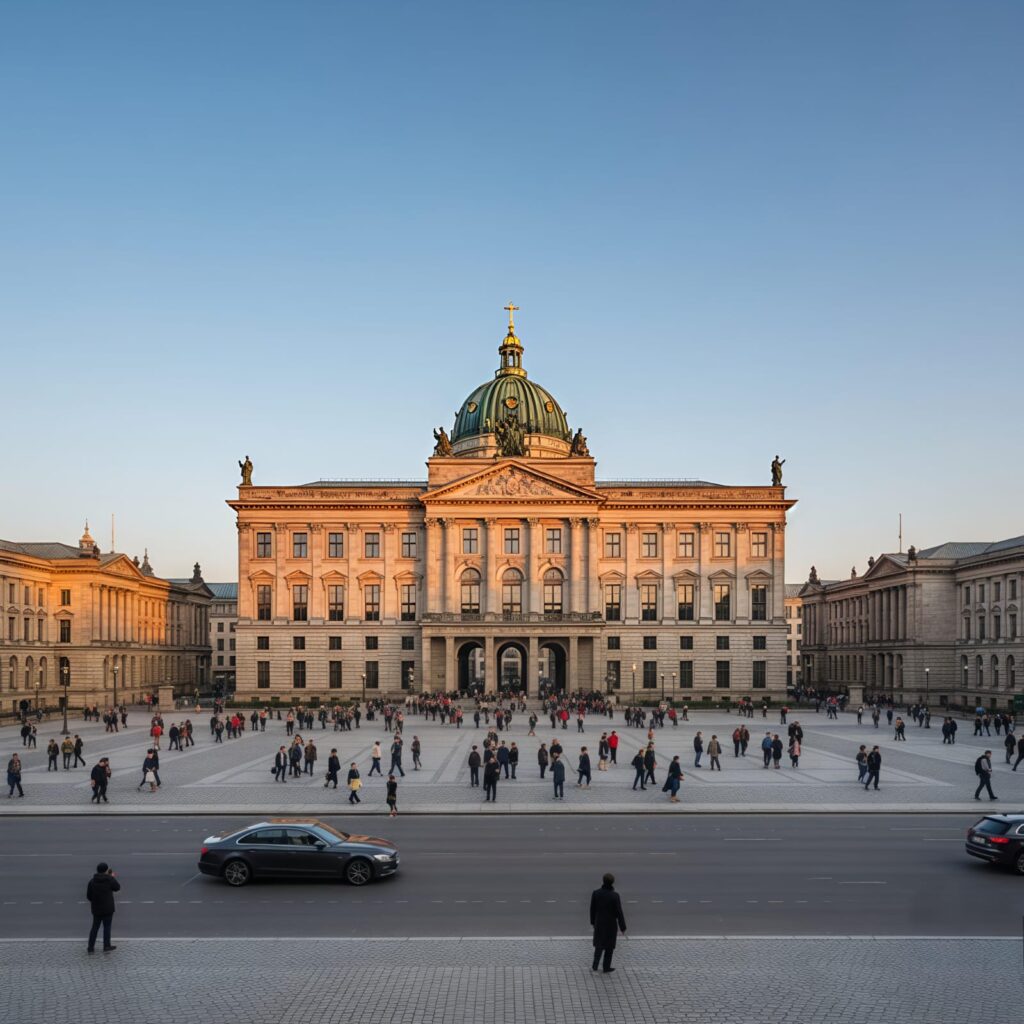
This massive museum complex replicates the baroque facades of the original Prussian City Palace on three sides. However, the fourth side—facing the Spree River—remains modern and flat.
Inside, the Humboldt Forum houses non-European art and culture collections. It functions as a place of learning and dialogue. Yet, the ghost of the Palace of the Republic still lingers.
Traces of the Past
The architects of the Humboldt Forum acknowledged the site’s complex history. They did not erase the GDR entirely.
The Bronze Glass: In the stairwell of the new building, you can find original bronze-tinted window panes from the Palace of the Republic.
The Signs: The museum preserves and displays several of the iconic “R” logos and wayfinding signs from the Palace.
The Gallery: A dedicated section of the museum tells the story of the site, featuring models and artifacts from the Palace era.
Why the Palace of the Republic Still Matters
Why should a traveler or history buff care about a building that doesn’t exist?
Because the Palace of the Republic represents the duality of life in the GDR. It illustrates that life under socialism did not appear entirely black and white. Citizens could live in a dictatorship and still harbor fond memories of a bowling night.
Furthermore, the destruction of the Palace highlights how nations deal with difficult history. By erasing the architecture of the GDR, Berlin removed a visible reminder of its division. Whether that represents a healing process or a loss of heritage remains a topic of heated discussion in Berlin bars today.
Traveler’s Guide: Finding the Lost Palace
Although the building has vanished, you can still trace its legacy on your next trip to Berlin. Here is how to find the echoes of the Palace of the Republic.
Visit the Humboldt Forum Go to Museum Island. Stand in the Schlüterhof courtyard. Imagine the bronze glass wall that once stood there. Enter the “History of the Site” exhibition (often free of charge) to see physical remnants of the Palace of the Republic.
Spot the Lamps Believe it or not, the famous lamps survived. You can find some of the original globe lights hanging in the Café Sybille on Karl-Marx-Allee. This historic boulevard sits just a short train ride away. Order a cheesecake, sit under the retro lights, and soak in the atmosphere.
The DDR Museum Located just across the river from where the Palace stood, the DDR Museum offers an interactive look at East German life. They maintain a section dedicated to the Palace of the Republic, including dinnerware from the restaurants.
Walking Tours Many specialized walking tours focus on “Red Berlin” or “Cold War Berlin.” Ask your guide specifically about the Palast. They often carry photos that show exactly how the view looked in 1980 compared to today.
Final Thoughts
The Palace of the Republic presented a paradox. It stood as a house of the people built by a regime that spied on them. It served as a place of joy in a country of walls.
Eventually, asbestos and politics brought it down. Yet, for a brief moment in history, it shimmered in the center of Berlin. Understanding this building is key to understanding the soul of the city. It reminds us that buildings are never just bricks and mortar; they function as the containers of our collective memory.
So, when you stand before the reconstructed palace today, take a moment to look closer. Search for the ghost of the bronze glass. Listen for the faint sound of bowling pins. The Palace of the Republic may be gone, but the city certainly has not forgotten it.
About the Author