Introduction: The Mirror City in the Light of 2026
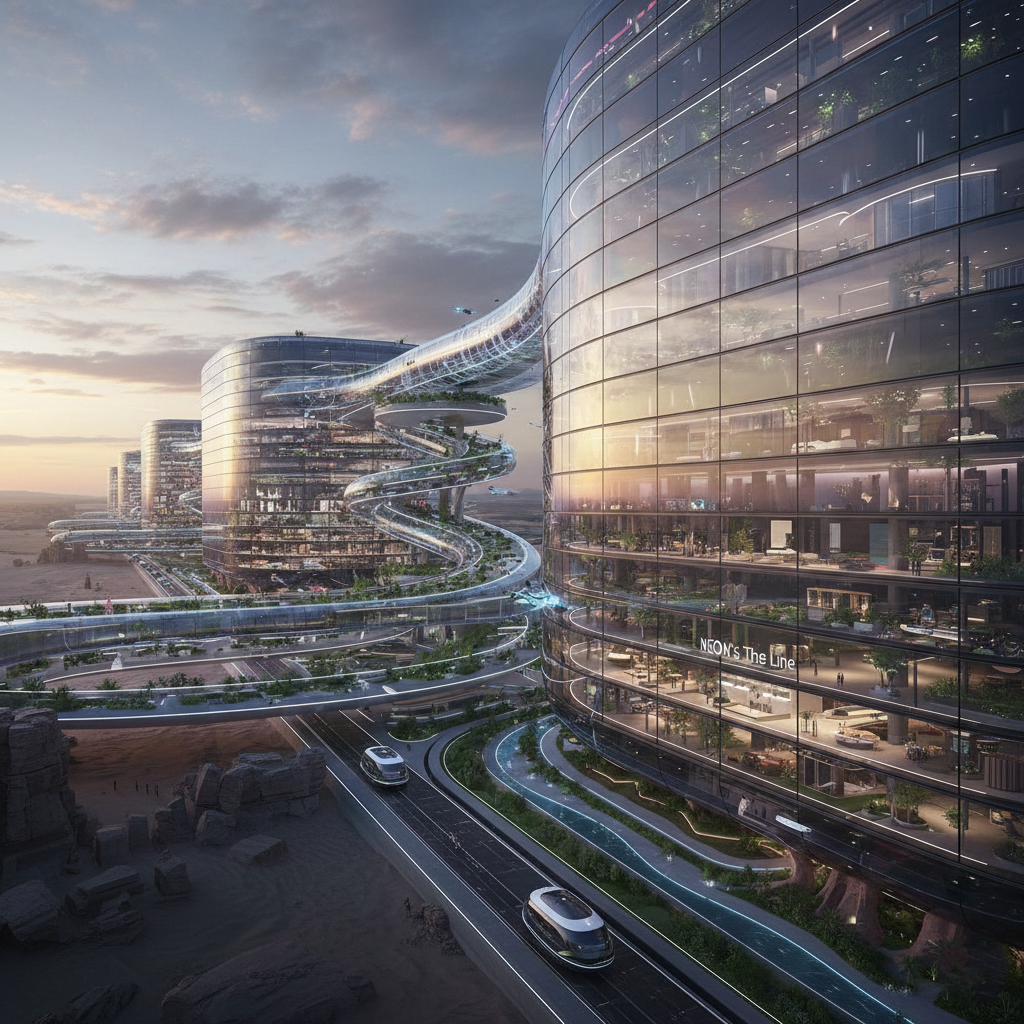
The year 2026 marks a turning point for the Saudi Arabian desert. Several years ago, the world watched a video about a city shaped like a long, thin line. This project, known as The Line, aimed to change how humans live. It promised a 170-kilometer mirror wall that would house millions of people. Furthermore, it pledged to do this without any cars or carbon emissions.
However, the reality we see in this Architecture: The “Line” City (NEOM) 2026 Update is quite different. The dream has not died, but it has certainly changed shape. Instead of a 170km streak, the focus has shifted to a smaller, more manageable section. This part is called the “Hidden Marina.” Consequently, the project is now a story of intense, high-tech focus rather than sprawling desert growth.
Moreover, this update explores how the design is evolving to meet new challenges. We will look at why the scale changed and how the mirrors actually work. In addition, we will investigate the role of Artificial Intelligence in running the city. Therefore, we invite you to look past the shiny renderings and see the concrete and steel rising from the sand today.
The Great 2026 Recalibration: Scaling for Success
To begin with, we must address the change in size. The original plan for a 170km city was the most ambitious goal in history. In contrast, the 2026 reality focuses on a 2.4-kilometer “Phase 1.” This shift happened because building a 500-meter-tall wall is harder than anyone expected.
Why 2.4 Kilometers?
The decision to focus on the Hidden Marina was a smart one. Specifically, it allows the Saudi government to prove the concept works before spending billions more.
Cost Control: Reducing the length helps manage the huge budget.
Engineering Tests: Builders can solve problems in a small area first.
Speed to Market: A smaller city can open its doors to residents by 2030.
Consequently, the work at the Hidden Marina is moving at a record pace. Furthermore, thousands of workers are pouring concrete into deep foundation piles every single day. As a result, the “Hidden Marina” is now a hive of activity that can be seen from space. Therefore, the Architecture: The “Line” City (NEOM) 2026 Update confirms that the project is very much alive, just more focused.
Moving from Millions to Thousands
Initially, the goal was to house 1.5 million people by 2030. However, the revised 2026 plan targets around 300,000 residents for the first phase. While this seems like a step back, it is actually more realistic. Furthermore, these 300,000 people will be the ultimate test group for future living. Consequently, their experience will decide if the rest of the 170 kilometers ever gets built.
Engineering the Mirror Wall: A Masterclass in Design
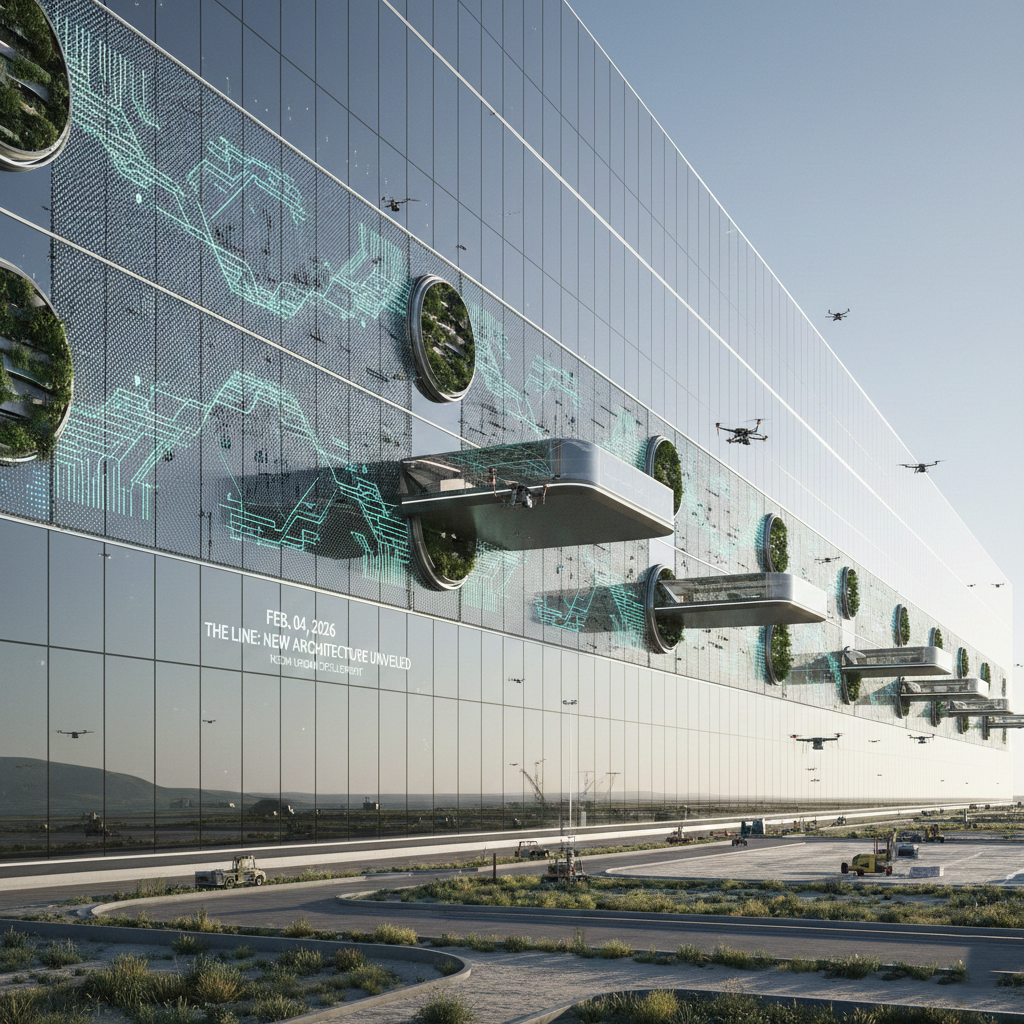
The mirror facade is the most iconic part of the project. Standing 500 meters tall, it creates a visual trick that makes the city look invisible. This Architecture: The “Line” City (NEOM) 2026 Update dives into the science of that glass.
Fighting the Desert Heat
How do you stop a giant mirror from becoming a magnifying glass? The answer lies in the glass itself.
Special Coatings: The glass uses a ceramic pattern that stops heat from entering the city.
Diffuse Reflection: Instead of a flat mirror, the surface has tiny angles. Consequently, it scatters sunlight rather than focusing it.
Active Ventilation: The space between the two walls acts like a chimney. As a result, hot air rises and pulls cool air in from the bottom.
Furthermore, these systems mean the city stays cool without using massive amounts of power. In fact, the temperature inside the walls is often 10 degrees cooler than the outside desert. Therefore, the architecture uses the sun to help cool the city, which is a brilliant paradox.
Surviving the Wind and Sand
A wall this size is a giant sail for the wind. To keep it steady, engineers had to use new tricks.
Tuned Mass Dampers: These are giant weights that stop the building from swaying.
Aerodynamic Slots: The walls have holes that allow wind to pass through harmlessly.
Sand-Repelling Glass: The mirrors use a special coating that prevents sand from sticking.
Moreover, these features ensure the building lasts for centuries. In addition, they make the interior very quiet for residents. Consequently, you can live 500 meters in the air without feeling a single vibration. Therefore, the engineering behind The Line is as impressive as its look.
Zero Gravity Urbanism: The Logic of Verticality
The term “Zero Gravity Urbanism” is the soul of the Architecture: The “Line” City (NEOM) 2026 Update. It means we no longer need to build “out.” Instead, we build “up” and “down.”
The Three-Layer System
In a traditional city, everything happens on the ground. However, The Line splits life into three distinct layers.
The Top Layer: This is for people. It is a world of parks, homes, and schools.
The Middle Layer: This is for service and shops. You can find everything you need here.
The Bottom Layer: This is for transport. High-speed trains move you across the city in minutes.
Consequently, you never have to walk more than five minutes to find a grocery store or a park. Furthermore, there are no cars to worry about. As a result, children can play safely in the “streets” of the upper levels. Therefore, the city feels like a giant, 3D park rather than a concrete jungle.
The 5-Minute City Metric
The architecture forces everything to be close. Specifically, designers use vertical paths to connect homes to offices.
High-Speed Lifts: These elevators move both vertically and horizontally.
Sky Bridges: These paths allow you to walk between the two mirror walls.
Integrated Greenery: Plants grow on every level to clean the air.
Moreover, this design saves people hours of travel time every day. In contrast to cities like Los Angeles, there is no traffic here. Consequently, the quality of life is expected to be much higher. Therefore, the 2026 design proves that vertical living is the most efficient way to house people.
The Digital Pivot: Why The Line is a Data Fortress
One of the most interesting parts of the Architecture: The “Line” City (NEOM) 2026 Update is the focus on AI. NEOM is not just a city; it is a giant computer you live in.
The Role of Data Centers
As AI demand grows globally, The Line has adapted. It is now being designed to house some of the world’s largest data centers.
Natural Cooling: The design of the walls helps cool the servers for free.
Secure Storage: The thick walls are a natural shield for sensitive data.
Clean Power: Solar and wind farms nearby provide the green energy these computers need.
Consequently, the city has a built-in economy from day one. Furthermore, the companies renting these data centers help pay for the city’s maintenance. As a result, The Line is a “Cognitive City” that earns its own keep. Therefore, the architecture serves both humans and machines in a unique way.
Living with the “City Brain”
The city uses an AI called “NEOS” to manage everything. Specifically, the AI watches the weather, the power use, and the flow of people.
Predictive Maintenance: The city knows when a lightbulb will break before it happens.
Energy Optimization: Lights dim in areas where no one is walking.
Safety Monitoring: Drones and sensors keep the city one of the safest on Earth.
Moreover, this data is used to make the city better every day. In addition, it creates a “frictionless” life for the residents. Consequently, you never have to wait for a train or a lift. Therefore, the AI is the silent partner that makes the architecture work.
The Construction Reality: Building the Impossible
If you look at the site in 2026, you will see the world’s largest earth-moving operation. This Architecture: The “Line” City (NEOM) 2026 Update shows that the work is non-stop.
The Power of Robotics
Because the heat is so intense, humans cannot do all the work. Consequently, NEOM uses thousands of autonomous robots.
3D Printing: Small parts of the interior are being printed on-site.
Robotic Welders: These machines join the steel frames with perfect accuracy.
Autonomous Trucks: They move millions of tons of sand without any drivers.
Furthermore, this keeps the human workers safe in air-conditioned hubs. In addition, it reduces the chance of mistakes in the building. As a result, the “Hidden Marina” is rising faster than any traditional city could. Therefore, the construction of The Line is a revolution in how we build.
The Modular Approach
How do you build a city in the middle of a desert? You build it in parts.
Factory Assembly: Rooms are built in factories in other parts of Saudi Arabia.
Shipping: These modules are brought to the site by sea or truck.
Stacking: Giant cranes lift the modules into place like Lego bricks.
Moreover, this method is much cleaner than traditional building. It reduces waste and saves time. Consequently, the city can be built in “modules” that can be added over time. Therefore, the 2.4km section is just the first of many modules to come.
Sustainability: The Green Heart of the Mirror City
A major part of the Architecture: The “Line” City (NEOM) 2026 Update is the environment. NEOM claims to be the most sustainable project on Earth.
Renewable Energy and Storage
The city will run on 100% clean energy. To do this, it needs more than just solar panels.
Solar Farms: Miles of panels catch the intense desert sun.
Wind Turbines: The coastal wind provides power at night.
Hydrogen Power: NEOM is building a massive green hydrogen plant to store energy.
Consequently, the city will never need to burn oil or gas. Furthermore, it will likely export clean energy to the rest of the world. In addition, the mirror walls reflect heat, reducing the need for air conditioning. Therefore, the architecture itself is a tool for saving the planet.
The Circular Water System
Water is the biggest challenge in the desert. However, The Line has a plan that uses every drop.
Advanced Desalination: Seawater is turned into fresh water using solar power.
Zero Brine Waste: The leftover salt is turned into minerals for industry.
100% Recycling: All wastewater is cleaned and used to water the vertical gardens.
Moreover, this means the city is a “closed loop.” It does not take from nature, and it does not dump waste. Consequently, the gardens inside the wall stay green even in a drought. Therefore, the water system is a miracle of modern engineering.
The Human Experience: Life in a 200-Meter-Wide Canyon
What is it actually like to live in The Line? This Architecture: The “Line” City (NEOM) 2026 Update explores the psychology of the design.
Finding the Horizon
Some people worry that living between two walls will feel like a prison. To fix this, architects used “Biophilic Design.”
Hanging Gardens: Thousands of trees and plants are built into the walls.
Artificial Sunlight: Clever mirrors bring natural light deep into the lower levels.
Open Voids: Large sections of the wall are left open to give views of the desert and sea.
Consequently, you never feel trapped. Furthermore, the air is cleaned by the plants, making it smell like a forest. In addition, the sound of water features hides the noise of other people. Therefore, the city is designed to be a peaceful sanctuary.
The “Sim City” Social Structure
Living in a planned city means everything is curated. Specifically, the shops and gyms are placed to encourage people to meet.
Common Areas: Every few floors, there are big “sky plazas” for parties and meetings.
Diverse Housing: There are tiny apartments for singles and huge villas for families.
Global Community: The city is inviting talent from every country on Earth.
Moreover, this creates a unique social vibe. It is like a luxury university campus that never ends. In contrast to old cities, you are always surrounded by people who are building the future. Consequently, the social energy is expected to be very high. Therefore, life in The Line will be unlike anything else in history.
Economic Impact: Who Pays for the Mirror?
Building a city like this costs hundreds of billions of dollars. This Architecture: The “Line” City (NEOM) 2026 Update looks at the money trail.
The Public Investment Fund (PIF)
The Saudi government is the main investor. They are using their oil money to build a world that does not need oil. Consequently, they see The Line as a “legacy project.” Furthermore, they believe it will become a global tourist destination.
Foreign Direct Investment (FDI)
To finish the project, Saudi Arabia needs global partners.
Tech Giants: Companies are investing in the AI and data center layers.
Hotel Brands: Luxury names are building five-star resorts inside the walls.
Real Estate: People from all over the world are buying “off-plan” homes.
Moreover, the city is a “Special Economic Zone.” This means it has its own laws and taxes to make business easier. In addition, it serves as a gateway between Europe, Asia, and Africa. Consequently, the economic potential is massive. Therefore, the high cost is seen as a long-term investment.
Critical Challenges: The Roadblocks of 2026
No project this big is without problems. This Architecture: The “Line” City (NEOM) 2026 Update must be honest about the risks.
1. The Carbon Debt of Construction
While the city runs on green energy, building it takes a lot of carbon. Specifically, making concrete and steel is “dirty” work.
The Problem: The “embodied carbon” of the mirror walls is huge.
The Solution: NEOM is testing “green concrete” and recycled steel.
The Goal: They want to be carbon-neutral over the city’s whole life.
Consequently, they are under pressure to prove their green claims. Furthermore, critics say the city is too big to be truly sustainable. Therefore, the next few years will be a race to prove the doubters wrong.
2. The Scale and Connectivity
With the city now just 2.4km long, the high-speed rail faces a problem.
The Issue: A train that goes 500km/h cannot reach top speed in such a short distance.
The Fix: Phase 1 will likely use a simpler shuttle system.
The Long-Term: The high-speed rail will only make sense as the city grows.
Moreover, this makes the first phase feel a bit disconnected from the original vision. In contrast, it makes the city feel more like a dense urban hub. Consequently, the “Line” might feel more like a “Block” for the first few years. Therefore, the project must manage the transition from a small hub to a long line.
Comparative Analysis: The Line vs. History
How does the Architecture: The “Line” City (NEOM) 2026 Update compare to other mega-projects?
| Feature | The Great Wall of China | The Burj Khalifa | The Line (2026 Phase) |
| Concept | Horizontal Defense | Vertical Height | Linear Density |
| Length | 21,196 km | N/A | 2.4 km (Current) |
| Height | ~8 m | 828 m | 500 m |
| Residents | N/A | ~35,000 | ~300,000 |
| Tech Level | Ancient | Modern | Futuristic (AI) |
Consequently, we see that The Line is a blend of everything we have learned in history. Furthermore, it takes the height of a skyscraper and the length of a wall. In addition, it adds the brain of a computer. Therefore, it is the next logical step in human building.
The Role of “Oxagon” and “Trojena”
The Line does not sit alone. It is part of a bigger system called NEOM.
Oxagon: The Floating Port
Nearby, a city called Oxagon is being built on the water. Specifically, it is a floating hub for industry and logistics.
Green Manufacturing: This is where the parts for The Line are made.
Zero-Carbon Port: It will be the most advanced port in the world.
Synergy: People who work in Oxagon will live in The Line.
Consequently, the two cities share the same “Spine” of transport. Furthermore, they are powered by the same green energy grid. Therefore, they are two halves of the same futuristic machine.
Trojena: The Mountain Escape
If the desert gets too hot, residents can head to Trojena. This is a mountain resort with a man-made lake and even a ski slope.
Outdoor Living: It offers a break from the enclosed walls of The Line.
Tourism: It will host the Asian Winter Games in 2029.
Connectivity: A train will connect The Line to Trojena in under an hour.
Moreover, this makes the NEOM region a complete world. You have the sea, the city, and the mountains. Consequently, it is a lifestyle that no other city can offer. Therefore, the architecture of The Line is just one piece of a much larger puzzle.
The 2026 Construction Stats: By the Numbers
To give you a clear picture, let’s look at the hard data from the site.
Excavation: Over 100 million cubic meters of earth have been moved.
Piling: More than 5,000 foundation piles have been driven into the rock.
Workforce: Over 50,000 workers are currently on-site.
Energy: The first solar farms are already providing power to the site offices.
Consequently, the physical progress is undeniable. Furthermore, the logistics of feeding and housing this many people is a feat in itself. In addition, the site is a living lab for new construction tech. Therefore, even if the city takes longer to finish, the lessons learned here will change building forever.
Conclusion: The Verdict on The Line in 2026
The Architecture: The “Line” City (NEOM) 2026 Update shows a project that has grown up. The wild dreams of 2021 have met the hard reality of 2026. Consequently, the project is now more focused and more professional.
Furthermore, the shift to a 2.4km “Hidden Marina” is a sign of wisdom, not failure. It shows that the builders are willing to adapt to succeed. In addition, the pivot to AI and data centers gives the city a strong economic foundation. Therefore, we should stop asking “Will they build it?” and start asking “How will we live in it?”
As a result, the world is watching a new type of history being made. The Line is a bet on the future of humanity. It is a bet that we can live closer together, use less land, and protect the planet. Whether it reaches 170km or stays at 2.4km, it is already the most important building on Earth. Therefore, we look forward to 2030, when the first residents will finally call the Mirror City “home.”
Key Takeaways for 2026:
Focus: The “Hidden Marina” is the priority.
Engineering: Mirrors and vertical layering are proven concepts.
Tech: AI is the heart of the city’s economy and management.
Scale: Smaller initial population targets make the project more realistic.
Impact: NEOM is setting new standards for green construction.
About the Author