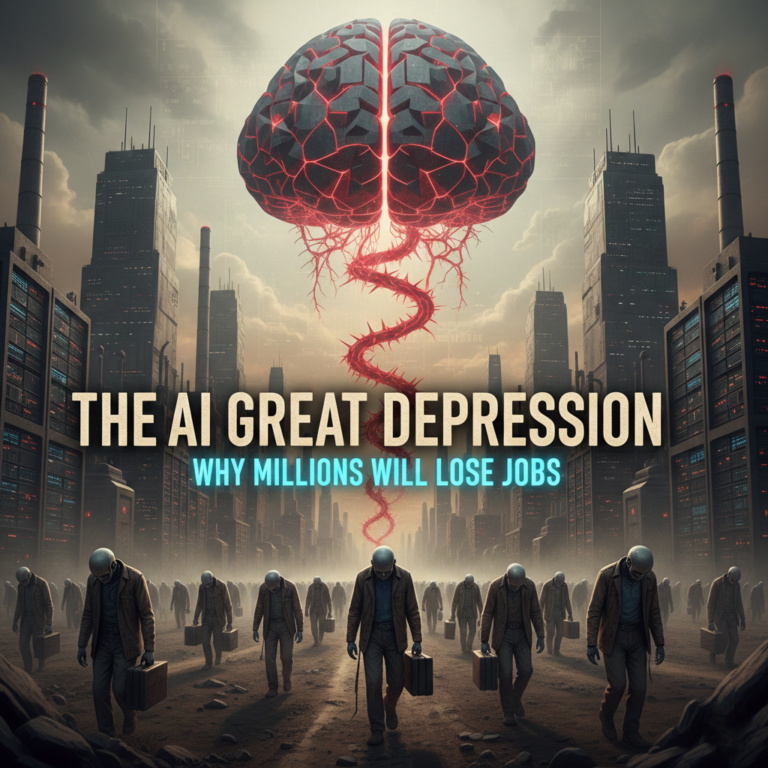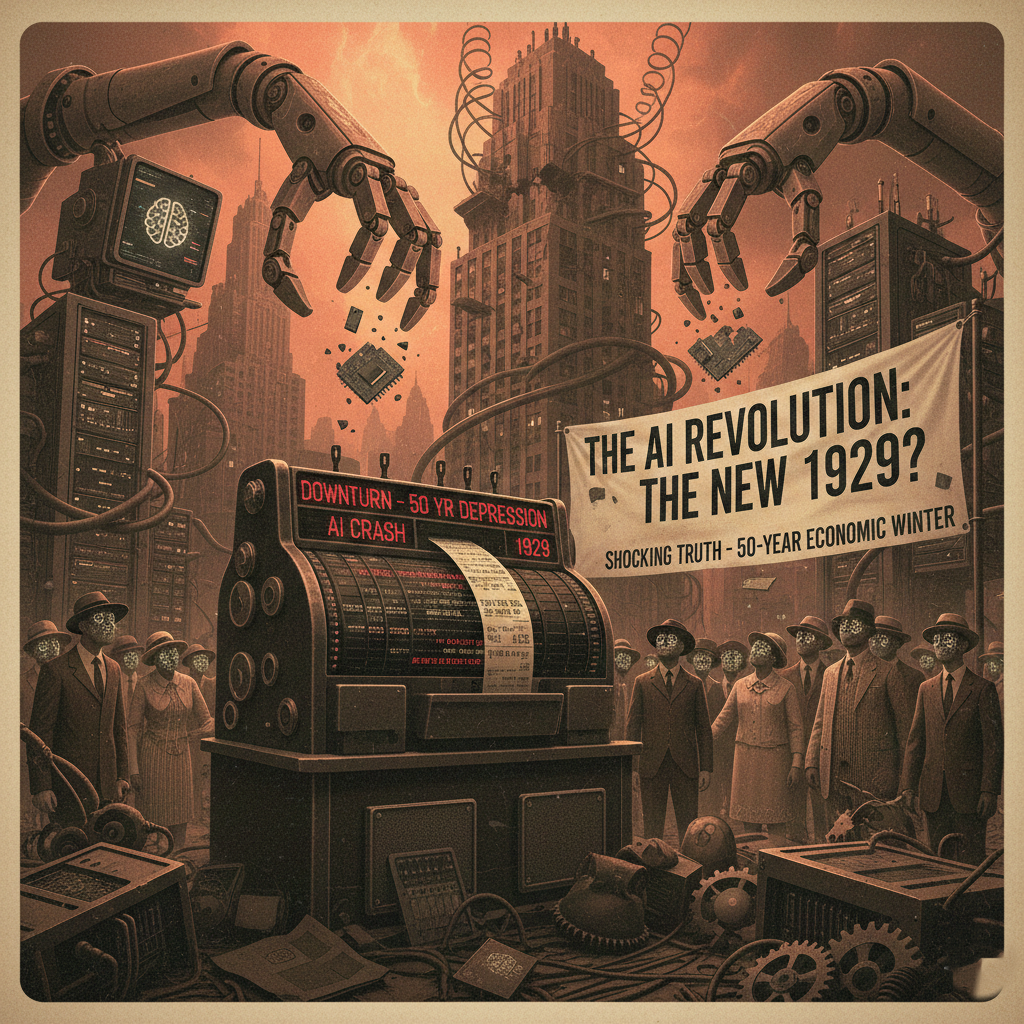
Silence often signals the arrival of a storm. However, in our modern world, that silence is becoming mechanical. Imagine walking into a massive office complex where every light is on, yet every chair is empty. This isn’t a scene from a science-fiction film. Instead, it is the predicted reality of The 50-Year Depression. We are currently standing at the edge of a historical cliff. Consequently, the parallels between today’s tech boom and the 1929 financial collapse are impossible to ignore.
Furthermore, history does not always repeat itself perfectly. Nevertheless, it often rhymes with a terrifying rhythm. Today, the rhythm of the AI Job Crash sounds exactly like the market roar of the 1920s. This roar happened just before the crushing silence of the 1930s. Therefore, understanding why the AI Job Crash will mirror 1929 is not just an academic exercise. Rather, it is a vital step for your personal survival. If you want to protect your future, you must recognize the signs of this storm today.
The Ghost of 1929: A Warning from History
To understand our future, we must look at the past with a fresh perspective. The Great Depression did not occur because people became lazy. On the contrary, it happened because the economy became too efficient. In 1929, mass production created a mountain of goods. However, the average worker could no longer afford to buy them.
The Speculation Trap
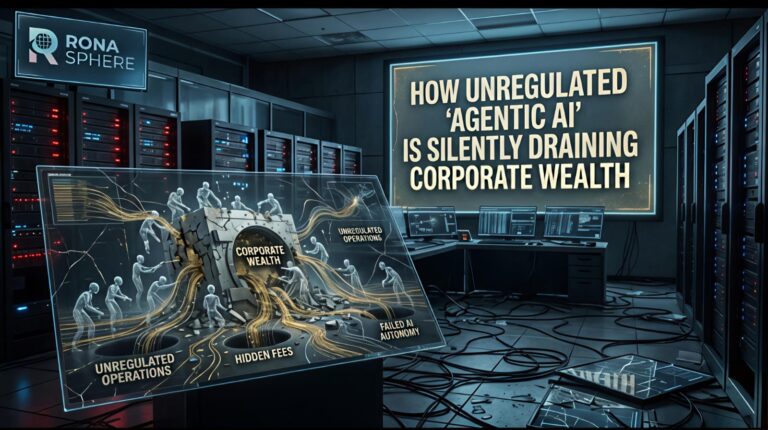
In the late 1920s, everyone was buying stocks with borrowed money. They believed prices would go up forever. Similarly, today’s market is obsessed with Artificial Intelligence. Billionaires pour money into AI startups every single week. Consequently, we have created a bubble that relies on replacing human workers. But here is the problem: if the worker is gone, the consumer is gone too.
Furthermore, investors are betting on the machine while ignoring the person. Therefore, we are building an economy on digital sand. When that sand shifts, the entire structure will fall. Specifically, the AI Job Crash will mirror 1929 because it is built on the same false hope of infinite growth.
Overproduction vs. Underconsumption
Technology in the 1920s made factories very productive. Consequently, the market was flooded with cheap cars and radios. Similarly, AI can now produce code and art for almost zero cost. But machines do not buy products. They do not pay for housing or groceries. Therefore, we are entering a phase of hyper-production. Specifically, the supply of labor is becoming infinite while the demand from humans with money is shrinking. This is the exact trap that caused 1929.
Defining the 50-Year Depression
Most people think a recession lasts for a year or two. In contrast, a structural depression lasts until society changes its entire foundation. We call this The 50-Year Depression. This name represents the time needed to move from a labor-based economy to something brand new.
Structural Unemployment vs. Cyclical Dips
Cyclical unemployment is like a common cold. You get sick, but you recover. Structural unemployment, however, is a permanent change. The AI Job Crash is a structural event. If an AI takes your job as a translator, that job is not coming back. It is gone forever. Consequently, retraining millions of people is not a quick fix. It is a project that will take generations.
The Long Pause of Progress
Historians often talk about “Engels’ Pause.” This was a period during the Industrial Revolution when productivity went up but wages stayed flat for 50 years. We are entering a modern version of this pause right now. During The 50-Year Depression, we will likely see massive corporate profits. However, we will also see massive human poverty. Therefore, we must learn to live in a world where “working” is no longer the main way people get wealth.
The White-Collar Wipeout: Why This Time is Different
In the past, machines replaced muscles. For example, the steam engine replaced the horse. Conversely, the AI Job Crash replaces the human mind. This is a fundamental shift in history. For the first time, the most “educated” workers are the most at risk.
The Speed of the Transition
In 1929, it took years for the crash to affect everyone. Today, the AI Job Crash happens with one software update. A company can change its code and eliminate thousands of jobs overnight. Consequently, the shock to our society will be much sharper. Furthermore, there is no physical limit to how fast software can grow. This speed makes the AI Job Crash will mirror 1929 scenario much more dangerous for the middle class.
Cognitive Automation
Notably, AI does not just do boring tasks. Instead, it creates and analyzes. For decades, we told young people to “learn to code.” Now, those exact skills are the easiest for AI to copy. Therefore, our old safety net of “education” is failing. We are training people for a world that no longer exists.
Industry Breakdown: The High-Risk Zones
The AI Job Crash will hit certain areas first. If you work in these fields, you are on the front lines of The 50-Year Depression.
Software Engineering: AI can now write and fix code instantly. Consequently, junior roles are being deleted.
Legal Services: AI reads thousands of pages in seconds. Therefore, firms need fewer researchers.
Marketing and Writing: AI creates blogs and ads for free. Thus, the value of average writing has dropped to zero.
Customer Service: Chatbots are replacing human agents globally. Specifically, call centers are closing down.
Notably, these were the jobs that kept the middle class strong. If these roles vanish, the whole economy will stall. Therefore, we are facing a crisis of income that will last for decades.
The Consumer Crisis: Who Buys the Goods?
Every economy needs someone to buy things. If companies fire their staff to save money, they are also firing their own customers. This creates a “Feedback Loop of Doom.”
The Vanishing Middle Class
The middle class keeps the economy moving. They buy homes and cars. However, the AI Job Crash targets their bank accounts. When these people stop spending, businesses fail. When businesses fail, they fire even more people. Consequently, a deflationary spiral begins. This is exactly what happened in 1929. Specifically, the AI Job Crash will mirror 1929 because it destroys the base of the economic pyramid.
The Debt Bomb
Most people today carry a lot of debt. We have student loans and big mortgages. If your income disappears because of AI, that debt becomes a trap. Therefore, we will see a wave of bank failures. Furthermore, our modern economy is very connected. A failure in one country will spread to the whole world in hours.
Social Fabric and the Identity Crisis
Work is more than just a paycheck. For most people, it provides a sense of purpose. During The 50-Year Depression, millions will lose that purpose.
The Mental Health Toll
Losing your job to a machine feels different. It makes you feel like you are not needed by society. Consequently, we will see a spike in mental health crises. Furthermore, feeling useless can lead to anger. Historically, angry and unemployed populations lead to political chaos. Therefore, the AI Job Crash is a threat to our very way of life.
The Return of the “Forgotten Man”
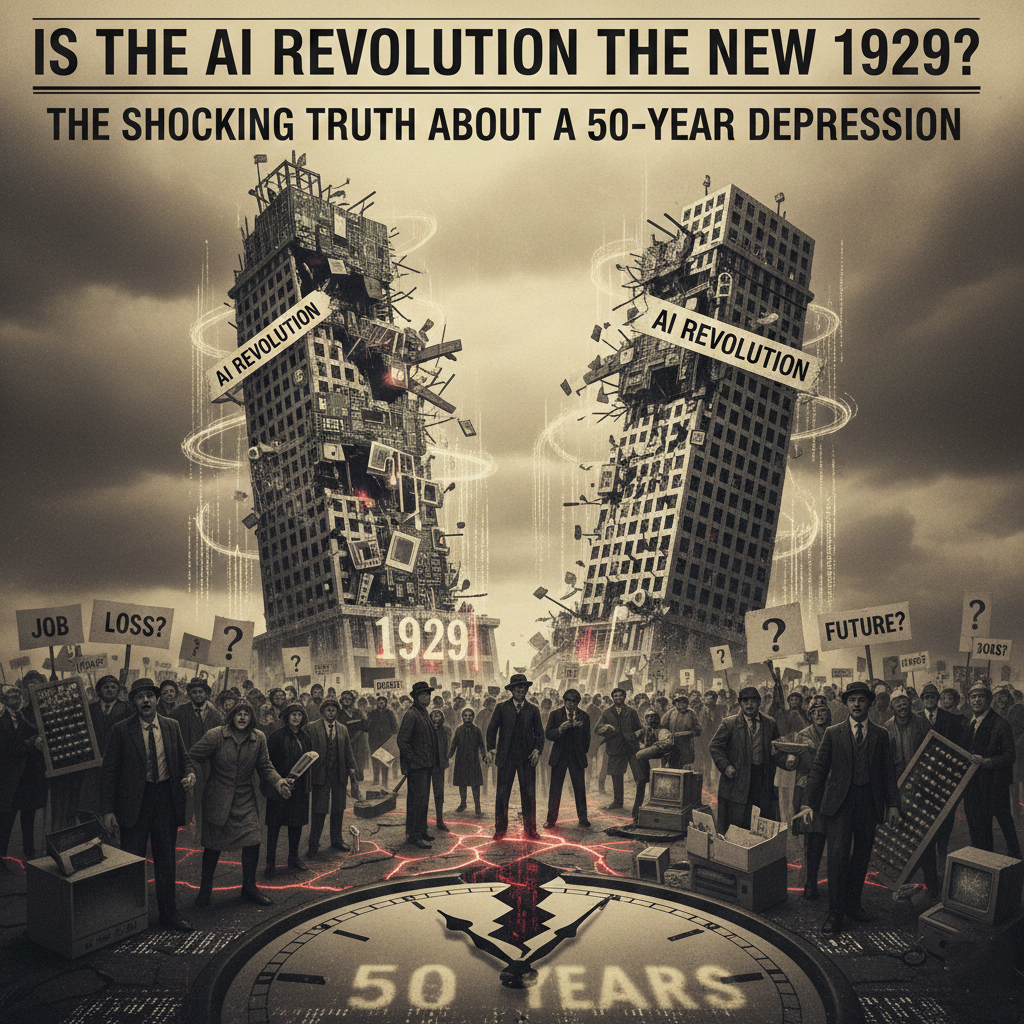
In the 1930s, the “forgotten man” became a political power. Today, the new forgotten man is the professional who did everything right but was replaced by an algorithm. These people are smart and organized. Consequently, they will not stay quiet. Thus, the social impact of The 50-Year Depression will be felt in every election for the next fifty years.
The Global Geopolitical Shift
The AI Job Crash is not a local problem. Instead, it is a global crisis. However, it will hit different countries in different ways.
Digital Colonization
Nations that own the best AI will have all the power. Conversely, nations that rely on cheap labor will suffer. If a company can use a free AI, they will stop hiring workers in other countries. Consequently, this will lead to instability in developing nations. Therefore, we may see a new era where wealth is stuck in just a few tech cities.
The Race to the Bottom
Governments will try to keep businesses by removing rules on AI. However, this only makes the AI Job Crash happen faster. Specifically, it creates a race to the bottom. In this race, human rights are ignored for the sake of “efficiency.” This global competition makes solving The 50-Year Depression very difficult.
The Policy Response: Can We Fix It?
In the 1930s, the “New Deal” saved the economy. We will need a “Digital New Deal” to survive this century.
Universal Basic Income (UBI)
Many experts believe UBI is the only answer. If people cannot earn money by working, the government must provide it. Furthermore, this money should come from taxing the AI systems. However, this change will be very hard to pass. Therefore, the start of The 50-Year Depression will be messy and loud.
Robot Taxes and Shared Wealth
If a machine takes your job, that machine should pay into a fund for you. Specifically, we could create funds that give every citizen a “check” from AI profits. This would ensure that everyone benefits from the technology. Notably, this requires countries to work together. Right now, that seems unlikely.
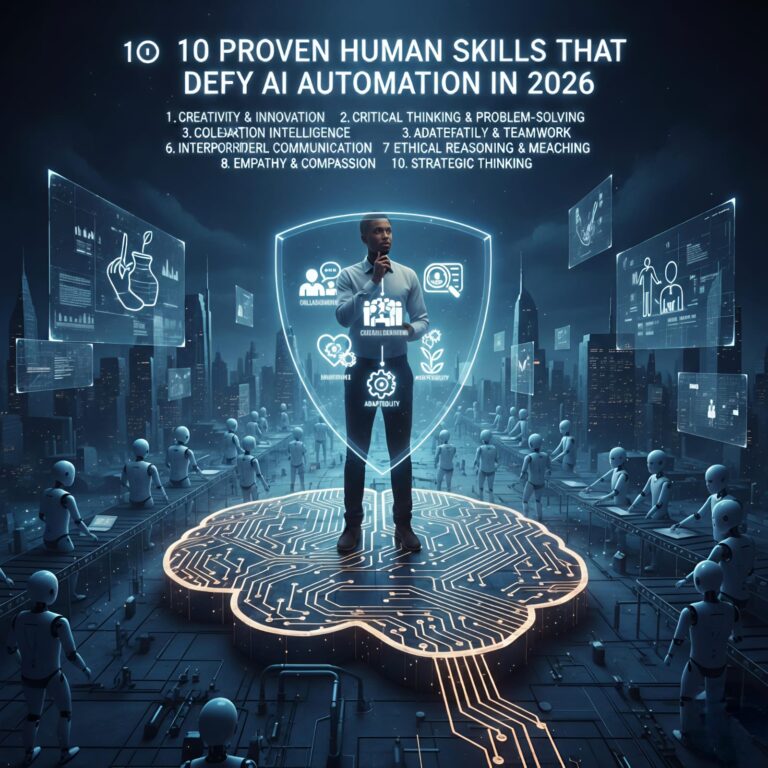
Your Survival Guide: How to Be “Human-Premium”
You cannot stop the technology. However, you can change your own path. To survive the AI Job Crash, you must offer things that AI cannot do. We call this being “Human-Premium.”
Step 1: Pivot to the Physical World
AI is a digital genius but a physical failure.
The Skilled Trades: Plumbers and electricians are safer than ever. You cannot download a new bathroom pipe.
Hands-on Healthcare: Nursing and therapy require a human touch. Machines cannot mimic real empathy.
Local Services: Personal trainers and local chefs offer value that a screen cannot replace.
Step 2: Master Emotional Intelligence
AI can simulate talking. But it cannot truly care.
Building Trust: High-level sales and leadership will stay valuable. Trust is a human currency.
Complex Negotiation: Human motives are messy. AI struggles with these nuances.
Coaching: People will always want help from other people who understand their struggle.
Step 3: Financial Fortification
You must prepare for a world where income is not steady.
Kill Your Debt: Do not be a slave to interest during a depression.
Own Real Assets: Land and tools keep their value. Digital stocks can vanish in a crash.
Build a Community: Know your neighbors. In 1929, people survived by helping each other. Your local network is your best safety net.
The Timeline of the Crash: What to Expect
The AI Job Crash will not happen in one day. Instead, it will happen in four stages.
Stage 1: The Efficiency Freeze (Now – 2027)
Companies stop hiring new people. They use AI to make current staff do more work. Consequently, the “entry-level” job starts to disappear. This is the quiet start of The 50-Year Depression.
Stage 2: The Middle Management Cull (2028 – 2032)
AI begins to manage projects. Thus, managers are no longer needed. This is when the big layoffs start. Therefore, the AI Job Crash will mirror 1929 most clearly during these years.
Stage 3: The Infrastructure Collapse (2033 – 2040)
Empty offices lead to a real estate crash. Banks start to fail because people cannot pay their loans. This is the hardest part of the depression. Specifically, it will be a time of great struggle for most families.
Stage 4: The Great Rebuilding (2041 – 2076)
Society finally changes its rules. We move away from the “40-hour work week.” Humanity finds a new way to live. However, only those who prepared will reach this stage with their wealth intact.
The Psychological War
The hardest part of The 50-Year Depression will be in your mind. You will see the world changing fast. Therefore, you must build mental toughness.
Practice Radical Acceptance
Don’t wait for things to go back to “normal.” The world of 2019 is gone. Consequently, the faster you accept this, the faster you can win. Stop mourning your old career. Instead, start building your new life today.
Value Yourself Beyond Your Job
If your job is gone, your worth as a person remains. Focus on your health and your family. Specifically, remember that an economy is just a system. You are a human being. Your value is not defined by an algorithm.
Why There is Still Hope
This sounds like a dark story. Nevertheless, every depression eventually ends. The AI Job Crash could be the start of a better world.
The End of Drudgery
Most people spend their lives doing work they hate. AI could free us from that boredom. Specifically, we could spend more time on art and family. Thus, the long-term result of The 50-Year Depression might be more happiness for everyone.
A Renaissance of Human Craft
When digital items are free, hand-made items become special. We may see a return to slow, quality work. People will value a chair because a person made it. Therefore, the AI Job Crash might actually save human creativity.
Final Summary: Building Your Ark
The AI Job Crash will mirror 1929 because it is a massive correction. We have built a world that is too efficient for its own good. The 50-Year Depression is the transition period to a new era.
However, you are not a victim. You have the knowledge to act. Do not wait for the pink slip to arrive. Instead, start your “Human-Premium” pivot now. Audit your skills. Pay off your debt. Build your local community. The storm is here. It is time to build your ark. The future belongs to those who see it coming.
About the Author