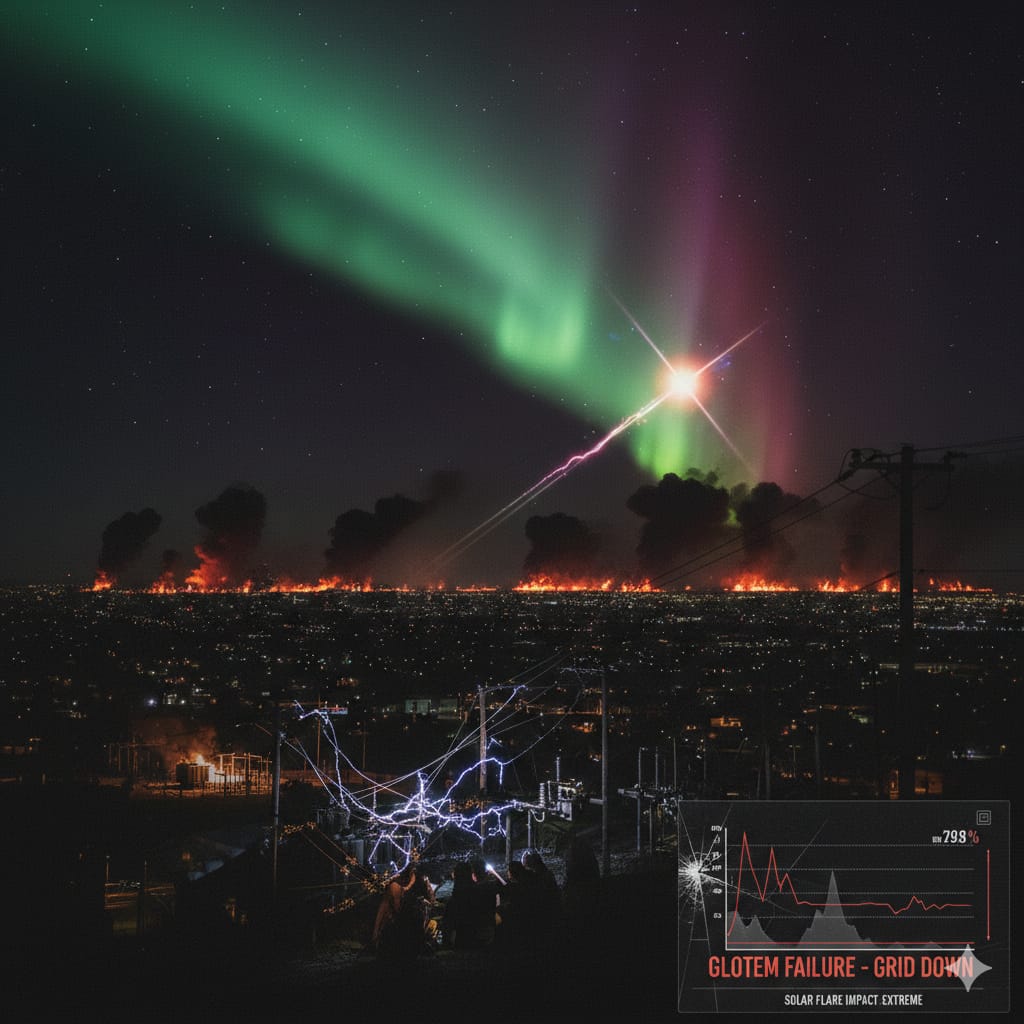
Imagine waking up to a world where the hum of your refrigerator has vanished. You reach for your phone, but the screen remains dark. There is no Wi-Fi, no running water, and the traffic lights outside are frozen. This isn’t the plot of a dystopian novel; it is the “Blackout” risk posed by a massive solar flare. As we navigate the peak of Solar Cycle 25 in 2026, the vulnerability of the Western power grid to a solar flare has moved from a scientific curiosity to a national security priority.
Furthermore, our reliance on technology has reached an all-time high. Consequently, a disruption to our electrical infrastructure would ripple through every sector of society. From healthcare to high-frequency trading, everything depends on a stable flow of electrons. In contrast to historical societies, we are uniquely ill-equipped to handle a long-term loss of power. Therefore, understanding the mechanics of this threat is essential for every citizen.
Understanding the Solar Flare Threat
To grasp the danger, we must look beyond the beautiful auroras that dance across the sky. A solar flare is a sudden explosion of energy on the Sun’s surface. While the light and X-rays reach us in roughly eight minutes, the real “Blackout” risk comes from Coronal Mass Ejections (CMEs). These are massive clouds of charged plasma that can slam into Earth’s magnetic field.
When a CME hits, it creates a geomagnetic storm. Consequently, these storms induce electrical currents on the ground. These Geomagnetically Induced Currents (GICs) enter our long-distance transmission lines. Because our Western power grid is highly interconnected, these rogue currents can travel hundreds of miles. They seek a path to the ground through our most expensive and sensitive equipment.
The Science of Destruction
The primary victim of a solar flare is the high-voltage transformer. These massive machines are the heart of the Western power grid. When GICs flow through them, they cause the transformer core to saturate. Furthermore, this saturation leads to intense internal heating. In a worst-case scenario, the copper windings melt, and the transformer becomes a multi-ton hunk of useless metal.
Moreover, these transformers are not easily replaced. They weigh hundreds of tons and require specialized transport. In contrast to smaller electronics, you cannot simply buy a replacement at a local store. Therefore, the loss of even a few dozen transformers could lead to a localized “Blackout” risk that lasts for months or even years.
Historical Warnings: The Carrington Event and Beyond
History provides a sobering look at the “Blackout” risk. In 1859, the Carrington Event—the largest solar storm on record—caused telegraph wires to spark and ignite fires. Telegraph operators reported receiving shocks from their equipment. Interestingly, some were able to send messages even after they disconnected their batteries, powered solely by the atmospheric electricity.
If a similar event happened today, the consequences would be catastrophic. Furthermore, more recent events have shown us the modern version of this chaos:
1989 Quebec Blackout: A relatively minor storm knocked out the entire Hydro-Québec grid in just 92 seconds. Consequently, six million people lost power for nine hours during a freezing winter.
2003 Halloween Storms: These caused power outages in Sweden and damaged several high-voltage transformers in South Africa.
2025 “Cannibal Storm”: Just recently, a series of X-class flares disrupted GPS and radio communications across the Northern Hemisphere. This served as a “dry run” for the 2026 solar maximum.
Consequently, these events prove that our infrastructure is not as robust as we might hope. In contrast to hurricanes or earthquakes, a solar flare is a global event. Therefore, help may not come from neighboring states, as they will likely be facing the same “Blackout” risk.
Why the Western Power Grid is Particularly Vulnerable
You might wonder why modern technology hasn’t solved this. Paradoxically, our quest for efficiency has increased our “Blackout” risk. The Western power grid is now more interconnected than ever. While this allows for better load sharing and lower prices, it also creates a massive “antenna” for solar flares.
1. Aging Infrastructure
Many transformers in the United States and Europe are decades old. These units were not designed with modern space weather data in mind. Consequently, their insulation is more likely to fail under the stress of GICs. Furthermore, the maintenance backlogs in many utility companies mean that minor vulnerabilities are often ignored until it is too late.
2. The Replacement Bottleneck
High-voltage transformers are not “off-the-shelf” items. They are custom-built, often in foreign countries. Furthermore, the lead time for a single unit can be 12 to 24 months. If a massive solar flare destroyed dozens of these units simultaneously, the “Blackout” risk would shift from a temporary nuisance to a long-term societal collapse.
3. Geographic Hazards
Regions with high-resistance rock, like the Northern US, Canada, and parts of Scandinavia, are more vulnerable. Because the ground cannot easily absorb the induced current, it flows more readily into the metal power lines. Consequently, the Western power grid in these regions is at a much higher risk during a geomagnetic storm.
4. Just-in-Time Logistics
Our modern economy runs on “just-in-time” delivery. This means that grocery stores only have about three days of food on the shelves. Furthermore, fuel pumps require electricity to function. Therefore, a “Blackout” risk that lasts longer than a week would lead to immediate shortages of essential goods. In contrast to historical crises, we have very little “buffer” in our supply chains.
The Ripple Effect: Beyond Just Electricity
When we discuss the “Blackout” risk, we must look at the secondary effects. A solar flare doesn’t just turn off the lights. It disrupts the very fabric of modern life.
Communication Failures
Satellite communications are extremely sensitive to solar activity. During a major solar flare, GPS signals can become degraded or lost entirely. Consequently, airplanes may be grounded, and maritime shipping could come to a halt. Furthermore, the ionospheric changes can disrupt high-frequency radio waves used by emergency services.
Financial Instability
The global financial system relies on precise timing provided by GPS satellites. Furthermore, the high-speed data centers that process millions of trades per second require constant power. In contrast to a physical bank run, a solar-induced “Blackout” risk could cause a digital freeze, making it impossible for people to access their funds or pay for goods.
Water and Sanitation
Most modern water systems rely on electric pumps to move water from reservoirs to homes. Furthermore, sewage treatment plants require power to process waste. Therefore, a prolonged “Blackout” risk could lead to a secondary public health crisis. In contrast to the power grid, the water system is often even more fragile and slower to recover.
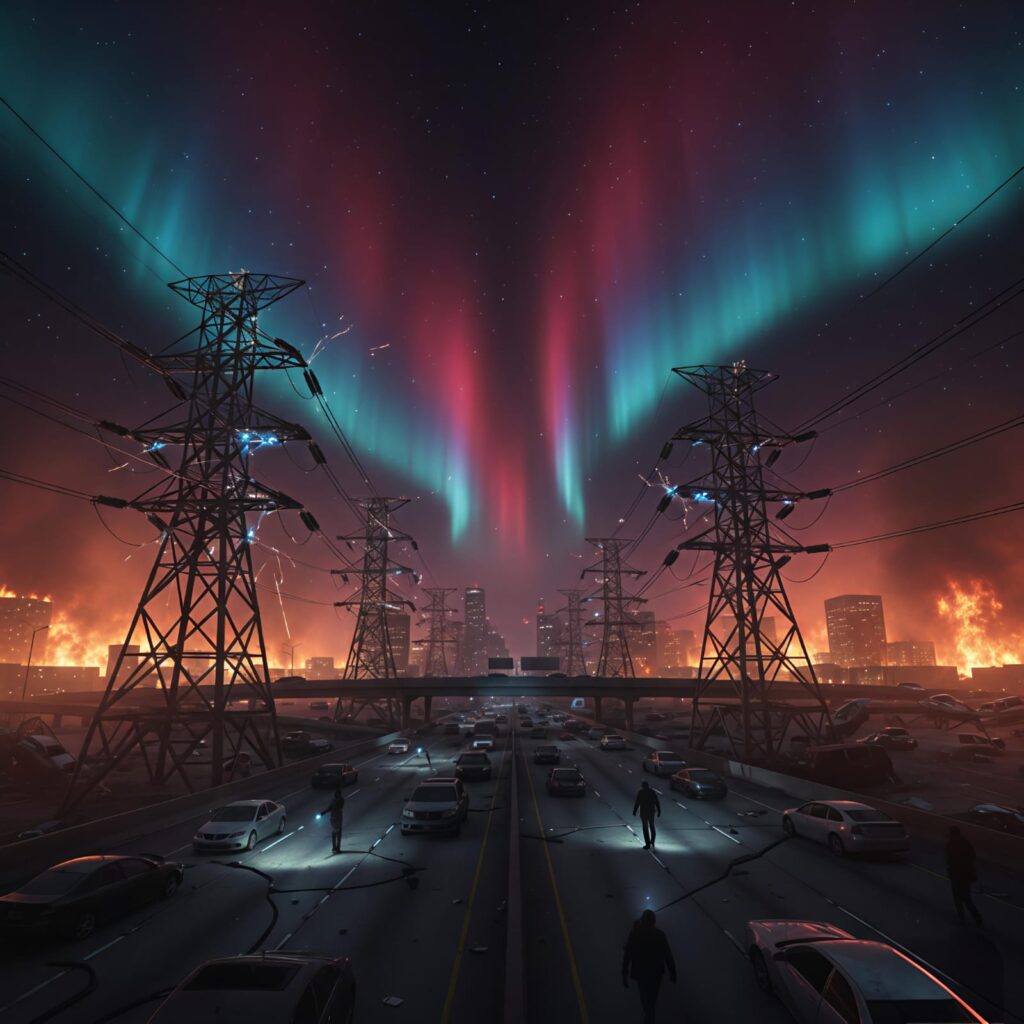
Surviving the Big One: Practical Preparation
While governments work on grid hardening, the “Blackout” risk requires individual action. You don’t need to be a “prepper” to be prepared. Simple steps can ensure your family stays safe during a solar-induced outage.
How to Prepare for a Long-Term Power Outage
Backup Energy: Invest in a solar generator or a portable power station. Unlike gas generators, these can be recharged without a working gas station. Furthermore, they are silent and safe to use indoors.
Water Security: Aim for at least one gallon of water per person per day. Manual hand pumps for wells are excellent “analog” backups. Consequently, you should keep at least a two-week supply of water on hand.
Communication: Keep a battery-powered or hand-crank emergency radio. In a solar flare event, the internet will likely be the first thing to go. Therefore, a radio will be your only source of official information.
Analog Maps: If GPS satellites are disrupted, your phone’s navigation will fail. Keep physical maps of your local area in your car. In contrast to digital maps, these don’t require a signal or a battery.
Cash Reserves: Keep a small amount of physical cash in small denominations. Consequently, if the card readers are down, you can still buy basic supplies from local vendors.
Protecting Your Own Electronics
While a solar flare primarily targets the grid, a massive event can induce currents in home electronics. Consequently, you should consider the following:
Faraday Bags: These are specialized pouches that block electromagnetic fields. Furthermore, you can use them to store backup phones, radios, and hard drives.
Unplugging: If a major space weather warning is issued, unplug sensitive electronics. This breaks the physical connection to the grid, reducing the “Blackout” risk for your personal devices.
The Path to a Resilient Grid
The “Blackout” risk is not an inevitability; it is a challenge we can meet. Engineers are currently developing GIC blocking devices. These are essentially giant capacitors that can disconnect sensitive equipment before the surge arrives. Furthermore, improved satellite monitoring gives us a crucial 12 to 48-hour warning.
In contrast to the 19th century, we now have the data to predict these events. Grid operators can proactively “shed load” or temporarily shut down vulnerable lines to protect the overall system. This “controlled dark” is a small price to pay to avoid a permanent “Blackout” risk.
Government and Policy Changes
Many experts are calling for the “hardening” of the Western power grid. This includes:
Strategic Transformer Reserves: Maintaining a stockpile of spare transformers that can be deployed quickly.
Incentivizing Microgrids: Encouraging local communities to produce their own power. Consequently, if the main grid fails, these “islands” of power can keep essential services running.
Enhanced Legislation: Requiring utility companies to meet minimum standards for geomagnetic resilience. Furthermore, providing federal funding for these expensive upgrades is essential.
The Role of Artificial Intelligence
Interestingly, AI is now being used to predict how GICs will flow through specific parts of the grid. Consequently, operators can run simulations to identify the weakest links. This allows for targeted upgrades rather than trying to fix the entire Western power grid at once. Therefore, technology is both our greatest vulnerability and our greatest shield against the “Blackout” risk.
| Mitigation Strategy | Effectiveness | Cost | Implementation Time |
| GIC Blocking Capacitors | High | High | Long-term |
| Operational Load Shedding | Medium | Low | Immediate |
| Microgrid Adoption | High | Moderate | Ongoing |
| Satellite Monitoring | High | Moderate | Immediate |
The Psychology of the “Blackout” Risk
One of the most overlooked aspects of a long-term power outage is the human element. Furthermore, how we react as a society will determine our survival. In contrast to the panic seen in movies, historical data suggests that communities often pull together during disasters.
However, the psychological stress of a “Blackout” risk cannot be ignored. Consequently, mental health preparation is just as important as physical preparation. Therefore, building strong ties with your neighbors now is a vital part of your emergency plan. When the lights go out, your community will be your most valuable resource.
Storytelling: A Glimpse into the Future
Imagine it is July 2026. The news reports a massive X-class flare. Consequently, the government issues a “Level 5” geomagnetic storm warning. You have 15 hours. You fill your bathtub with water, check your solar charger, and call your family.
As the storm hits, you see the sky turn a brilliant, eerie purple. Then, the streetlights flicker and die. Furthermore, the silence is deafening. But because you prepared, you aren’t panicking. You turn on your crank radio and listen for updates. In contrast to your neighbors who ignored the warnings, you have a plan. This is how we manage the “Blackout” risk.
Debunking Common Myths
There is a lot of misinformation regarding solar flares. Consequently, it is important to distinguish fact from fiction to avoid unnecessary fear.
Myth: A solar flare will fry your phone in your pocket.
Fact: Solar flares affect long-distance conductors like power lines. Furthermore, small devices aren’t “long” enough to pick up much induced current. The “Blackout” risk to your phone is that the charging network and towers will fail, not the device itself.
Myth: We won’t have any warning.
Fact: We have satellites like SOHO and DSCOVR constantly watching the Sun. Consequently, we usually have at least 24 hours of warning before a CME hits.
Myth: It will be just like “The Last of Us”.
Fact: While a long-term outage is serious, we have the engineering capability to recover. Therefore, the goal is to prevent the damage rather than just surviving the aftermath.
Final Thoughts: The 2026 Solar Maximum
As we move deeper into 2026, the Sun is reaching its peak activity. The “Blackout” risk is a reminder of our dependence on a fragile electrical web. However, by combining high-level engineering with personal preparedness, we can weather the coming storm. The Western power grid may be vulnerable, but it is not defenseless.
Furthermore, we must demand that our leaders take this threat seriously. Consequently, investing in grid resilience is not just an engineering project; it is an insurance policy for civilization. In contrast to many global threats, the “Blackout” risk has a clear solution. We just need the collective will to implement it.
Therefore, stay informed, stay prepared, and keep a watchful eye on the Sun. The vulnerability of the Western power grid to a solar flare is a challenge, but it is one that we are finally starting to address with the seriousness it deserves.
About the Author