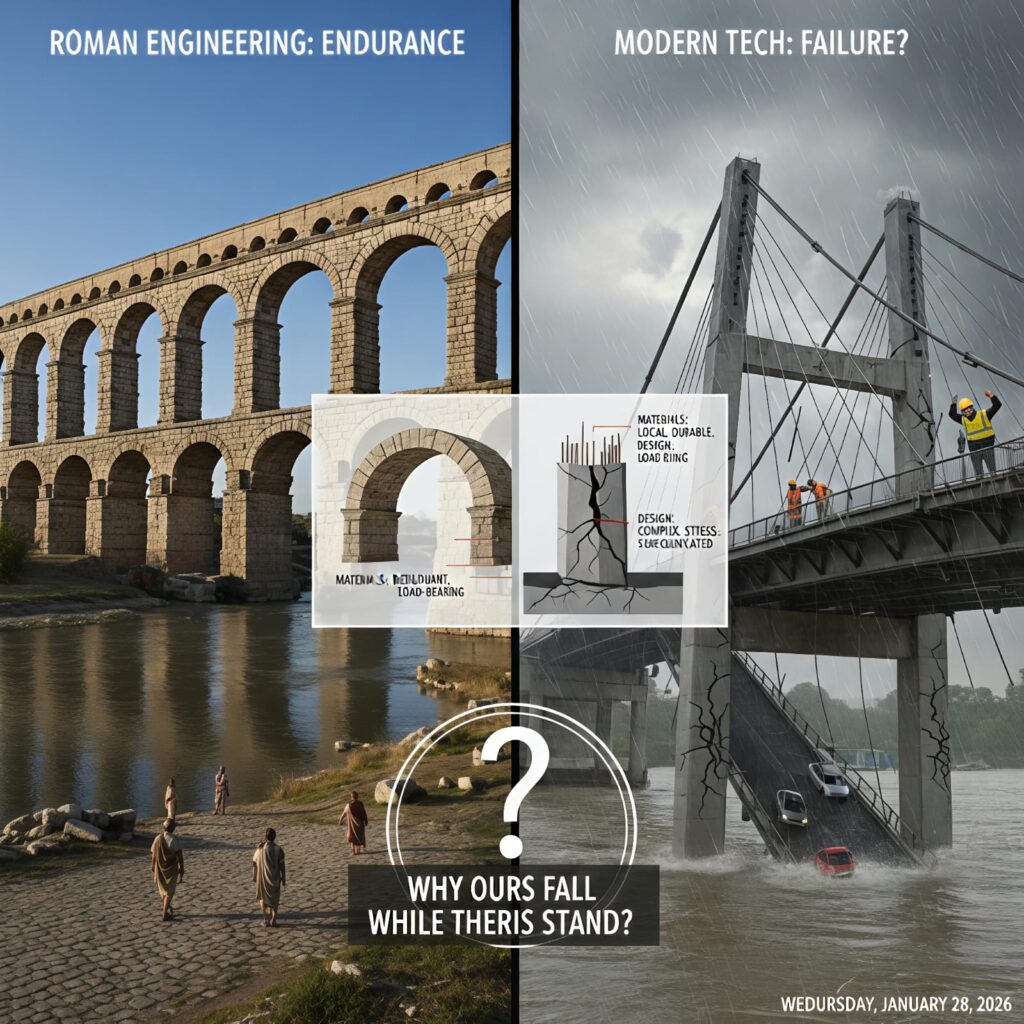
If you stand on the banks of the Tiber River today, you can see a miracle of history. The Pons Fabricius, built in 62 BC, still carries heavy foot traffic every single day. Meanwhile, in many modern cities, highway overpasses built in the 1970s are already falling apart. This happens because they are structurally unsound. This huge gap in lifespan forces us to look at Roman Engineering vs. Modern Tech. Despite our advanced computers, we have lost the ability to build for the centuries.
Furthermore, the difference between these two eras is not just about age. Instead, it is a total difference in materials and mindset. To understand why ancient arches remain while modern beams crumble, we must look closer. Consequently, we will explore the “Secret Sauce” of Rome and the “Weak Spot” of the modern world.
The Magic of Ash: The Secret of Roman Concrete
When we talk about Roman Engineering vs. Modern Tech, we must start with opus caementicium. This is the name for Roman concrete. For a long time, modern scientists were confused by Roman piers. These pillars stay strong even after 2,000 years in salty ocean water.
The Volcanic Power
First, the Romans did not use the Portland cement we use today. Instead, they used volcanic ash from places like Mount Puteoli. Furthermore, they mixed this ash with lime and seawater. Consequently, a unique chemical reaction happened inside the mix. While modern concrete stays still, Roman concrete stays active. This activity is the main reason it survives so long.
The Self-Healing Trick
Recently, researchers found a secret inside the walls. The “white spots” in Roman concrete were actually lime clasts.
The Crack: First, a small crack forms in the bridge.
The Infiltration: Then, rain or seawater leaks into that crack.
The Fix: Consequently, the water hits the lime and dissolves it.
The Cure: Finally, the lime fills the crack and hardens into stone again.
In contrast, water destroys a modern bridge from the inside. Therefore, in the fight of Roman Engineering vs. Modern Tech, the ancients created a living bridge. We create a bridge that starts dying the day it opens.
The Steel Trap: Why Modern Tech Rusts
The biggest “upgrade” in modern times is Reinforced Concrete. However, this is actually our biggest weakness. In the debate of Roman Engineering vs. Modern Tech, our love for steel is what causes our bridges to fail.
How Decay Happens
Modern bridges use steel bars (rebar) to stay strong. This allows us to build long, flat roads. However, steel hates water. Even a tiny crack lets moisture reach the metal.
Rust: As steel rusts, it grows much larger.
Pressure: Consequently, this growth pushes against the concrete.
Pop: The concrete eventually cracks and falls off in big chunks.
Because the Romans had no steel, they had to build differently. They used compression. They built massive stone arches that pushed downward. Since stone does not rust, the bridge does not explode from the inside. Consequently, the “tech” in Roman Engineering vs. Modern Tech often picks fast results over long-term safety.
The Power of the Arch: Pure Geometry
If you think of a bridge, you probably see a Roman arch. This shape is the most stable form in nature. In the history of Roman Engineering vs. Modern Tech, the arch is the champion of physics.
How it Works
The beauty of the arch is how it moves weight. Every stone pushes against its neighbor. Eventually, the arch sends all that weight straight into the ground. As long as the ends are strong, the bridge will never fall. In fact, more weight makes the stones lock together even tighter.
The Problem with Modern Spans
In contrast, modern bridges use cables or joints. These parts allow us to cross huge bays. However, they need constant oiling and repair. If one cable snaps, the whole bridge might fall. Consequently, a Roman bridge is like a mountain. A modern bridge is like a machine. Machines always break.
The “Safety Margin” Mindset
In our world, we want to be efficient. We use computers to find the thinnest amount of concrete we can use. This is a core part of the Roman Engineering vs. Modern Tech divide.
Building for the Future
Roman builders did not have calculators. To be safe, they practiced massive over-engineering. If a bridge needed to hold a few carts, they built it to hold a mountain. Furthermore, they used thick stone skins to protect the soft core. This kept the weather away from the heart of the bridge.
The Cheap Choice
Modern tech follows the “Lowest Bidder” rule. We try to use the minimum amount of material to save money. Furthermore, we often plan for a bridge to last only 50 years. While this saves tax money today, it costs a fortune tomorrow. When we look at Roman Engineering vs. Modern Tech, we see a clear choice. One group built for forever. We build for the next few years.
Skin in the Game: True Accountability
We must also talk about the people. The Romans had a very scary way to ensure quality.
The Ultimate Test
Once the stone arch was finished, the wooden supports came out. At that exact moment, the lead engineer had to stand directly under the bridge. If the bridge fell, the engineer died. Furthermore, the builders carved their names into the rocks. Their family pride was on the line.
Modern Paperwork
In the world of Modern Tech, no one is truly responsible. There are designers, contractors, and inspectors. If a bridge falls, lawyers argue for years. No one stands under the bridge. Consequently, the pride of the work is gone. This leads to the weak bridges we see today.
Fighting the River: The Water Secret
Modern bridges often fail because of scour. This is when a river washes away the dirt under a bridge. In the battle of Roman Engineering vs. Modern Tech, the Romans were better at building in water.
Underwater Glue
The Romans found a way to make glue that works in the sea. By mixing ash with lime, they made a cement that hardens under the water. They built huge wooden boxes in the river and pumped the water out. Then, they placed solid concrete on the hard rock.
Modern Weakness
Modern piers are often just poles driven into the mud. While this is fast, the river can eventually wash that mud away. Because Roman piers were as thick as the bridge itself, they stood firm. Therefore, when big floods come, Roman Engineering stays put while Modern Tech gets washed away.
The Cost of Fixing: A Big Lie
Many people say, “Modern bridges are cheaper.” However, this is not true if you think about the long term.
The Big Investment
A Roman bridge cost a lot of money and labor at the start. However, that bridge might not need a repair for 500 years. When you spread that cost over 2,000 years, the bridge is almost free.
The Modern Debt
Modern tech creates a money pit. We build a bridge for millions. Then, in 20 years, we must pay millions more for paint and repairs. By year 60, the bridge is trash. Consequently, we are always building the same bridges over and over. The Romans did it right the first time.
8. Resilience vs. Strength
To understand Roman Engineering vs. Modern Tech, we must look at the tiny details.
The Brittle Modern Bridge
Modern cement is made at very high heat. This makes it very strong but very stiff. Because it is stiff, it cracks easily when the ground moves. Furthermore, making this cement creates a lot of pollution.
The Flexible Roman Way
The Roman binder was made at lower heat. Consequently, the concrete was a bit “softer.” This allowed the bridge to bend slightly during small earthquakes. In the fight of Roman Engineering vs. Modern Tech, the Romans picked “bending” over “breaking.”
Patience vs. Speed
In our world, speed is everything. We want roads built in a few months. This haste is a big part of Modern Tech.
Roman Time
The Romans were happy to take ten years to build one bridge. They knew that their concrete needed time to get strong. Furthermore, they used soldiers to do the work. This kept the workers focused and disciplined.
The Modern Rush
In contrast, modern projects are always in a hurry. Consequently, we use chemicals to make concrete dry in hours. While this opens the road fast, it ruins the quality. Therefore, the speed of Modern Tech is often what kills the bridge later.
Real World Examples
The Pons Aelius
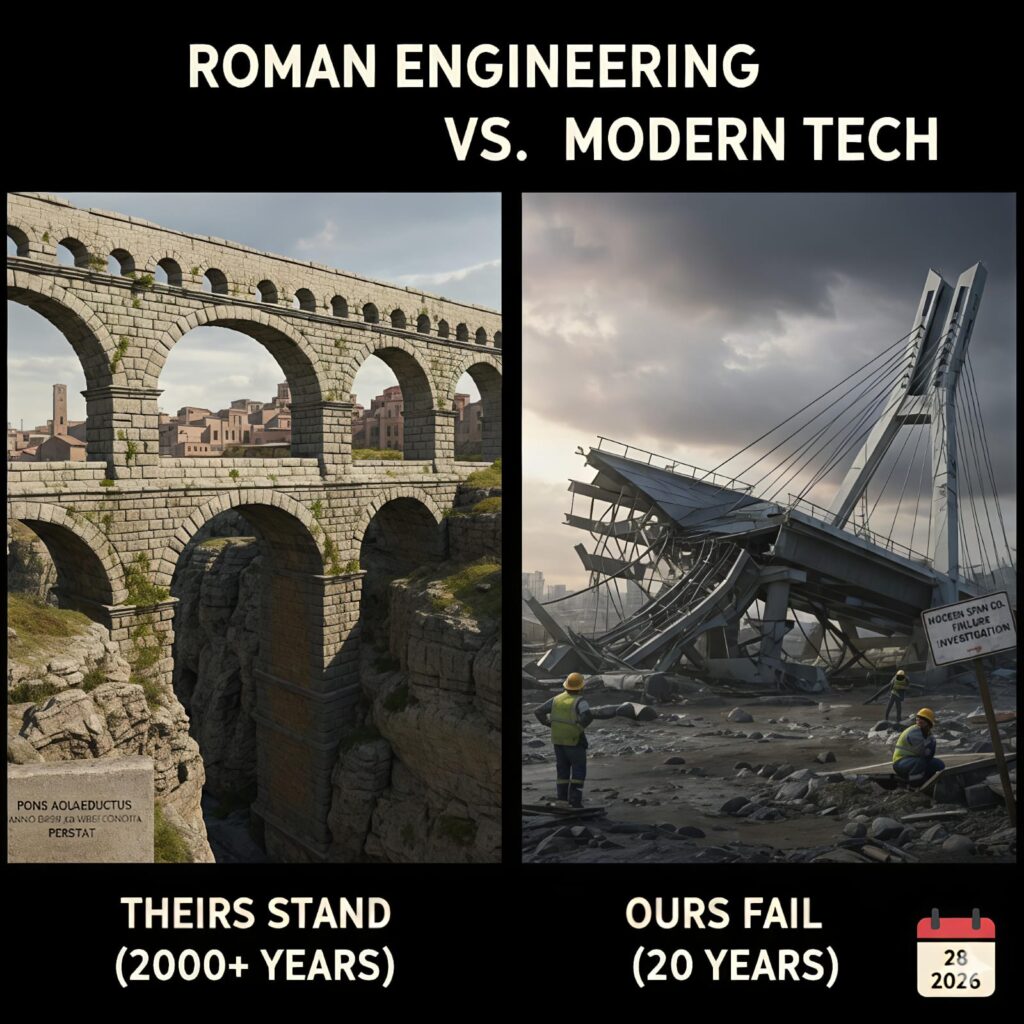
This bridge was built in 134 AD. It has survived nearly 2,000 years of floods and wars. It is a perfect example of Roman Engineering vs. Modern Tech. Even with modern cars driving on it, the Roman base does not move.
The Morandi Bridge
In 2018, a modern bridge in Italy fell down. Many people died. The cause was rust inside the concrete. This shows the danger of modern ways. When our bridges fail, they fail fast. A Roman bridge usually gives warnings for centuries.
11. Material Sourcing and Sustainability
Furthermore, we must consider where the materials come from. Roman engineering used local resources. Consequently, the carbon footprint was very low.
Local Volcanics
Romans used what was under their feet. This meant they did not have to ship heavy stones across the world. Furthermore, the lime they used was processed in local kilns. This created a circular economy.
Global Supply Chains
In contrast, modern tech relies on global shipping. We get our steel from one country and our cement from another. Consequently, a single bridge has a massive environmental cost before it even opens. Therefore, when we compare Roman Engineering vs. Modern Tech, we see that the ancient way was much greener.
Maintenance Philosophy
Additionally, the way we look after our bridges has changed. Romans built for low maintenance. Consequently, they didn’t need a huge department of transportation.
Passive Durability
A Roman bridge is “passive.” This means it just sits there and stays strong. Furthermore, it does not have moving parts that need grease. Because of this, it can be forgotten for a century and still be safe.
Active Monitoring
Modern tech is “active.” We have to use sensors and cameras to watch for cracks. Furthermore, we have to paint the steel to stop rust. If we stop doing this for just ten years, the bridge becomes a death trap. Consequently, the modern way requires a lot of future money and work.
The Impact of Heavy Traffic
Moreover, we must talk about the weight of modern trucks. Some people say Roman bridges last because they only carry carts. However, this is not entirely true.
Modern Loads
It is true that a 40-ton truck is heavy. Modern tech is built to handle this. Consequently, we use thick steel beams. Furthermore, we use complex math to distribute the weight.
Ancient Resilience
However, Roman bridges have survived the weight of modern tanks and trucks during wars. Furthermore, they have survived the weight of thousands of people gathered at once. While they were not built for semi-trucks, their “over-built” nature allowed them to adapt. Consequently, they are much tougher than we give them credit for.
Cultural Value and Protection
Besides engineering, there is the social side. A bridge is a part of a city’s soul.
The Bridge as a Gift
Romans saw a bridge as a gift to the gods and the people. Consequently, they made them look like temples. Furthermore, they celebrated when a bridge was finished. This made the people love the bridge.
The Bridge as a Utility
Today, we see a bridge like a pipe or a wire. It is just a tool to get from A to B. Consequently, we don’t care about it. If it gets ugly, we tear it down. Therefore, the Roman way used “love” as a way to make sure the bridge was kept safe for ages.
The Role of the Military
Furthermore, we cannot forget that Roman engineers were soldiers. This gave them a different view of the world.
Discipline in Design
A soldier does not want to rebuild a bridge every year. Consequently, they build it to be a fortress. Furthermore, they use methods that are simple and hard to mess up. This “military grade” quality is why they still stand.
Corporate Interests
Modern tech is often driven by corporate profit. Consequently, companies want to finish fast so they can move to the next job. Furthermore, they might use cheaper parts to increase profit. This is a huge risk for the public. Therefore, the Roman military model was much better for long-term safety.
16. Engineering Education Then and Now
Additionally, how we train engineers has changed. Roman engineers learned by doing.
Apprenticeship
A Roman student spent decades on job sites. Consequently, they saw exactly how stone and water behaved. Furthermore, they learned the “secrets” of the masters that were not written in books.
Classroom Learning
Modern engineers spend years in classrooms. They learn a lot of math. However, they might not touch actual concrete until they graduate. Consequently, they might understand the “theory” but not the “feeling” of the material. Therefore, the Roman way created builders who truly understood the earth.
The Choice for the 21st Century
So, where do we go from here? We are at a turning point in history.
The Path of Waste
We can keep using Modern Tech as it is. Consequently, we will keep spending billions on bridges that fail. Furthermore, we will keep polluting the air with cement smoke. This path leads to a world full of rubble.
The Path of Wisdom
Or, we can learn from Roman Engineering. We can start building with volcanic materials again. Furthermore, we can use the arch shape more often. Consequently, we can leave a world for our children that is not falling apart.
Urban Planning and Longevity
Moreover, the way we build cities affects how long bridges last. Roman cities were built to stay in one place.
Static Cities
A Roman bridge was part of a permanent road. Consequently, the bridge never had to move. Furthermore, the land around it was protected.
Expanding Cities
Modern cities are always changing. We build a bridge, and then 20 years later, we need to move it to make room for a stadium. Consequently, we don’t bother building for 2,000 years. We think the bridge will be in the way anyway. Therefore, we need to plan our cities better if we want eternal bridges.
Summary of the Showdown
Ultimately, the battle of Roman Engineering vs. Modern Tech is a battle of values.
Material: Roman ash vs Modern steel.
Shape: Roman arch vs Modern flat beam.
Goal: Roman eternity vs Modern efficiency.
Result: Roman survival vs Modern decay.
Furthermore, we see that the Romans were not “primitive.” In many ways, they were more advanced than we are today. They understood the planet better. Consequently, their work remains as a silent teacher.
Final Thoughts
In conclusion, the winner is clear. If you want to move fast, pick modern tech. However, if you want to stand still for eternity, follow the Romans. We must stop thinking that “new” always means “better.” Sometimes, the best way forward is to look back 2,000 years.
Furthermore, we must demand better from our builders. We should not accept bridges that only last 50 years. Consequently, we should push for a return to quality. Let us build arches that our descendants can walk across in the year 4000.
Key Lessons to Take Home:
Ash is good: It heals cracks and saves the planet.
Steel is risky: It is a ticking time bomb of rust.
Arches are best: They are the strongest shape in the universe.
Take your time: A bridge built in a rush will fail in a rush.
Consequently, the study of Roman Engineering vs. Modern Tech is the most important lesson for any builder today. Let us choose the path of the arch.
About the Author