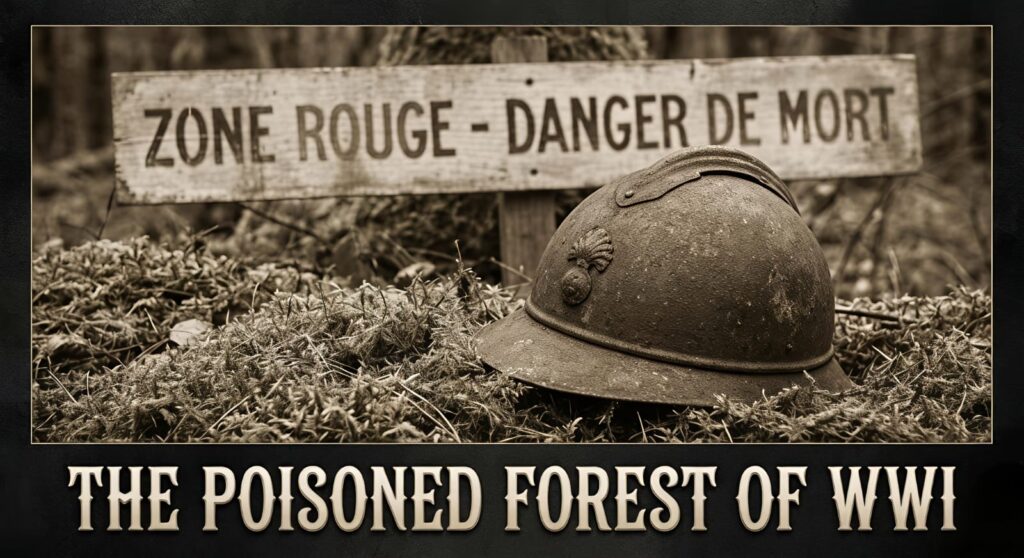
Imagine a place where the birds do not sing, the water runs black with arsenic, and the soil beneath your feet hides enough explosives to level a city block. This is not a scene from a post-apocalyptic film; rather, it is the chilling reality of the Zone Rouge in northeastern France.
For over a century, this “Red Zone” has stood as a silent, moss-covered tomb, serving as a permanent scar of World War I. While the rest of the world moved on from the “Great War,” France had to cordon off massive swaths of its own territory. Consequently, these lands became legally “impossible to clean.”
Today, we will dive deep into the history, the environmental catastrophe, and the terrifying legacy of the Zone Rouge.
The Birth of a Restricted Wilderness
Immediately after the 1918 Armistice, the French government surveyed the wreckage of the Western Front. Although many areas were eventually reclaimed, officials identified roughly 1,200 square kilometers that were beyond repair. They officially designated this territory as the Zone Rouge.
Initially, the government defined this area as land where “human life is impossible” due to the density of unexploded ordnance. Furthermore, the sheer volume of human and animal remains turned the soil into a biological hazard. Even though a hundred years have passed, the Zone Rouge remains a restricted area where entry is strictly forbidden.
The Categorization of Devastation
To manage the recovery, France split the land into different colored zones. Consequently, different levels of restoration were applied based on the severity of the damage:
Green Zones: These areas suffered minimal damage, and farmers returned quickly to restore the landscape.
Yellow Zones: These regions saw moderate damage to infrastructure and soil, requiring significant but achievable cleanup.
Red Zones (Zone Rouge): These sectors witnessed the total destruction of soil, water, and vegetation. In contrast to the other zones, the Zone Rouge was deemed non-recoverable.
Why the Zone Rouge Is Still Lethal Today
You might wonder why nature hasn’t simply “healed” the Zone Rouge over the last century. Unfortunately, the chemical footprint of World War I is much deeper than simple surface craters. Furthermore, the modern appearance of the forest hides a cocktail of industrial-strength poisons.
1. The “Iron Harvest”
During the war, soldiers fired an estimated one billion shells across the Western Front. Remarkably, historians estimate that roughly 30% of these shells failed to explode on impact. Consequently, millions of live explosives remain buried in the Zone Rouge mud.
Every year, French “demineurs” (bomb disposal experts) recover tons of shells. However, they admit that at current rates, it could take another 700 years to clear the area. These shells are not just iron; many contain lethal chemical payloads that become more unstable as they corrode.
2. Chemical Warfare Seepage
The Zone Rouge served as the primary testing ground and battlefield for gas attacks. Chlorine, phosgene, and mustard gas saturated the ground during the height of the conflict. Because these chemicals do not break down easily, they have leached into the groundwater over the decades.
In some parts of the Zone Rouge, the arsenic levels in the soil are thousands of times higher than what is considered safe. Consequently, any attempt to farm this land would result in toxic crops. Furthermore, the acidity of the soil prevents natural regeneration.
3. Lead and Heavy Metals
Shrapnel is not just jagged iron. Instead, many WWI munitions contained high levels of lead and mercury. As these shells rust away in the damp French earth, they release toxic heavy metals into the surrounding silt.
Therefore, the plants growing in the Zone Rouge often contain concentrated toxins that can kill animals. In contrast to a healthy forest, the Zone Rouge acts as a biological filter that accumulates poison. Consequently, the food chain remains broken.
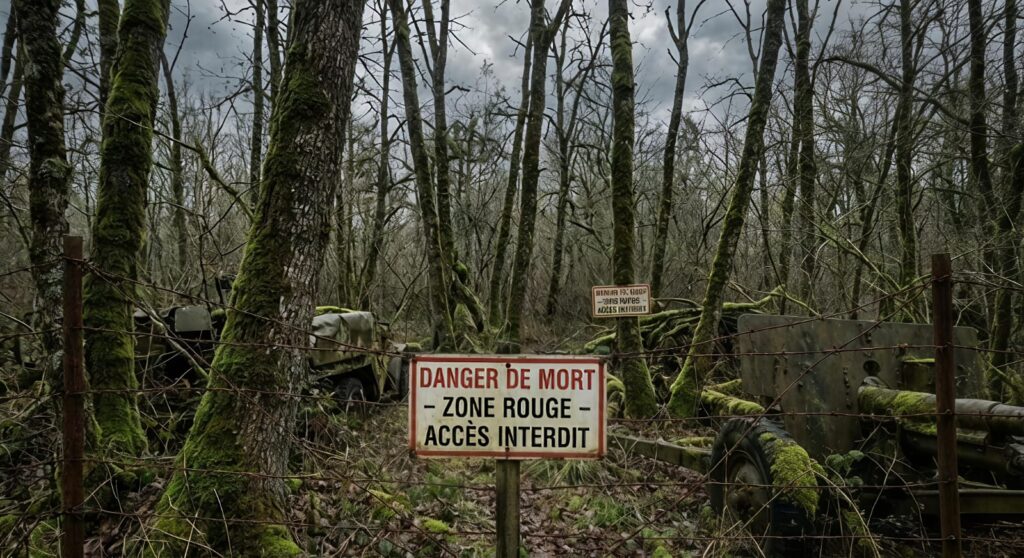
The Ghost Villages of the Zone Rouge
Before 1914, this region was a thriving agricultural hub dotted with charming hamlets. However, the intensity of the fighting—particularly during the Battle of Verdun—literally wiped these towns off the map.
Today, there are nine “Villages Détruits” (Destroyed Villages) within the Zone Rouge that were never rebuilt. These include:
Beaumont-en-Verdunois
Bezonvaux
Cumières-le-Mort-Homme
Fleury-devant-Douaumont
Haumont-près-Samogneux
Louvemont-Côte-du-Poivre
In contrast to modern ghost towns, these villages have no standing buildings. Only small stone markers indicate where a bakery or a church once stood. The French government maintains these as “communes” in honor of the soldiers who died there. Consequently, they exist as legal ghosts—towns with mayors but no residents.
Life Inside the Forbidden Forest: A Toxic Wilderness
If you were to step into the Zone Rouge today, you would see a lush, green forest. However, this beauty is deceptive and hides a dark reality. Locals often refer to these as “war forests” because the trees were planted specifically to hide the devastated landscape.
The Disappearance of Biodiversity
Interestingly, scientists have found that the biodiversity in the Zone Rouge is incredibly low. While deer and wild boar roam the woods, hunters must be extremely cautious. Because the animals eat contaminated vegetation, their meat often contains dangerous levels of lead and arsenic.
Consequently, the French government frequently issues warnings against consuming game from the Zone Rouge. In contrast to vibrant national parks, this forest is a quiet, stagnant place where life struggles to thrive. Furthermore, many native species have completely vanished from the area.
The “Place-à-Gaz”
Deep within the forest lies a site known as the Place-à-Gaz. This was a location where authorities burned millions of chemical shells after the war in a desperate attempt to clear the land. For years, nothing grew there.
Even now, only a few stunted lichens survive in the highly acidic soil. This spot remains one of the most concentrated points of pollution in the entire Zone Rouge. Consequently, the soil here looks more like the surface of a dead planet than a French forest.
The Silent Threat: Arsenic and the Water Table
One of the most terrifying aspects of the Zone Rouge is its impact on the local water supply. Furthermore, the contamination is not stationary; it moves with the rain and the subterranean currents.
Scientists monitoring the area have discovered that the groundwater beneath the Zone Rouge contains arsenic levels that would be fatal if consumed over a long period. Consequently, the surrounding communities must constantly monitor their wells.
In contrast to other rural areas in France, where local water is a point of pride, the water near the Zone Rouge is treated with extreme suspicion. This chemical legacy means that the war is still actively attacking the people of France.
Can Humans Ever Return to the Zone Rouge?
The short answer is: not in our lifetime. While some parts of the Zone Rouge have been downgraded over the decades, the core restricted areas remain a permanent “No-Go Zone.” Furthermore, the logistical challenge of cleaning the area grows harder as time passes.
The Risk of Spontaneous Explosion
The primary deterrent remains the unexploded ordnance. Over time, the chemical fuzes in these shells become more unstable. Consequently, just moving a rock or starting a campfire could trigger a blast.
Furthermore, the “Iron Harvest” brings shells to the surface every spring due to the natural freezing and thawing of the soil. This movement, known as frost heaving, ensures that the Zone Rouge is never truly static. Consequently, the danger levels fluctuate with the seasons.
The Cost of Remediation
Cleaning the Zone Rouge would be the most expensive environmental project in human history. To make the land safe, workers would need to strip the top three feet of soil across hundreds of square miles and incinerate it.
Because the cost is so high, the French government prefers to keep the area forested and restricted. Consequently, the land remains a “frozen” conflict zone, preserved in its state of ruin. Furthermore, the sheer volume of metal would destroy modern recycling equipment.
Lessons from the Red Zone: A Warning for the Future
The Zone Rouge serves as a haunting reminder of the long-term environmental cost of conflict. It proves that war doesn’t end when the treaties are signed; instead, the land continues to suffer for centuries.
Environmental Stewardship
Modern environmentalists look at the Zone Rouge as a case study in “anthrosols”—soils created or profoundly modified by human activity. By studying the chemical decay in the Zone Rouge, we can better understand how to protect our planet.
In contrast to theoretical models, the Zone Rouge provides raw, terrifying data on environmental collapse. Furthermore, it highlights the permanence of chemical contamination. Consequently, it serves as a global warning for modern military planners.
A Sanctuary for Memory
Ultimately, the Zone Rouge has transitioned from a wasteland to a sacred site. It protects the remains of tens of thousands of soldiers who were never found. By keeping humans out, the forest allows these souls to rest in a peaceful sanctuary.
Consequently, the Zone Rouge is as much a graveyard as it is a forest. Furthermore, the restricted access prevents the commercialization of these hallowed grounds. In contrast to tourist-heavy sites, the Zone Rouge remains solemn and untouched.
Tactical Advice: How to Experience the History Safely
If you are a history enthusiast, you might feel tempted to explore the Zone Rouge. However, you must prioritize safety and legality. Furthermore, there are ways to witness this history without stepping into the forbidden zones.
Visit the Verdun Memorial: This world-class museum provides context for the battles that created the Zone Rouge.
Stick to Official Paths: In “Yellow” zones, always stay on paved or marked trails. Consequently, you avoid the risk of treading on buried shells.
Hire a Guide: Local experts know the boundaries of the Zone Rouge perfectly. Furthermore, they can show you the subtle signs of the war.
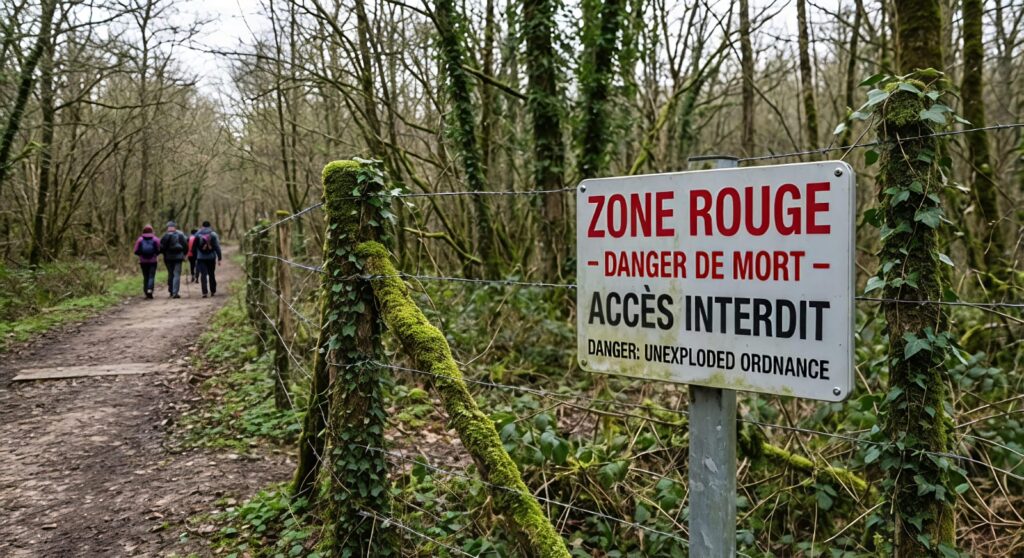
Respect the Signage: When you see a sign marked “Danger de Mort,” take it literally. The Zone Rouge does not offer second chances.
The Persistent Pollution of the “Iron Harvest”
Every year, the farmers near the Zone Rouge engage in a ritual that seems insane to outsiders. As they plow their fields, they often turn up rusted shells. This phenomenon, known as the “Iron Harvest,” is a direct result of the war’s intensity.
Furthermore, the shells that remain in the Zone Rouge are even more dangerous because they have been undisturbed. Consequently, the risk of chemical leakage increases every year. Furthermore, the metal is often so corroded that it cannot be safely handled by non-experts.
The Role of the Demineurs
The French civil security agency employs teams of “demineurs” who spend their entire careers clearing the Zone Rouge. Consequently, these brave individuals face daily risks to protect the public.
They collect hundreds of tons of munitions every year, yet the pile never seems to get smaller. Furthermore, many of the shells they find in the Zone Rouge are “gas shells” that require specialized containment. Consequently, the work is slow, meticulous, and incredibly dangerous.
The Danger of Souvenir Hunting
Unfortunately, some people ignore the warnings and enter the Zone Rouge to find artifacts. This is not only illegal but suicidal. Because the chemicals inside the shells can be absorbed through the skin, even a non-explosive shell can be deadly.
Consequently, many “souvenir hunters” end up in hospitals with chemical burns. Furthermore, their presence in the Zone Rouge complicates the work of the demineurs. In contrast to legitimate history, these artifacts bring nothing but danger to their collectors.
A Detailed Look at the Soil Composition
To truly understand why the Zone Rouge is forbidden, we must look at the science of the soil. Consequently, we can see that the damage is not just structural; it is molecular.
| Contaminant | Source | Effect on the Zone Rouge |
| Arsenic | Chemical Shells | Sterilizes the soil and poisons groundwater. |
| Lead | Shrapnel and Bullets | Accumulates in plants and enters the food chain. |
| Mercury | Percussion Caps | Damages the nervous systems of local wildlife. |
| Perchlorate | Explosive Fillers | Disrupts thyroid function in humans and animals. |
In contrast to healthy agricultural soil, the earth in the Zone Rouge is a toxic slurry. Furthermore, the lack of traditional soil bacteria means that organic matter does not break down at a normal rate. Consequently, the Zone Rouge feels like a place where time has literally stopped.
The Ethical Dilemma: Preserve or Purify?
There is an ongoing debate in France regarding the future of the Zone Rouge. Some argue that the land should be cleared at any cost to return it to the people. In contrast, others believe that the Zone Rouge should remain as it is.
The Argument for Preservation
Many historians believe that the Zone Rouge is a “living museum.” Furthermore, they argue that the danger of the land serves as a powerful deterrent. Consequently, by leaving the Zone Rouge alone, we maintain a physical reminder of the consequences of total war.
In contrast to restored monuments, the Zone Rouge offers an unedited version of history. Furthermore, it honors the “Missing” whose bodies remain part of the soil. Consequently, any disturbance is seen as a desecration.
The Argument for Purification
Environmentalists often argue that leaving the Zone Rouge contaminated is a ticking time bomb. Because the chemicals are migrating into the water table, they believe that the government has a moral obligation to act.
Furthermore, they point out that the restricted land could be used for renewable energy projects if it were safe. Consequently, they view the Zone Rouge as a wasted resource that actively harms the surrounding communities. In contrast, politicians often cite the prohibitive cost as a barrier to any large-scale cleanup.
The Zone Rouge in Modern Culture
The mystery of the Zone Rouge has captured the imagination of writers and filmmakers. Furthermore, it has become a symbol of the “Anthropocene,” the era where human impact on the planet is the dominant force.
Literature and Film
Many novels explore the idea of a “forbidden zone” where nature takes over in a twisted way. In contrast to the romanticized view of nature reclaiming the land, the Zone Rouge shows a darker side of this process.
Consequently, it has inspired works that dwell on the theme of “haunted landscapes.” Furthermore, these stories often use the Zone Rouge as a metaphor for the psychological scars left by trauma. In contrast to simple war stories, these narratives focus on the environmental aftermath.
Photography of the Forbidden
Because humans are banned, photographers who obtain special permission to enter the Zone Rouge capture haunting images. These photos often show trees growing through rusted tanks or flowers blooming in shell craters.
Furthermore, these images provide a rare glimpse into a world where humans are no longer the masters. Consequently, the photography of the Zone Rouge has become a genre of its own, blending history with environmental advocacy.
Technical Appendix: The Chemical Legacy of 1914
To provide further depth, we must examine the specific chemicals that make the Zone Rouge uninhabitable. Furthermore, we must understand how they interact with the French environment.
Phosgene Gas: While phosgene dissipates in the air, its degradation products can lower the pH of the soil. Consequently, the soil becomes too acidic for most crops.
Mustard Gas: This oily liquid can persist in the soil for decades, especially in clay-rich areas of the Zone Rouge. Furthermore, it can be reactivated if the soil is disturbed.
Arsenic Compounds: Used in “blue cross” shells, arsenic remains in the topsoil indefinitely. Consequently, it remains the primary reason for the permanent ban on farming.
In contrast to biological agents, these chemical pollutants do not have a “half-life” in the traditional sense. Furthermore, the combination of these chemicals creates “synergistic toxicity,” where the mixture is more dangerous than the individual parts. Consequently, the Zone Rouge is a complex chemical puzzle that modern science is still trying to map.
Conclusion: The Forest That Never Forgets
The Zone Rouge stands as a testament to the destructive power of human technology. It is a place where the earth itself was “murdered,” as French officials described it in 1919.
While the trees have grown back, they stand over a landscape of poison and iron. Furthermore, the existence of the Zone Rouge reminds us that our actions today can have consequences that last for centuries.
By respecting the borders of the Zone Rouge, we acknowledge the sacrifices made in the past. We also accept a sobering truth: some wounds are so deep that time alone cannot heal them. Consequently, the Zone Rouge will likely remain a forbidden, toxic, and silent witness to history for many generations to come.
About the Author