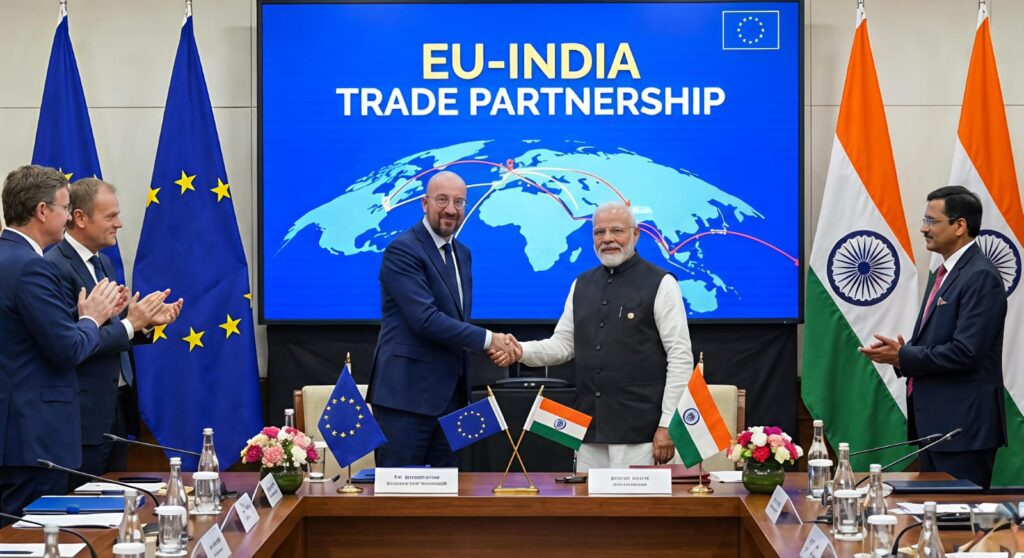
Big news hit the world on January 27, 2026. After 19 years of waiting, the EU and India free trade agreement finally became a reality. This deal connects two of the largest markets on the planet. Consequently, the way we trade, work, and travel between Europe and India is changing forever.
Why This Deal Matters Right Now
Initially, many people thought this day would never come. Negotiations started all the way back in 2007. However, the world changed a lot since then. Because of new global challenges, both sides realized they needed a strong partner. Therefore, they worked hard to find common ground.
Today, the EU and India free trade agreement stands as a symbol of hope. It is not just about moving boxes from one port to another. Instead, it is about building trust between two very different cultures. In fact, this pact is expected to help millions of people find better jobs. Furthermore, it will make everyday goods much cheaper for families in both regions.
A Long Road: The Story of the EU and India Free Trade Agreement
To truly understand this deal, we must look at where it started. In 2007, leaders met with big dreams. But, they soon ran into big problems. At that time, India wanted more visas for its workers. Meanwhile, the EU wanted India to lower taxes on cars and wine. Because neither side would budge, the talks stopped in 2013.
Eventually, things began to move again in 2022. The world was coming out of a pandemic. Consequently, countries realized that they could not rely on just one or two suppliers. They needed more options. Thus, the EU and India free trade agreement became a top priority once again.
After sixteen rounds of very long meetings, they finally reached the finish line. In 2025, the final details were polished. Finally, in early 2026, the deal was signed. Now, we are standing at the start of a brand-new chapter in history.
Huge Wins: Who Benefits the Most?
The EU and India free trade agreement is massive. It covers almost every part of the economy. Because it removes so many barriers, almost everyone wins. However, some groups will see changes faster than others.
Cars and Machines
For a long time, European car companies found it hard to sell in India. This was because taxes were as high as 100% or more. However, the EU and India free trade agreement changes the rules. Now, a set number of cars can enter India with a tax of only 10%.
Consequently, you will soon see more European cars on Indian roads. This is not just good for drivers. In fact, it also helps Indian factories. Because European companies will build more parts in India, local jobs will grow. Furthermore, Indian engineers will get to work with the latest green car technology.
Wine, Spirits, and Luxury Goods
If you like French wine or Scotch whisky, there is great news. Previously, these items were very expensive in India because of high taxes. But, the EU and India free trade agreement slashes these duties. For many premium drinks, the tax will drop from 150% down to much lower levels over the next few years.
Actually, this is a two-way street. Indian wine makers will also find it easier to sell their products in Europe. Because of this, we might see more Indian brands in shops in Paris or Berlin. Consequently, the world of fine dining is about to get much more interesting.
Textiles, Clothes, and Fashion
India is famous for its beautiful clothes and fabrics. However, selling them to Europe used to be expensive due to extra fees. Now, the EU and India free trade agreement removes these fees. Indian textile hubs like Tiruppur and Surat are already getting ready for more orders.
Consequently, European shoppers will find high-quality Indian clothes at better prices. Furthermore, this will help small family-owned businesses in India grow into global brands. In fact, experts think this sector alone could create over a million new jobs.
The Secret Ingredient: Rules of Origin
You might wonder how we know if a product is truly from India or the EU. This is where “Rules of Origin” come in. These are the rules that prove where a product was made. Under the EU and India free trade agreement, these rules are very clear.
Specifically, a product cannot just pass through a country to get the tax break. Instead, a large part of the work must happen inside India or the EU. For example, if a phone is put together in India, most of its parts should be Indian or European.
Because of these rules, the deal encourages companies to build real factories. It stops people from trying to cheat the system. Therefore, the EU and India free trade agreement ensures that the benefits go to the people who actually do the work.
Professional Mobility: Moving for Work
One of the biggest wins for India was about people, not just goods. This is often called “Mode 4” trade. Basically, it means making it easier for professionals to travel and work. The EU and India free trade agreement makes this much simpler.
Better Visas for Experts
In the past, an Indian IT expert might have struggled to get a visa for 27 different European countries. Now, there is a more unified system. Specifically, the deal makes it easier for:
IT Professionals: Tech experts can now move between offices more freely.
Engineers: Building projects will benefit from shared talent.
Scientists: Researchers can join forces on big health and climate projects.
Students: More scholarships will be available for Indian students in Europe.
Consequently, this “brain exchange” will make both regions smarter. In fact, many European companies are excited to hire Indian talent to help with their digital needs. Furthermore, Indian workers will bring back valuable skills and new ideas when they return home.
Protecting the Planet: The Green Deal
Today, we cannot talk about trade without talking about the Earth. The EU and India free trade agreement is one of the “greenest” deals ever signed. Both sides have promised to protect the environment while they grow their economies.
The Carbon Tax (CBAM)
The EU has a new rule called the Carbon Border Adjustment Mechanism. This is a tax on products that create a lot of pollution, like steel or cement. Initially, Indian companies were worried this would hurt their sales. However, the EU and India free trade agreement includes a plan to help.
Specifically, the EU will provide money and technology to help Indian factories become cleaner. Because of this, Indian steel will eventually be just as “green” as European steel. Consequently, the deal helps fight climate change instead of making it worse.
Renewables and Hydrogen
India and the EU are both leaders in solar and wind power. Under the EU and India free trade agreement, they will share even more secrets. They are working together to create “Green Hydrogen.” This is a clean fuel that could power ships and planes in the future. Therefore, this trade pact is also a partnership for a cleaner future.
Helping the Little Guy: Support for SMEs
Most people think trade deals are only for big corporations. However, the EU and India free trade agreement has a special focus on Small and Medium Enterprises (SMEs). In fact, there is an entire chapter dedicated just to them.
Why Small Businesses Should Care
Small businesses often find trade rules too confusing. Because of this, they often stay local. To solve this, the deal includes:
Simple Digital Portals: A website that explains exactly how to sell your goods.
Less Paperwork: You can now self-certify your goods, which saves time.
Dedicated Help Desks: If a small business has a problem, they have someone to call.
Consequently, a small jewelry maker in Jaipur can now sell to a shop in Rome without needing a giant legal team. Furthermore, these small wins add up to a huge boost for the whole economy.
The Digital Frontier: Trading in the Cloud
We live in a digital world. Therefore, the EU and India free trade agreement covers things like e-commerce and data. This is very important because India is a global leader in digital services.
Rules for the Internet
The deal ensures that digital trade is safe and fair. Specifically, it protects your personal data when it moves across borders. Furthermore, it stops governments from forcing companies to share their secret software code.
Because of these rules, startups can grow faster. For example, an Indian app developer can now sell their service in Germany with more confidence. Similarly, European fintech companies can offer better tools to Indian users. Consequently, the digital economy will see a massive boom.
Protecting Ideas: Intellectual Property (IP)
When someone invents something new, they want to make sure no one steals it. This is called Intellectual Property. The EU and India free trade agreement makes these protections stronger in both regions.
From Medicine to Movies
This part of the deal is very important for life-saving medicines. India is the world’s biggest maker of generic drugs. These are affordable versions of expensive medicines. Under the EU and India free trade agreement, India can keep making these affordable drugs.
At the same time, the deal protects the new inventions of European scientists. Therefore, we get the best of both worlds. We get new, amazing medicines, and we also keep them affordable for those who need them. Furthermore, it protects artists, musicians, and filmmakers from piracy.
Food and Farming: What’s on the Menu?
Farming is a sensitive topic for both India and Europe. Because of this, the EU and India free trade agreement was very careful here. It protects farmers while still opening up new markets.
Geographical Indications (GI Tags)
Have you ever wondered why only some tea can be called “Darjeeling”? That is a GI tag. It proves the product comes from a specific place and has a certain quality. Under the EU and India free trade agreement, both sides will protect hundreds of these tags.
Specifically, Europe will protect Indian items like:
Basmati Rice
Alphonso Mangoes
Kashmiri Saffron
In return, India will protect European favorites like Feta cheese and Champagne. Consequently, you can be sure that what you are buying is the real deal. Furthermore, this helps farmers earn more money for their hard work.
Government Contracts: Bidding for Success
Every year, governments spend billions of dollars on things like new roads, schools, and hospitals. This is called public procurement. In the past, it was very hard for a foreign company to win these contracts.
However, the EU and India free trade agreement opens this door. Specifically, European companies can now bid for big Indian government projects. Similarly, Indian firms can bid for projects across all 27 EU countries.
Because of this, governments will get more choices and better prices. Consequently, taxpayers get better value for their money. Furthermore, it encourages the best companies in the world to help build the infrastructure of the future.
Geopolitics: A Friendship of Equals
The EU and India free trade agreement is not just about money. It is also about power and safety. In a world that sometimes feels unstable, having a strong friend is vital.
Moving Away from Risk
Many countries realized that they were too dependent on one or two nations for their goods. This is often called “de-risking.” Because India has a huge workforce and a stable democracy, the EU sees it as the perfect partner.
Similarly, India wants to access the high-tech tools and investments that Europe offers. By working together, they become a powerful team. Consequently, the EU and India free trade agreement makes the whole world a bit more balanced. It shows that two different regions can work together for a better future.
How to Get Ready: Your Practical Checklist
If you are a business owner or a professional, you need to act now. The benefits of the EU and India free trade agreement will not just fall into your lap. You have to prepare. Here is a simple guide to help you get started:
1. Check Your HS Codes
Every product has a “Harmonized System” (HS) code. You need to know yours. This code tells you exactly how much tax you will pay under the new deal. Because some taxes drop faster than others, knowing your code is the first step to saving money.
2. Proof of Origin
Start keeping better records of where your materials come from. As we mentioned, the “Rules of Origin” are very strict. Therefore, you need to be able to prove that your product is truly Indian or European.
3. Look at Your Staffing
If you are an Indian company, do you need to send experts to Europe? Start looking at the new visa rules today. If you are a European company, think about how you can use Indian tech talent to grow your business.
4. Go Green
The EU is very serious about the environment. If your factory creates a lot of waste or pollution, you might face extra costs. However, if you start using solar power or recycling now, you will be ahead of the game.
5. Talk to an Expert
Trade deals are long and complicated. Even with this guide, you might have specific questions. Therefore, it is a good idea to talk to a trade consultant or a lawyer. Because they know the fine print, they can help you avoid expensive mistakes.
Real-Life Examples: How the Deal Works
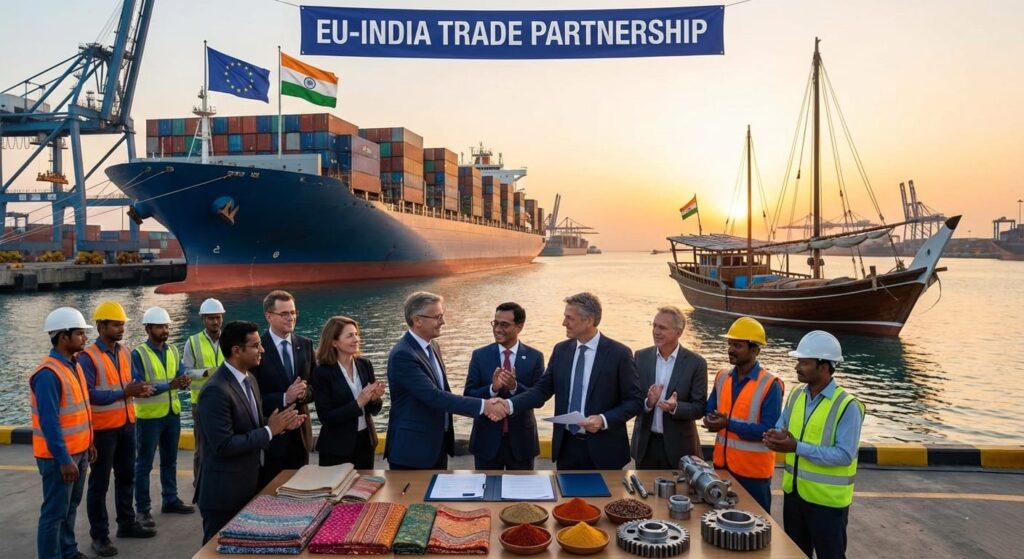
Sometimes, big trade terms can feel a bit dry. Let’s look at two stories to see how the EU and India free trade agreement helps real people.
The Story of Rohan’s Tech Startup
Rohan has a small company in Bengaluru. He makes AI software that helps farmers. He wanted to sell his software to farmers in Spain and Italy. But, the old rules made it very hard to protect his code and move money back to India.
Because of the EU and India free trade agreement, the rules for digital trade are now clear. Rohan can sell his app in Europe just as easily as he sells it in India. Furthermore, he can travel to Madrid for meetings without waiting months for a visa. Consequently, his little startup is now a global business.
The Story of Elena’s Machine Shop
Elena runs a high-tech factory in Germany. She makes precision tools for making medicines. She wanted to sell to India, but the 30% tax made her tools too expensive for Indian customers.
Under the EU and India free trade agreement, that tax has dropped to almost zero. Consequently, Indian medicine makers can now afford Elena’s tools. This means India can make even better medicines. Meanwhile, Elena has so many new orders that she had to hire ten new workers in Germany. In fact, everyone won in this deal.
What Happens Next? The Roadmap to 2030
The signing of the EU and India free trade agreement is just the beginning. Over the next ten years, we will see even more changes. Most experts think that trade between the two regions will double by the year 2030.
Initially, we will see taxes drop on the most popular items. Later, the more sensitive sectors like agriculture will slowly open up. Because the deal is built on a “living document,” both sides will meet every year to make it even better. Therefore, the partnership will continue to grow as the world changes.
Common Questions About the Agreement
To help you even more, we have answered some of the most common questions about the EU and India free trade agreement.
Is the deal active right now?
Yes, the main parts of the deal started on January 27, 2026. However, some tax cuts happen slowly over several years. Consequently, you should check the specific schedule for your industry.
Will this make my groceries more expensive?
Actually, it should do the opposite! Because the deal removes taxes on many foods and drinks, you might see lower prices at the supermarket. For example, olive oil from Europe might get cheaper in India. Similarly, Indian rice might get cheaper in Europe.
Does the deal help with climate change?
Yes, it does. In fact, it is one of the main goals of the pact. By sharing green technology and setting high environmental standards, both sides are working together to protect the planet.
Can I move to Europe for work more easily now?
If you are a skilled professional in a field like IT, engineering, or health, then yes. The EU and India free trade agreement makes the visa process much smoother and more predictable.
Conclusion: A Bright Future Ahead
The EU and India free trade agreement of 2026 is a giant leap forward. It bridges the gap between two of the most important parts of the world. Because of this deal, we will see more innovation, more jobs, and more affordable goods.
Initially, there might be some small challenges as businesses learn the new rules. However, the long-term benefits are huge. Whether you are a business owner, a worker, or a shopper, this deal is good news for you.
Ultimately, the EU and India free trade agreement proves that when we work together, we can overcome any obstacle. It is a roadmap for a more connected and successful world. So, are you ready to take advantage of this new era of growth?
Deep Dive: The Technical Annexes Simplified
For those who want to know the “nitty-gritty” details, we have broken down the technical parts of the EU and India free trade agreement.
Sanitary and Phytosanitary (SPS) Measures
This sounds complicated, but it is just about food safety. It ensures that any food moving between the regions is safe to eat. Under the new deal, both sides have agreed to use the same testing methods. Because of this, food won’t get stuck at the border for weeks waiting for a lab test.
Technical Barriers to Trade (TBT)
This covers the rules for non-food items, like electronics or toys. The EU and India free trade agreement makes sure that these rules are transparent. For example, if the EU changes the rules for how a toy is labeled, they must tell India well in advance. Consequently, factories have time to update their products.
Dispute Settlement
What happens if one side thinks the other is not following the rules? The EU and India free trade agreement creates a special court to solve these problems. This keeps things fair and stops small disagreements from turning into big trade wars. Therefore, businesses can invest with confidence, knowing the rules will be enforced.
Final Thoughts: Don’t Miss Out
The EU and India free trade agreement is a once-in-a-generation event. It is the result of nearly 20 years of hard work. Because the world is moving so fast, you cannot afford to ignore these changes.
In fact, the companies that move first will be the ones that win. So, start researching your HS codes, talk to your partners, and get ready for a very busy 2026. The bridge between Europe and India is now open. It is time for you to cross it.
About the Author