The world of work has changed forever. As we step into the middle of this decade, the office looks nothing like it did just a few years ago. Specifically, the tools we use have become smarter than we ever imagined. Consequently, many professionals feel a sense of deep unease about their future. However, there is a silver lining that most people miss. While machines have taken over the data and the logic, they still cannot touch the soul of what makes us human. To thrive today, you must master The AI Workplace 2026: 10 Human Skills Robots Still Can’t Replace.
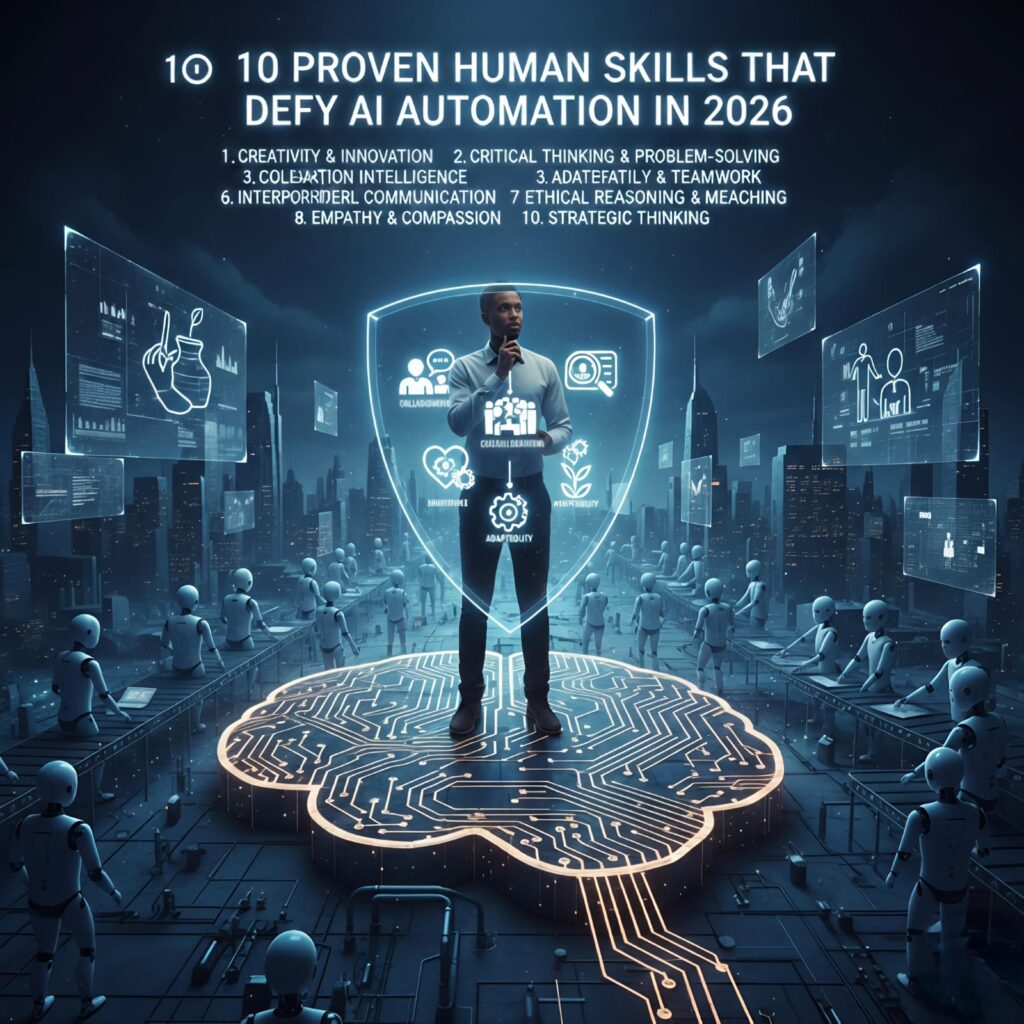
Actually, the “AI Revolution” has finally settled into a “Human Renaissance.” We no longer try to beat the computer at its own game. Instead, we are leaning into the messy, beautiful, and complex traits that code cannot copy. Furthermore, this shift is creating a new hierarchy of value. In this guide, we will explore exactly how you can become indispensable by doubling down on your humanity.
1. Strategic Empathy: Feeling the “Why”
In the landscape of The AI Workplace 2026: 10 Human Skills Robots Still Can’t Replace, empathy is the new gold. Specifically, AI can mimic a sympathetic tone. It can scan your face and detect a frown. However, it cannot feel the weight of your silence.
Why Robots Fail at Feeling
A machine operates on data points, not heartbeats. Consequently, if a client is upset, the AI might offer a discount code based on a “retention algorithm.” In contrast, a human professional senses that the client is actually grieving a loss or fearing for their job. Therefore, the human offers a listening ear and a moment of genuine connection. This “Strategic Empathy” builds a level of trust that no software can achieve.
Moreover, empathy requires a shared biological experience. You know what it feels like to fail. You know the sting of a cold morning and the joy of a win. Because of this shared history, you can connect with colleagues on a level that feels real. Ultimately, in a world full of digital noise, realness is the most expensive luxury.
How to Sharpen Your Empathy
Practice Deep Presence: Put your phone away during meetings. Actually look at the person speaking.
Listen for the Unspoken: Notice the pauses and the shifts in tone. Often, the most important part of the message is what they didn’t say.
Validate first, Solve second: Humans need to feel heard before they want a solution. AI skips the hearing and goes straight to the solving.
2. Ethical Discernment in the “Gray Zones”
As we navigate The AI Workplace 2026: 10 Human Skills Robots Still Can’t Replace, we face more “gray zones” than ever before. Specifically, AI is great at following rules. It is terrible, however, at knowing when those rules should be bent for a higher moral purpose.
The Problem of Cold Logic
Algorithms prioritize efficiency above all else. Consequently, an AI might suggest cutting a loyal supplier to save 3% on costs. But a human leader remembers that this supplier helped the company during a crisis five years ago. Therefore, the human chooses loyalty over a tiny margin increase. This is called Ethical Discernment. It is the ability to look at a situation and ask, “Is this right?” instead of just “Is this fast?”
Furthermore, ethical choices often involve cultural nuances. An AI trained in one country might make a decision that is offensive in another. In contrast, a human with cultural intelligence can navigate these tricky waters with grace. Consequently, your moral compass is your best career insurance.
Building Your Ethical Muscle
Study Philosophy: Read about different ways to view right and wrong.
Ask “Who Wins?”: Before making a big call, look at who benefits and who gets hurt.
Speak Up Early: If a project feels “off,” say something. Your gut is a biological computer that is much older and wiser than any LLM.
3. Complex Cross-Domain Synthesis
If you look at The AI Workplace 2026: 10 Human Skills Robots Still Can’t Replace, you will notice that AI is a “Specialist.” It knows one thing very, very well. Humans, however, are “Synthesizers.” We can take an idea from a cooking show and apply it to a software marketing campaign.
Connecting the Dots
A computer can analyze a million legal cases in seconds. But it cannot easily see how a trend in modern art might change how people want to interact with a law firm. Specifically, humans excel at “analogical reasoning.” We find patterns across different worlds. Consequently, we create things that are truly new.
Moreover, this synthesis allows for “Out-of-the-Box” thinking. An AI stays inside the box because that is where its data is. In contrast, you can jump from the box, run into the woods, and come back with an idea that changes everything. Therefore, being a “Generalist” is no longer a weakness; it is a superpower.
How to Become a Master Synthesizer
Read Widely: Don’t just read business books. Read poetry, science, and history.
Mix Your Hobbies: Combine your love for hiking with your job in sales. How does the trail change your perspective on the “climb” to a quota?
Talk to Strangers: Every person you meet is a library of different data. Collect their stories.
4. High-Stakes Negotiation and Rapport
In the era of The AI Workplace 2026: 10 Human Skills Robots Still Can’t Replace, the biggest deals still happen because people like each other. Specifically, negotiation is a game of psychology, not just math.
The Dance of the Deal
A robot can find the “optimal price” for a merger. However, it cannot tell when a CEO is feeling insecure about their legacy. Consequently, the AI might push too hard and break the deal. In contrast, a human negotiator knows when to tell a joke, when to share a meal, and when to walk away. Furthermore, building rapport is about “vibe.” It is that invisible energy that says, “I have your back.”
Actually, people often make decisions that are not “logical.” They buy from people they trust, even if the price is higher. Therefore, your ability to build a bridge between two hearts is much more valuable than any data sheet.
Tips for Better Negotiation
Focus on the Person, Not the Price: Understand what the other person is afraid of.
Use Your Body Language: A lean in or a nod can say more than a thousand words.
Be Patient: AI is fast, but humans need time to process. Use the power of a slow, thoughtful conversation.
5. Anthropological Curiosity: Seeing the Human Ritual
Data tells us what people did. Curiosity tells us why they did it. In The AI Workplace 2026: 10 Human Skills Robots Still Can’t Replace, the role of the “Human Watcher” is vital.
Beyond the Spreadsheet
Specifically, an AI can see that sales of coffee drop at 2:00 PM. But it takes a human to walk into the cafe and notice that the sun hits the windows at that time, making it too hot to sit there. This is “Anthropological Curiosity.” It is the act of observing human rituals and needs in the real world.
Furthermore, humans have a sense of “wonder.” We ask “Why?” just for the sake of knowing. Consequently, we discover needs that customers didn’t even know they had. While the AI is busy optimizing the old, the curious human is busy inventing the new.
Cultivating Your Curiosity
The “Why” Game: Ask “Why?” five times when you see a problem.
Go Offline: Get out of the office and watch how people use products in their daily lives.
Be a Beginner: Approach every task like it’s your first time doing it. What do you notice that experts miss?
6. Radical Creativity: Breaking the Model
AI is a “Predictor.” It looks at the past to guess the future. In The AI Workplace 2026: 10 Human Skills Robots Still Can’t Replace, we need people who can break the pattern.
The Power of the Weird
Most great ideas were “weird” at first. Specifically, they didn’t fit the data. If we asked an AI to design a phone in 2005, it would have added more buttons. However, a human (Steve Jobs) decided to take all the buttons away. This “Radical Creativity” is the ability to ignore the “most likely” outcome and try the “impossible” one.
Moreover, creativity is fueled by emotion. We create because we are angry, or happy, or bored. AI doesn’t have these fuels. Consequently, its “art” often feels hollow. In contrast, a human creation has a “soul” that people can feel. Therefore, your “weird” ideas are actually your most valuable assets.
How to Stay Radically Creative
Do Something Wrong on Purpose: Try a solution that you know shouldn’t work. What did you learn?
Limit Your Tools: Sometimes, having less makes you think more. Try to solve a problem without using any AI at all.
Daydream: Give your brain time to do nothing. This is when the best ideas arrive.
7. Leadership and “Narrative Architecture”
In The AI Workplace 2026: 10 Human Skills Robots Still Can’t Replace, leaders are storytellers. Specifically, people don’t follow a logic tree; they follow a vision.
Building the Dream
A computer can give you a “Quarterly Plan.” But it cannot make you feel proud to be part of a team. Consequently, a human leader must build a “Narrative.” They must explain where we are going and why it matters. Furthermore, this requires “presence.” It requires standing in front of a room and sharing your passion.
Actually, leadership is about managing energy. When the team is tired, the leader provides a spark. When the team is scared, the leader provides a shield. Therefore, your ability to tell a story that people want to live in is the ultimate 2026 career skill.
Leadership Tips for the AI Age
Share the “Why”: Never give a task without explaining how it helps a real person.
Be Humanly Flawed: Admit when you are wrong. It makes you relatable and builds trust.
Celebrate Small Wins: AI doesn’t care about a “good job,” but humans live for it.
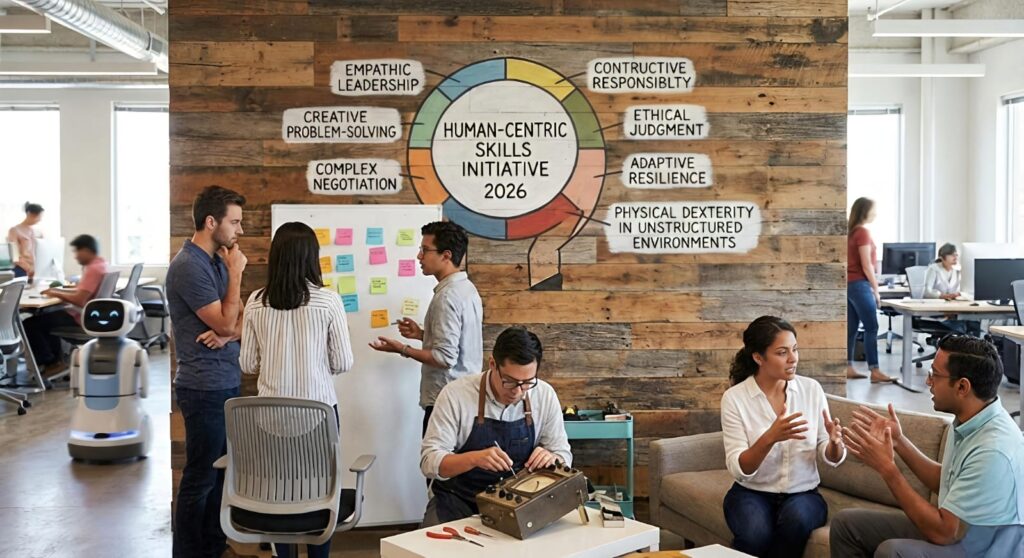
8. Intuition in “Black Swan” Events
When the world turns upside down, the data becomes useless. In The AI Workplace 2026: 10 Human Skills Robots Still Can’t Replace, intuition is your compass during a storm.
The Gut Feeling
Specifically, an AI needs historical data to make a choice. But what happens when something happens that has never happened before? For instance, a new type of global crisis or a sudden market shift. Consequently, the AI will freeze or give bad advice. In contrast, a human has “Intuition.”
This “gut feeling” is actually your brain processing thousands of tiny clues that you aren’t even aware of. Furthermore, humans have a survival instinct. We can pivot on a dime. Therefore, while the machines are “calculating,” the humans are “acting.”
Training Your Intuition
Trust Your First Thought: Practice making small decisions in under five seconds.
Reflect on Your Wins: When you had a “hunch” that worked, what were the signs?
Stay Calm: Intuition speaks quietly. You can’t hear it if you are panicking.
9. Mentorship and the Human Spark
You can’t learn how to be a “pro” from a chatbot. In The AI Workplace 2026: 10 Human Skills Robots Still Can’t Replace, the teacher-student bond is sacred.
Transmitting the “Knack”
Actually, most jobs have a “knack”—a secret way of doing things that isn’t in the manual. Specifically, you learn this by watching an expert. This is “Tacit Knowledge.” Moreover, a mentor provides something AI can’t: belief. When a mentor says, “I think you have what it takes,” it changes the student’s life.
Consequently, the act of passing on wisdom is a deeply human experience. It involves patience, encouragement, and tough love. Therefore, if you can teach and grow other people, you will always have a place in the workforce.
How to Be a Great 2026 Mentor
Don’t Just Give Answers: Ask questions that help the student find the answer themselves.
Focus on Character: Teach them how to handle failure and how to be honest.
Learn from the Student: Mentorship should be a two-way street.
10. Physical Mastery and the Real World
We often forget that we live in a physical world. In The AI Workplace 2026: 10 Human Skills Robots Still Can’t Replace, being able to move and touch things is a major advantage.
The Robot Struggle
Specifically, it is very hard to build a robot that can walk into a random house, find a leaky pipe, and fix it. This is because the world is messy and unpredictable. Consequently, trades and physical roles are safer than many “office” jobs. Furthermore, there is a growing demand for things “made by humans.”
Actually, we are seeing a return to craftsmanship. People want furniture built by a person. They want bread baked by a baker. Therefore, don’t ignore the power of your hands.
Embracing the Tangible
Learn a Physical Skill: Even if it’s just a hobby, it keeps your brain connected to the real world.
Offer “In-Person” Value: Go to the site. Touch the product. Meet the client face-to-face.
Respect the Craft: Value the work of those who build the physical world we live in.
The “Human-in-the-Loop” Revolution
As we look deeper into The AI Workplace 2026: 10 Human Skills Robots Still Can’t Replace, we see a new role emerging. We call it the “Human-in-the-Loop.” This means that while the AI does the heavy lifting, the human makes the final call.
Why You Are the Pilot
Specifically, think of AI as a powerful engine. An engine can move a car, but it doesn’t know where to go. It doesn’t know if the road is beautiful or if there is a child playing in the street. Consequently, you are the pilot. You provide the direction and the safety.
Furthermore, this role requires “Judgment.” You must look at the AI’s work and say, “This is smart, but it’s not kind,” or “This is fast, but it’s not us.” Actually, this power of “Veto” is where your authority lives. Therefore, you should never feel like a slave to the machine. You are its boss.
Case Study: The Healthcare Shift of 2025
To prove the importance of The AI Workplace 2026: 10 Human Skills Robots Still Can’t Replace, let’s look at what happened in hospitals last year. Specifically, many clinics tried using AI to deliver “bad news” to patients via text or video.
The results were a disaster. Patients felt ignored and unvalued. Consequently, the hospitals saw a huge rise in lawsuits and a drop in patient health. In contrast, the clinics that kept “Human Care Coordinators” saw better results. Why? Because a human nurse can hold a patient’s hand. They can offer a tissue. They can sit in the silence of a difficult moment. Ultimately, this proved that healing is a social act, not just a medical one.
How to “AI-Proof” Your Resume
If you want to win in The AI Workplace 2026: 10 Human Skills Robots Still Can’t Replace, you need to change how you talk about yourself.
Stop Listing Tasks
Specifically, don’t just say you can “manage a budget” or “write reports.” An AI can do those. Instead, say you “navigated a complex team conflict” or “developed a creative strategy that defied market trends.”
Moreover, use “Human-Centric” keywords. Use words like:
Advocacy: Showing you stand up for others.
Resilience: Showing you can bounce back from a mess.
Collaboration: Showing you work well with different types of people.
Consequently, your resume will tell a story of a person who is much more than a set of technical skills. Therefore, you will stand out in a sea of digital applicants.
The Psychological Advantage of Being Human
In The AI Workplace 2026: 10 Human Skills Robots Still Can’t Replace, our biggest hurdle is often our own fear. However, if we understand our psychological strengths, we can stay confident.
The Power of Intention
A machine has no “Intention.” It does what it is told. In contrast, you have “Will.” You have goals and dreams. Specifically, this drive allows you to persist when things get hard. AI doesn’t feel the “burn” to succeed. Consequently, your passion is a fuel that never runs out.
Furthermore, humans have “Humor.” We can laugh at a bad situation. This lightens the mood and helps teams survive stress. Actually, a well-timed joke can do more to save a project than a thousand lines of code. Therefore, don’t be afraid to bring your whole self to work—your laugh, your drive, and your heart.
Future-Proofing for 2027 and Beyond
While we focus on The AI Workplace 2026: 10 Human Skills Robots Still Can’t Replace, we must also look ahead. Specifically, the technology will keep getting better. But so will we.
The Co-Evolution
Actually, we are evolving alongside our tools. Consequently, we are becoming more “Strategic.” We are spending less time on the “How” and more time on the “What” and “Why.” This is a promotion for the entire human race.
Furthermore, the future is not “Human vs. AI.” It is “Human + AI.” But the “Human” part must lead. Therefore, the more you practice these ten skills, the more powerful you will become. You aren’t being replaced; you are being upgraded.
Summary of Your Human Superpowers
| Skill | Why AI Can’t Do It | Your Action Plan |
| Empathy | No biological feelings. | Listen deeply and validate emotions. |
| Ethics | No moral compass. | Study philosophy and ask “Is this right?” |
| Synthesis | Limited to one domain. | Read widely and mix your hobbies. |
| Negotiation | No sense of rapport. | Focus on trust and body language. |
| Curiosity | Only optimizes old data. | Watch people in the real world. |
| Creativity | Only predicts patterns. | Try “weird” ideas and daydream. |
| Leadership | No “Soul” or vision. | Tell stories that inspire belief. |
| Intuition | Needs history to work. | Practice making fast “gut” calls. |
| Mentorship | No personal bond. | Help others grow their character. |
| Dexterity | The world is too messy. | Value the physical and the “tangible.” |
Conclusion: Step Into the Renaissance
Ultimately, The AI Workplace 2026: 10 Human Skills Robots Still Can’t Replace is a message of hope. Specifically, it tells us that our value is not in being a better robot. Our value is in being a better human.
Consequently, you should stop fearing the future and start building it. Use the tools to do the boring work. Then, use your extra time to be kind, be creative, and be bold. Furthermore, remember that the most complex “algorithm” in the universe is still sitting inside your skull. It is called the human brain, and it has a “heart” attached to it.
Therefore, walk into your office tomorrow with your head high. You have skills that no computer can ever dream of. You are the architect of the future. Actually, you are the most important part of the workplace.
About the Author