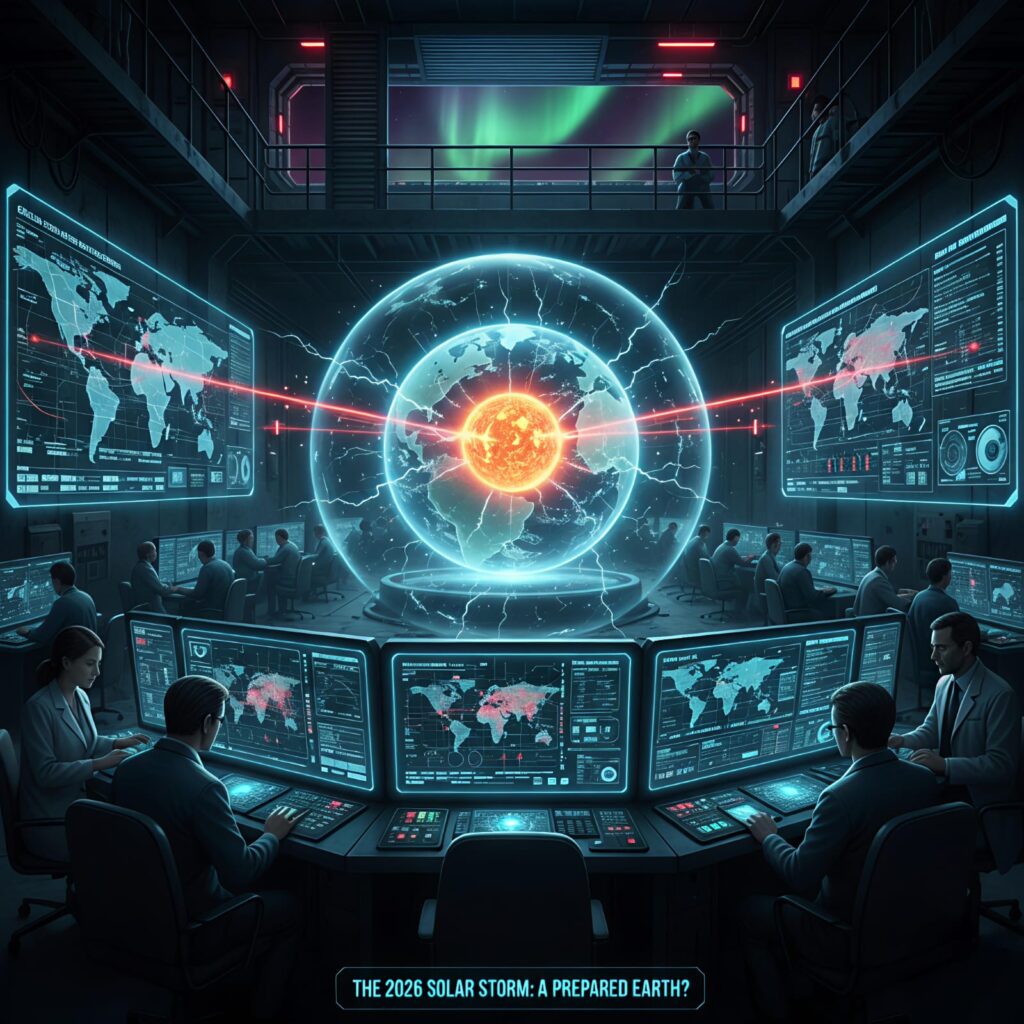
Imagine waking up tomorrow to a silent world. You reach for your phone, but it is dead. You try the light switch, but nothing happens. Even the water in your tap has stopped flowing because the pumps have no power. This is not a scene from a movie. Instead, it is a real risk we face in 2026. This year, the sun is reaching the peak of its activity. Scientists call this Solar Cycle 25. Consequently, experts warn that a massive 2026 solar storm could hit our planet. If it is as big as the famous Carrington Event, our modern world might face a total shutdown.
Furthermore, we must realize that our dependence on technology has grown since the last major storm. In contrast to the 19th century, we now rely on satellites for everything from banking to finding the nearest coffee shop. Therefore, the impact of a solar flare today would be much more severe. This article will explore why 2026 is such a critical year. Additionally, we will look at whether our global grid is actually strong enough to survive.
1. What Was the Carrington Event?
To understand the 2026 solar storm, we must first look at history. In 1859, a man named Richard Carrington saw a bright flash on the sun. This was a solar flare. Subsequently, a giant cloud of plasma hit Earth just hours later. At that time, we did not have computers or a complex global grid.
Telegraphs Caught Fire: Machines sparked and shocked their users. Some even worked without being plugged in because the air was full of electricity.
Bright Skies: The Northern Lights were so bright that people in the Caribbean could see them. Furthermore, miners in the mountains woke up at midnight. They started cooking breakfast because they thought it was dawn.
The Problem Today: In 1859, we only had telegraphs. Today, our lives depend on a massive global grid. Consequently, a similar storm would be much more dangerous now.
2. Why is 2026 the “Danger Year”?
The sun follows an 11-year cycle. It goes from “quiet” to “active” and back again. Right now, we are in Solar Cycle 25. This cycle is turning out to be much stronger than experts first thought.
The Solar Maximum
By mid-2026, the sun will hit its “Solar Maximum.” This is the peak of its activity. During this time, the sun’s magnetic field flips. Consequently, this causes huge explosions. These are called Coronal Mass Ejections (CMEs).
In January 2026, we already saw a “Severe” S4 radiation storm. This was the strongest one in over 20 years. This event tells us that the sun is waking up. Therefore, the chance of a “Carrington-level” event is very high this year. Additionally, the frequency of X-class flares is increasing, which means the global grid is under constant pressure.
3. How the Global Grid Could Fail
Our global grid is a giant web of wires. It moves power across countries. However, it has one major weakness: space weather.
The Transformer Crisis
The biggest worry involves high-voltage transformers. These are the giant boxes at power stations.
Invisible Currents: A solar storm sends electricity into the ground. Subsequently, this power flows into our big wires.
Heat Damage: This extra power makes transformers get very hot. Consequently, they can melt or even explode.
No Quick Fix: You cannot buy these at a store. They are custom-built and very heavy. Therefore, replacing them can take two years. If hundreds break at once, the global grid could stay dark for a long time.
Furthermore, these transformers are often the “backbone” of the system. If one fails, others must pick up the load. This can cause a “cascading failure.” In simple terms, one small break can turn into a giant blackout.
4. The Trillion-Dollar Disaster
Is the world ready for the cost? Experts say a giant solar storm could cost up to $2.6 trillion. This is because our economy relies on the global grid.
Cascading Economic Effects
| Sector | Why it Fails | Impact Level |
| Energy | Transformers melt and lines fail. | Critical |
| Banking | Digital money and ATMs stop working. | High |
| Food | Trucks can’t get gas; stores close. | Severe |
| Water | Electric pumps stop working. | Immediate |
Furthermore, the recovery could take years if the hardware is fried. Consequently, insurance companies are starting to worry about “Space Weather Risk.” In contrast to a normal storm, a solar event hits the whole world at once. Therefore, no country can easily send help to another.
5. Is Anyone Doing Anything to Help?
The good news is that we are not helpless. Governments are working on this right now.
Space Sentinels
We have “eyes” in space. Satellites like Aditya-L1 and the Parker Solar Probe watch the sun 24/7. In late 2025, a new satellite called SWFO-L1 joined them. These tools give us a 30 to 60-minute warning. Consequently, this is enough time for power companies to turn things off safely.
Hardening the Grid
Engineers are “hardening” the global grid.
Blocking Devices: They are installing tools to block the sun’s electricity.
Microgrids: Many cities are building smaller power systems. These use local solar panels and batteries. Consequently, they can stay on if the main grid fails.
New Rules: Organizations like NASA now have “Space Weather Plans.” They practice what to do if a big storm hits.
6. How to Protect Your Home: A Simple Guide
You can prepare for the 2026 solar storm today. Here is a simple list to help you.
Step 1: The “Analog” Backup
If the internet goes down, you need old-fashioned tools.
Keep Cash: Have small bills at home. If the power is out, cards will not work.
Paper Maps: Do not rely on GPS. A solar storm can make GPS signals wrong. Consequently, you could get lost.
Hand-Crank Radio: This is the best way to get news if phones fail.
Step 2: Save Your Electronics
A solar storm creates a power surge. It is like a slow lightning strike.
Unplug Devices: If you hear a storm warning, unplug your computers and TVs. Just turning them off is not enough.
Faraday Protection: You can buy “Faraday bags” online. They are metal pouches that block space waves. Consequently, you can put a spare phone inside one for safety.

7. The Science of Space Weather
Why does the sun do this? The sun is a giant ball of boiling gas. Sometimes, its magnetic lines get tangled. When they snap, they release energy.
Solar Flares: These are flashes of light. They hit Earth in 8 minutes.
CMEs: These are giant clouds of particles. They are the real danger to the global grid. They take 1 to 3 days to reach us. When they hit our magnetic shield, they shake it. Consequently, this “shaking” creates the electricity that breaks our wires.
Furthermore, we must remember that Earth has a natural shield. This is called the Magnetosphere. However, a very strong storm can “break through” this shield. Therefore, the strength of the 2026 solar storm is what scientists are watching most closely.
8. The Hidden Risk of Rocks
Did you know the ground matters? Some rocks conduct electricity better than others.
Hard Rocks: Places like the Northern U.S. and Canada have very hard rocks. These rocks do not let electricity through easily.
The Result: Because the electricity cannot go through the ground, it jumps into the power lines instead. Consequently, these areas are at a higher risk of blackouts during a 2026 solar storm. In contrast, areas with softer, more conductive soil might be safer.
9. The Undersea Cable Threat
Most of our internet moves through cables under the ocean. These cables are long. Because they are long, they can pick up a lot of the sun’s electricity. If the “boosters” in these cables fail, the global internet could break. Consequently, this would stop global trade and communication instantly.
Furthermore, repairing these cables is very difficult. It requires special ships that take a long time to reach the site. Therefore, an “Internet Apocalypse” is a real concern for 2026.
10. How to Tell if a Storm is Coming
You should watch the “Space Weather Scales.” They are like the scales for hurricanes.
G1 to G2: Minor storms. You might see the Northern Lights.
G3 to G4: Strong storms. Satellites might have trouble.
G5: Extreme storms. This is the “Carrington” level. This is when the global grid is in real danger.
Consequently, if you see a “G5” alert on the news, you should take action immediately. Furthermore, staying informed through official NASA or NOAA apps is a great way to stay safe.
11. What Happens in the First 24 Hours?
If a G5 storm hits the global grid, the first day will be hard.
Communications Fail: Cell towers lose power or timing. Consequently, you cannot call for help.
Traffic Chaos: Stoplights turn off and GPS fails. Therefore, driving becomes dangerous.
Panic Buying: People rush to stores, but digital registers don’t work.Consequently, staying home is the safest choice during the first 24 hours of a major solar event.
12. Long-Term Effects of a Solar Superstorm
If the global grid suffers major damage, the effects last for years.
Food Scarcity: Without power, we cannot process or move food.
Water Issues: Clean water depends on electric pumps and filters.
Health Crisis: Hospitals need power for life-saving machines.Therefore, preparing for more than just a few days of outage is a smart idea for 2026. Furthermore, we must think about how to live without the “Just-in-Time” delivery system we have today.
13. The Role of Solar Power During a Storm
Ironically, home solar panels might be your best friend. If the global grid fails, a home battery system can keep your lights on. However, you must ensure your system has surge protection. Furthermore, you should check if your inverter is shielded. This prevents the storm from frying your home’s electronics. In contrast to the main grid, a small home system is easier to protect.
14. Global Cooperation: Can Nations Work Together?
No single country can fix the global grid. In 2026, nations are sharing data faster than ever. The UN has a group that looks at space weather. Consequently, they help countries prepare together. This is important because a storm on one side of the world can affect the other side through shared power lines. Therefore, international unity is our best defence.
15. The Impact on Air Travel
If you are flying during a 2026 solar storm, you might face delays.
Radiation: Planes at high altitudes are exposed to more radiation.
Radio Loss: Pilots use high-frequency radio to talk. Solar flares block these signals.Consequently, airlines often cancel flights over the North Pole during solar storms to keep people safe. Furthermore, passenger safety is always the top priority for flight controllers.
16. Why You Should Not Panic
While the 2026 solar storm sounds scary, we are more prepared than ever. In 1859, we knew nothing. Today, we have satellites, engineers, and plans.
Most solar storms are small. They provide beautiful auroras and minor radio noise. The “Big One” is rare. However, being ready for it makes you part of the solution. Consequently, if everyone has a small kit and a plan, the world can recover much faster. Therefore, focus on what you can control.
17. The Economic Shift: From Digital to Physical
A major storm could change how we use money. If the digital global grid is down, we might go back to physical trade for a while. This is why having some “tangible” assets is a good part of any 2026 plan. Furthermore, items like silver or even extra food can become very valuable. Consequently, diversifying your emergency kit is a wise move.
18. Looking Beyond 2026
After the peak in 2026, the sun will start to quiet down. The risks will drop. But we should use this time to build a better global grid. We need a grid that is “self-healing.” This means it can turn itself off and on without breaking. Furthermore, we should invest in more “hardened” infrastructure. Therefore, the lessons from 2026 will help us for the next 100 years.
19. Summary Checklist for 2026
Check the News: Look for space weather updates once a week.
Buy a Radio: Get one that doesn’t need a wall plug.
Store Water: Keep a few gallons per person in a dark place. Furthermore, check the expiration date.
Talk to Family: Make a plan for where to meet if phones don’t work. Consequently, everyone will know what to do.
20. Advanced Mitigation: AI and Forecasting
In 2026, we are finally using AI to predict solar impacts. For example, NASA’s DAGGER system can map the global grid in real-time. Consequently, it tells us exactly where the surge will hit. This allows utility companies to move power away from the danger zone. Furthermore, this technology can save millions of transformers. Therefore, AI is becoming a vital shield for our planet.
21. Shielding Your Vehicles
Modern cars are full of computers. Consequently, a massive 2026 solar storm could affect your engine.
The Risk: High-voltage surges can reset a car’s computer.
The Fix: Parking in a metal garage can help. Furthermore, older cars with fewer electronics are more likely to keep running. In contrast, modern electric vehicles (EVs) are very sensitive to power shifts. Therefore, keeping your car’s fuel tank full is essential.
22. The Impact on Agriculture
Farmers are the silent heroes of the global grid. Without power, they cannot milk cows or water crops.
The Problem: Automated farms rely on GPS and power.
The Solution: Many farmers are now buying backup generators. Furthermore, they are learning how to use manual tools again. Consequently, they can keep feeding the world even if the power goes out. Therefore, supporting local farmers is a great way to stay resilient.
23. Satellite Internet: The New Frontier
Services like Starlink provide internet from space. During a 2026 solar storm, these satellites are in the “front line.”
Potential Loss: Solar particles can damage the satellite’s brain.
Redundancy: Companies are launching more satellites to cover for the ones that break. Consequently, we might not lose the internet completely. However, speeds will likely drop. Therefore, having a backup way to talk is still needed.
24. Public Safety and Emergency Services
Police and fire stations need the global grid to work.
Response Times: If the radio fails, they cannot find you.
Power Backups: Most stations have giant batteries. Furthermore, they use satellite phones that are hardened against storms. Consequently, they will still be able to help in an emergency. Therefore, you should trust your local authorities to have a plan.
25. Final Thoughts: Our Star, Our Challenge
The sun gives us life. It also tests us. The 2026 solar storm is a test of our wisdom. We have built a world that is very fast and very smart. Now, we must make sure it is also very strong.
Is the global grid ready? Parts of it are. But the real readiness starts with you. Stay informed, stay calm, and keep your “analog” backups ready. Furthermore, we have lived through solar cycles for thousands of years. With the right steps, we will thrive through this one too. Consequently, we can look at the sun not with fear, but with respect.
About the Author